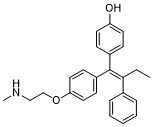
Endoxifen Z-isomer is the active Tamoxifen metabolite that causes this medication to have anti-estrogenic effects on breast cancer cells that express the estrogen receptor-alpha (ERα).
Physicochemical Properties
| Molecular Formula | C25H27NO2 |
| Molecular Weight | 373.49 |
| Exact Mass | 373.204 |
| Elemental Analysis | C, 80.40; H, 7.29; N, 3.75; O, 8.57 |
| CAS # | 112093-28-4 |
| Related CAS # | Endoxifen Z-isomer hydrochloride;1032008-74-4;Endoxifen hydrochloride;1197194-41-4;Endoxifen (E-isomer);114828-90-9;Endoxifen;110025-28-0;Endoxifen E-isomer hydrochloride;1197194-61-8 |
| PubChem CID | 10090750 |
| Appearance | White to off-white solid powder |
| Density | 1.099g/cm3 |
| Boiling Point | 519.327ºC at 760 mmHg |
| Melting Point | 127-129°C |
| Flash Point | 267.88ºC |
| Vapour Pressure | 0mmHg at 25°C |
| Index of Refraction | 1.599 |
| LogP | 5.75 |
| Hydrogen Bond Donor Count | 2 |
| Hydrogen Bond Acceptor Count | 3 |
| Rotatable Bond Count | 8 |
| Heavy Atom Count | 28 |
| Complexity | 467 |
| Defined Atom Stereocenter Count | 0 |
| SMILES | O(C([H])([H])C([H])([H])N([H])C([H])([H])[H])C1C([H])=C([H])C(=C([H])C=1[H])/C(/C1C([H])=C([H])C(=C([H])C=1[H])O[H])=C(\C1C([H])=C([H])C([H])=C([H])C=1[H])/C([H])([H])C([H])([H])[H] |
| InChi Key | MHJBZVSGOZTKRH-IZHYLOQSSA-N |
| InChi Code | InChI=1S/C25H27NO2/c1-3-24(19-7-5-4-6-8-19)25(20-9-13-22(27)14-10-20)21-11-15-23(16-12-21)28-18-17-26-2/h4-16,26-27H,3,17-18H2,1-2H3/b25-24- |
| Chemical Name | 4-[(Z)-1-[4-[2-(methylamino)ethoxy]phenyl]-2-phenylbut-1-enyl]phenol |
| Synonyms | Endoxifen, (Z)-Endoxifen; N-Desmethyl-4-hydroxytamoxifen; 4-Hydroxy-N-desmethyltamoxifen |
| HS Tariff Code | 2934.99.9001 |
| Storage |
Powder-20°C 3 years 4°C 2 years In solvent -80°C 6 months -20°C 1 month |
| Shipping Condition | Room temperature (This product is stable at ambient temperature for a few days during ordinary shipping and time spent in Customs) |
Biological Activity
| Targets |
Estrogen Receptor Beta (ERβ) and Estrogen Receptor Alpha (ERα) (the drug stabilizes ERβ and induces ERα/β heterodimer formation)[2] |
| ln Vitro |
In MCF7 breast cancer cells stably expressing ERβ, treatment with Endoxifen (specifically the (Z)-isomer) at concentrations of 20 nM, 40 nM, 100 nM, and 1000 nM for 24 hours stabilized ERβ protein levels in a concentration-dependent manner. This stabilization effect was also confirmed in Hs578T breast cancer cells and U2OS osteosarcoma cells expressing ERβ.[2] Co-immunoprecipitation assays in MCF7-ERβ and U2OS cells expressing both ER isoforms showed that Endoxifen induced the formation of ERα/β heterodimers. This interaction led to the stabilization and accumulation of both ERα and ERβ proteins.[2] Real-time PCR analysis demonstrated that low concentrations of Endoxifen (20 nM) significantly inhibited estrogen (1 nM)-induced expression of target genes (CCND1, PS2, PGR) specifically in MCF7 cells expressing ERβ, but not in parental MCF7 cells lacking ERβ. Higher concentrations (100-1000 nM) produced similar inhibitory effects in both cell lines.[2] Cell proliferation assays over eight days showed that low concentrations of Endoxifen (20-40 nM) markedly inhibited estrogen-induced proliferation in MCF7-ERβ cells, while parental MCF7 cells required much higher concentrations (100-1000 nM) for complete inhibition.[2] Microarray gene expression profiling revealed that treatment with estrogen plus 40 nM Endoxifen altered the expression of a unique set of 78 genes in MCF7-ERβ cells compared to estrogen treatment alone. Pathway analysis indicated that pathways related to ERα-mediated cell cycle regulation and cell migration were uniquely affected by Endoxifen only in cells expressing ERβ.[2] |
| Cell Assay |
For Western blotting to assess protein stability: Cells (MCF7-ERβ, Hs578T-ERβ, U2OS-ERβ) were treated with indicated concentrations of Endoxifen or vehicle for 24 hours. Cells were then lysed using NETN buffer (150 mM NaCl, 1 mM EDTA, 20 mM Tris pH 8.0, 0.5% Nonidet P-40). Protein concentrations were determined, and equal amounts of lysate were separated by SDS-PAGE. Proteins were transferred to PVDF membranes, probed with primary and secondary antibodies, and visualized using enhanced chemiluminescence.[2] For co-immunoprecipitation to detect protein-protein interactions: MCF7-ERβ or U2OS-ERα/β cells were treated with Endoxifen for 24 hours, washed, and lysed in NETN buffer. Equal amounts of lysate were incubated overnight at 4°C with an ERβ-specific antibody. Protein complexes were captured using protein G beads, separated by SDS-PAGE, and analyzed by Western blotting with an ERα-specific antibody.[2] For real-time reverse transcriptase PCR (RT-PCR) to measure gene expression: MCF7 and MCF7-ERβ cells were treated in triplicate as indicated for 24 hours. Total RNA was isolated using Trizol reagent. 500 ng of RNA was reverse transcribed to cDNA. Real-time PCR was performed in triplicate using SYBR Green chemistry. Quantification was based on threshold cycle (Ct) values, normalized to TATA Binding Protein (TBP) as a control.[2] For cell proliferation assays: MCF7 and MCF7-ERβ cells were pre-cultured in medium containing charcoal-stripped serum for three days. Cells were then plated at 2,000 cells per well in 96-well plates. Cells were treated with vehicle, 1 nM estrogen, or 1 nM estrogen plus increasing concentrations of Endoxifen (20 to 1000 nM). Medium and treatments were refreshed every other day for eight days. Proliferation rates were determined using a luminescent cell viability assay kit.[2] |
| ADME/Pharmacokinetics |
Metabolism / Metabolites Endoxifen has known human metabolites that include Endoxifen O-glucuronide and Endoxifen O-sulfate. Endoxifen is a known human metabolite of 4-Hydroxytamoxifen and N-Desmethyltamoxifen. The literature cites that in patients receiving standard tamoxifen therapy (20 mg/day), plasma concentrations of Endoxifen are highly variable, ranging from 5 to 180 nM, primarily due to genetic polymorphisms and drug interactions affecting the CYP2D6 enzyme responsible for its formation from N-desmethyl-tamoxifen.[2] Steady-state plasma concentrations of tamoxifen, 4-hydroxy-tamoxifen (4HT), and N-desmethyl-tamoxifen (NDT) in these patients are reported as approximately 300 nM, 7 nM, and 700 nM, respectively.[2] |
| References |
[1]. Endoxifen, the active metabolite of tamoxifen, inhibits cloned hERG potassium channels. Eur J Pharmacol. 2015 Apr 5;752:1-7. [2]. Estrogen receptor-beta sensitizes breast cancer cells to the anti-estrogenic actions of endoxifen. Breast Cancer Res. 2011 Mar 10;13(2):R27. |
| Additional Infomation |
4-Hydroxy-N-desmethyltamoxifen is a stilbenoid. Endoxifen is described as the most potent anti-estrogenic metabolite of tamoxifen, responsible for the drug's therapeutic effects in ERα-positive breast cancer cells at clinically relevant concentrations.[2] The study demonstrates that the presence of ERβ in breast cancer cells enhances their sensitivity to the anti-estrogenic effects of Endoxifen. This is proposed to occur through the stabilization of ERβ, induction of ERα/β heterodimers, and subsequent alteration of gene expression profiles, particularly at low Endoxifen concentrations (20-40 nM). This finding suggests that patients with ERβ-positive tumors might benefit from tamoxifen therapy even if they are poor metabolizers (with low endoxifen levels) due to CYP2D6 deficiency.[2] The (Z)-isomer of endoxifen was used in this study and was synthesized specifically for the research.[2] |
Solubility Data
| Solubility (In Vitro) | May dissolve in DMSO (in most cases), if not, try other solvents such as H2O, Ethanol, or DMF with a minute amount of products to avoid loss of samples |
| Solubility (In Vivo) |
Note: Listed below are some common formulations that may be used to formulate products with low water solubility (e.g. < 1 mg/mL), you may test these formulations using a minute amount of products to avoid loss of samples. Injection Formulations (e.g. IP/IV/IM/SC) Injection Formulation 1: DMSO : Tween 80: Saline = 10 : 5 : 85 (i.e. 100 μL DMSO stock solution → 50 μL Tween 80 → 850 μL Saline) *Preparation of saline: Dissolve 0.9 g of sodium chloride in 100 mL ddH ₂ O to obtain a clear solution. Injection Formulation 2: DMSO : PEG300 :Tween 80 : Saline = 10 : 40 : 5 : 45 (i.e. 100 μL DMSO → 400 μLPEG300 → 50 μL Tween 80 → 450 μL Saline) Injection Formulation 3: DMSO : Corn oil = 10 : 90 (i.e. 100 μL DMSO → 900 μL Corn oil) Example: Take the Injection Formulation 3 (DMSO : Corn oil = 10 : 90) as an example, if 1 mL of 2.5 mg/mL working solution is to be prepared, you can take 100 μL 25 mg/mL DMSO stock solution and add to 900 μL corn oil, mix well to obtain a clear or suspension solution (2.5 mg/mL, ready for use in animals). Injection Formulation 4: DMSO : 20% SBE-β-CD in saline = 10 : 90 [i.e. 100 μL DMSO → 900 μL (20% SBE-β-CD in saline)] *Preparation of 20% SBE-β-CD in Saline (4°C,1 week): Dissolve 2 g SBE-β-CD in 10 mL saline to obtain a clear solution. Injection Formulation 5: 2-Hydroxypropyl-β-cyclodextrin : Saline = 50 : 50 (i.e. 500 μL 2-Hydroxypropyl-β-cyclodextrin → 500 μL Saline) Injection Formulation 6: DMSO : PEG300 : castor oil : Saline = 5 : 10 : 20 : 65 (i.e. 50 μL DMSO → 100 μLPEG300 → 200 μL castor oil → 650 μL Saline) Injection Formulation 7: Ethanol : Cremophor : Saline = 10: 10 : 80 (i.e. 100 μL Ethanol → 100 μL Cremophor → 800 μL Saline) Injection Formulation 8: Dissolve in Cremophor/Ethanol (50 : 50), then diluted by Saline Injection Formulation 9: EtOH : Corn oil = 10 : 90 (i.e. 100 μL EtOH → 900 μL Corn oil) Injection Formulation 10: EtOH : PEG300:Tween 80 : Saline = 10 : 40 : 5 : 45 (i.e. 100 μL EtOH → 400 μLPEG300 → 50 μL Tween 80 → 450 μL Saline) Oral Formulations Oral Formulation 1: Suspend in 0.5% CMC Na (carboxymethylcellulose sodium) Oral Formulation 2: Suspend in 0.5% Carboxymethyl cellulose Example: Take the Oral Formulation 1 (Suspend in 0.5% CMC Na) as an example, if 100 mL of 2.5 mg/mL working solution is to be prepared, you can first prepare 0.5% CMC Na solution by measuring 0.5 g CMC Na and dissolve it in 100 mL ddH2O to obtain a clear solution; then add 250 mg of the product to 100 mL 0.5% CMC Na solution, to make the suspension solution (2.5 mg/mL, ready for use in animals). Oral Formulation 3: Dissolved in PEG400 Oral Formulation 4: Suspend in 0.2% Carboxymethyl cellulose Oral Formulation 5: Dissolve in 0.25% Tween 80 and 0.5% Carboxymethyl cellulose Oral Formulation 6: Mixing with food powders Note: Please be aware that the above formulations are for reference only. InvivoChem strongly recommends customers to read literature methods/protocols carefully before determining which formulation you should use for in vivo studies, as different compounds have different solubility properties and have to be formulated differently. (Please use freshly prepared in vivo formulations for optimal results.) |
| Preparing Stock Solutions | 1 mg | 5 mg | 10 mg | |
| 1 mM | 2.6774 mL | 13.3872 mL | 26.7745 mL | |
| 5 mM | 0.5355 mL | 2.6774 mL | 5.3549 mL | |
| 10 mM | 0.2677 mL | 1.3387 mL | 2.6774 mL |