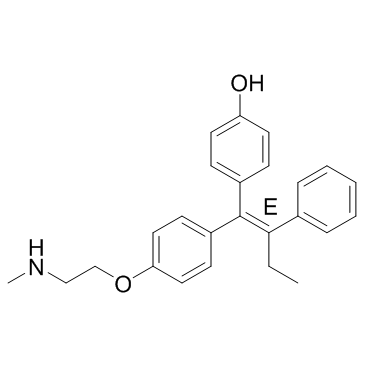
Endoxifen E-isomer is the E-isomer of (Z)-Endoxifennovel and is an Estrogen Response Modifier. (Z)-Endoxifen is an active metabolite generated, more potent selective estrogen receptor modulator (SERM) than Tamoxifen.
Physicochemical Properties
| Molecular Formula | C₂₅H₂₇NO₂ |
| Molecular Weight | 373.49 |
| Exact Mass | 373.204 |
| CAS # | 114828-90-9 |
| Related CAS # | Endoxifen (Z-isomer);112093-28-4;Endoxifen Z-isomer hydrochloride;1032008-74-4;Endoxifen hydrochloride;1197194-41-4;Endoxifen;110025-28-0;Endoxifen E-isomer hydrochloride;1197194-61-8 |
| PubChem CID | 3035980 |
| Appearance | White to off-white solid powder |
| LogP | 5.75 |
| Hydrogen Bond Donor Count | 2 |
| Hydrogen Bond Acceptor Count | 3 |
| Rotatable Bond Count | 8 |
| Heavy Atom Count | 28 |
| Complexity | 467 |
| Defined Atom Stereocenter Count | 0 |
| SMILES | CC/C(=C(/C1=CC=C(C=C1)O)\C2=CC=C(C=C2)OCCNC)/C3=CC=CC=C3 |
| InChi Key | MHJBZVSGOZTKRH-OCOZRVBESA-N |
| InChi Code | InChI=1S/C25H27NO2/c1-3-24(19-7-5-4-6-8-19)25(20-9-13-22(27)14-10-20)21-11-15-23(16-12-21)28-18-17-26-2/h4-16,26-27H,3,17-18H2,1-2H3/b25-24+ |
| Chemical Name | 4-[(E)-1-[4-[2-(methylamino)ethoxy]phenyl]-2-phenylbut-1-enyl]phenol |
| HS Tariff Code | 2934.99.9001 |
| Storage |
Powder-20°C 3 years 4°C 2 years In solvent -80°C 6 months -20°C 1 month |
| Shipping Condition | Room temperature (This product is stable at ambient temperature for a few days during ordinary shipping and time spent in Customs) |
Biological Activity
| Targets |
Estrogen Receptor (ER) (ligand, exhibits antiestrogenic activity). [2] |
| ln Vitro |
In MCF-7 cells, Endoxifen E-isomer (1-1000 nM; 12 hours) suppresses E2-induced PGR gene expression [2]. trans-Endoxifen and cis-Endoxifen both exhibited a dose-dependent inhibition of 17β-estradiol (E2, 1×10⁻¹⁰ M)-induced progesterone receptor (PGR) gene expression in MCF-7 human breast cancer cells. Maximal inhibition (complete blockage of E2 induction) was achieved at a concentration of 1×10⁻⁶ M for both isomers. The potency of inhibition was virtually identical between the trans- and cis-isomers of Endoxifen. In contrast, Endoxifen glucuronide conjugates (both O-glucuronides of trans- and cis-isomers) showed no inhibitory effect on E2-induced PGR expression at any concentration tested (1 nM to 1 μM). [2] In MCF-7 cells incubated in the absence of E2, trans-Endoxifen showed a slight, dose-dependent inhibition of basal PGR gene expression, but this effect was not statistically significant (p=0.07). cis-Endoxifen had no effect on basal PGR expression. [2] |
| Cell Assay |
PGR Expression Analysis: MCF-7 cells were cultured in phenol-free DMEM supplemented with 5% charcoal-stripped bovine calf serum for 3 days prior to treatment to remove estrogens. Cells were then treated with E2 (1×10⁻¹⁰ M) alone or in combination with various concentrations (1 nM to 1 μM) of trans- or cis-Endoxifen or their glucuronide conjugates for 12 hours. Total RNA was extracted using a commercial kit. cDNA was synthesized using reverse transcriptase and oligo(dT) primers. Real-time PCR was performed using TaqMan assays with primers and probes specific for the PGR gene. Glyceraldehyde-3-phosphate dehydrogenase (GAPDH) was used as an endogenous control for normalization. Gene expression levels were calculated using the ΔΔCt method. [2] Isomer Interconversion in Cell Culture: To assess the stability of isomers under experimental conditions, trans- or cis-Endoxifen (final conc. ~10 μM) was added to cell culture media adjusted to various pH values (6.0-8.5) and incubated at 37°C with 5% CO₂. Aliquots were taken at various time points up to 24 hours, mixed with acetonitrile, centrifuged, and the supernatant was analyzed by HPLC to determine the relative amounts of trans- versus cis-isomers. Minimal interconversion (<5%) was observed over 24 hours at pH ≥7.5. No interconversion was detected for the glucuronidated conjugates of Endoxifen. [2] |
| ADME/Pharmacokinetics |
Endoxifen is a secondary active metabolite of tamoxifen (TAM). It is formed in vivo via the metabolism of TAM. In women treated with TAM, Endoxifen is abundant in serum, present at levels 6- to 12-fold higher than another active metabolite, 4-hydroxy-TAM. [2] Metabolism: A major Phase II metabolic pathway for Endoxifen is glucuronidation, specifically O-glucuronidation at the 4-hydroxy position, catalyzed by UDP-glucuronosyltransferases (UGTs). This study demonstrated that glucuronide conjugates of Endoxifen are formed and are stable in cell culture conditions. The glucuronidation process effectively abolishes the antiestrogenic activity of Endoxifen. [2] |
| References |
[1]. Characterization of the isomeric configuration and impurities of (Z)-Endoxifen by 2D NMR, high resolution LC-MS, and quantitative HPLC analysis. J Pharm Biomed Anal. 2014 Jan;88:174-9. [2]. Elimination of antiestrogenic effects of active tamoxifen metabolites by glucuronidation. Drug Metab Dispos. 2007 Oct;35(10):1942-8. |
| Additional Infomation |
Endoxifen (4-hydroxy-N-desmethyltamoxifen) is a primary active metabolite of the antiestrogen drug tamoxifen. It exhibits high affinity for estrogen receptors and possesses potent antiestrogenic activity, contributing significantly to the therapeutic effects of tamoxifen in estrogen receptor-positive breast cancer. [2] This study is the first to examine and compare the antiestrogenic activities of individual trans- and cis-isomers of Endoxifen, finding them to be equipotent in inhibiting E2-induced gene expression. [2] The study highlights that glucuronidation is a critical deactivation pathway for Endoxifen. Variability in glucuronidation capacity among individuals could potentially influence the local and systemic efficacy of tamoxifen therapy by affecting the active Endoxifen concentrations. [2] |
Solubility Data
| Solubility (In Vitro) | DMSO : ~50 mg/mL (~133.87 mM) |
| Solubility (In Vivo) |
Solubility in Formulation 1: 1.25 mg/mL (3.35 mM) in 10% DMSO + 40% PEG300 + 5% Tween80 + 45% Saline (add these co-solvents sequentially from left to right, and one by one), clear solution; with sonication. For example, if 1 mL of working solution is to be prepared, you can add 100 μL of 12.5 mg/mL clear DMSO stock solution to 400 μL PEG300 and mix evenly; then add 50 μL Tween-80 to the above solution and mix evenly; then add 450 μL normal saline to adjust the volume to 1 mL. Preparation of saline: Dissolve 0.9 g of sodium chloride in 100 mL ddH₂ O to obtain a clear solution. Solubility in Formulation 2: 1.25 mg/mL (3.35 mM) in 10% DMSO + 90% (20% SBE-β-CD in Saline) (add these co-solvents sequentially from left to right, and one by one), suspension solution; with ultrasonication. For example, if 1 mL of working solution is to be prepared, you can add 100 μL of 12.5 mg/mL clear DMSO stock solution to 900 μL of 20% SBE-β-CD physiological saline solution and mix evenly. Preparation of 20% SBE-β-CD in Saline (4°C,1 week): Dissolve 2 g SBE-β-CD in 10 mL saline to obtain a clear solution. Solubility in Formulation 3: 1.25 mg/mL (3.35 mM) in 10% DMSO + 90% Corn Oil (add these co-solvents sequentially from left to right, and one by one), clear solution; with ultrasonication. For example, if 1 mL of working solution is to be prepared, you can add 100 μL of 12.5 mg/mL clear DMSO stock solution to 900 μL of corn oil and mix evenly. (Please use freshly prepared in vivo formulations for optimal results.) |
| Preparing Stock Solutions | 1 mg | 5 mg | 10 mg | |
| 1 mM | 2.6774 mL | 13.3872 mL | 26.7745 mL | |
| 5 mM | 0.5355 mL | 2.6774 mL | 5.3549 mL | |
| 10 mM | 0.2677 mL | 1.3387 mL | 2.6774 mL |