Physicochemical Properties
| Molecular Formula | C₁₂₁H₁₆₈N₂₆O₃₃S₄ |
| Molecular Weight | 2643.04 |
| Exact Mass | 2641.11 |
| CAS # | 117399-93-6 |
| Related CAS # | Endothelin-3, human, mouse, rabbit, rat TFA |
| PubChem CID | 16180095 |
| Appearance | Typically exists as solid at room temperature |
| LogP | 6.339 |
| Hydrogen Bond Donor Count | 34 |
| Hydrogen Bond Acceptor Count | 41 |
| Rotatable Bond Count | 49 |
| Heavy Atom Count | 184 |
| Complexity | 5720 |
| Defined Atom Stereocenter Count | 25 |
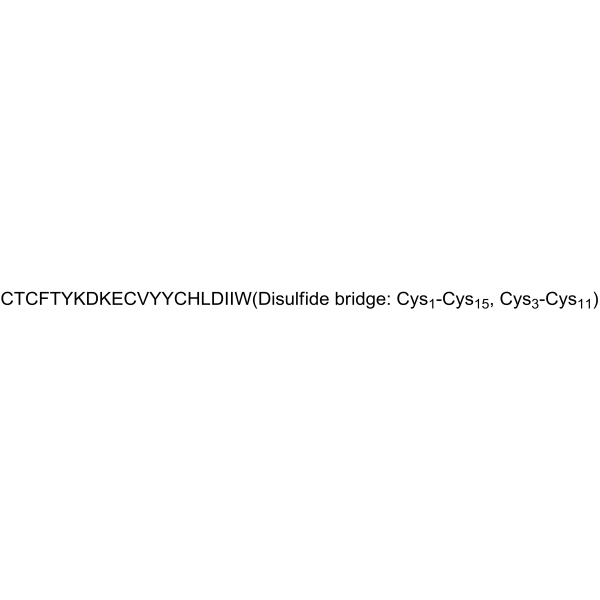
| SMILES | CC[C@@H]([C@H](NC([C@@H](NC([C@@H](NC([C@@H](NC([C@@H](NC([C@@H]1CSSC[C@H](N)C(N[C@H](C(N[C@H]2CSSC[C@H](NC([C@@H](NC([C@@H](NC([C@@H](NC([C@@H](NC([C@@H](NC([C@@H](NC([C@@H](NC2=O)CC3=CC=CC=C3)=O)[C@H](O)C)=O)CC4=CC=C(O)C=C4)=O)CCCCN)=O)CC(O)=O)=O)CCCCN)=O)CCC(O)=O)=O)C(N[C@H](C(N[C@H](C(N[C@H](C(N1)=O)CC5=CC=C(O)C=C5)=O)CC6=CC=C(O)C=C6)=O)C(C)C)=O)=O)[C@H](O)C)=O)=O)CC7=CN=CN7)=O)CC(C)C)=O)CC(O)=O)=O)[C@H](CC)C)=O)C(N[C@H](C(O)=O)CC8=CNC9=CC=CC=C89)=O)C |
| InChi Key | OQGZWNZGVYLIFX-JQWUVQPESA-N |
| InChi Code | InChI=1S/C121H168N26O33S4/c1-11-62(7)97(117(175)139-89(121(179)180)49-70-53-126-77-25-17-16-24-75(70)77)145-118(176)98(63(8)12-2)144-112(170)88(52-95(157)158)136-105(163)81(44-60(3)4)131-109(167)86(50-71-54-125-59-127-71)134-113(171)90-56-182-181-55-76(124)101(159)146-99(64(9)148)120(178)142-91-57-183-184-58-92(115(173)143-96(61(5)6)116(174)137-84(48-69-32-38-74(152)39-33-69)107(165)132-82(108(166)141-90)46-67-28-34-72(150)35-29-67)140-104(162)80(40-41-93(153)154)130-102(160)78(26-18-20-42-122)129-110(168)87(51-94(155)156)135-103(161)79(27-19-21-43-123)128-106(164)83(47-68-30-36-73(151)37-31-68)138-119(177)100(65(10)149)147-111(169)85(133-114(91)172)45-66-22-14-13-15-23-66/h13-17,22-25,28-39,53-54,59-65,76,78-92,96-100,126,148-152H,11-12,18-21,26-27,40-52,55-58,122-124H2,1-10H3,(H,125,127)(H,128,164)(H,129,168)(H,130,160)(H,131,167)(H,132,165)(H,133,172)(H,134,171)(H,135,161)(H,136,163)(H,137,174)(H,138,177)(H,139,175)(H,140,162)(H,141,166)(H,142,178)(H,143,173)(H,144,170)(H,145,176)(H,146,159)(H,147,169)(H,153,154)(H,155,156)(H,157,158)(H,179,180)/t62-,63-,64+,65+,76-,78-,79-,80-,81-,82-,83-,84-,85-,86-,87-,88-,89-,90-,91-,92-,96-,97-,98-,99-,100-/m0/s1 |
| Chemical Name | (3S)-3-[[(2S)-2-[[(2S)-2-[[(1R,4S,7S,10S,13S,16S,19S,22S,25R,28S,31R,36R,39S,42S,45S)-31-amino-7,13-bis(4-aminobutyl)-22-benzyl-4-(2-carboxyethyl)-10-(carboxymethyl)-19,28-bis[(1R)-1-hydroxyethyl]-16,39,42-tris[(4-hydroxyphenyl)methyl]-3,6,9,12,15,18,21,24,27,30,38,41,44,47-tetradecaoxo-45-propan-2-yl-33,34,49,50-tetrathia-2,5,8,11,14,17,20,23,26,29,37,40,43,46-tetradecazabicyclo[23.22.4]henpentacontane-36-carbonyl]amino]-3-(1H-imidazol-4-yl)propanoyl]amino]-4-methylpentanoyl]amino]-4-[[(2S,3S)-1-[[(2S,3S)-1-[[(1S)-1-carboxy-2-(1H-indol-3-yl)ethyl]amino]-3-methyl-1-oxopentan-2-yl]amino]-3-methyl-1-oxopentan-2-yl]amino]-4-oxobutanoic acid |
| HS Tariff Code | 2934.99.9001 |
| Storage |
Powder-20°C 3 years 4°C 2 years In solvent -80°C 6 months -20°C 1 month |
| Shipping Condition | Room temperature (This product is stable at ambient temperature for a few days during ordinary shipping and time spent in Customs) |
Biological Activity
| ln Vitro | The vasoconstrictor peptide family Endothelin (ET) has three distinct isomers: ET-1, ET2, and ET-3. It is composed of 21 amino acids. Vascular smooth muscle cells (VSMC), the heart, brain, and plasma all contain endothelin-3. Large Endothelin-3 is broken down by VSMC surface enzymes into the equivalent mature peptide Endothelin-3. In coronary VSMCs, endothelin-3 suppresses the production of endothelin ETA receptors without altering receptor density or functional ETA receptor responses. On the other hand, the vasoconstrictive response of the ETB receptor is abolished at high concentrations of Endothelin-3 (100 nM) owing to the desensitizing impact of Endothelin-3 [1]. ENCC adherence to different ECM components is stimulated by endothelin-3. Endothelin-3 causes quick modifications to the protrusion dynamics and morphology of ENCCs, which promotes lamellipodia growth and stabilization. This process is in line with an increase in focal adhesions and activated β1-integrin [2]. |
| ln Vivo | Endothelin-3 at low doses may reduce inflammatory reactions by producing NO and activating ETB2. At low doses, endothelin 3, which primarily works on ETB, particularly prevents platelet-activating factor (PAF)-induced paw edema, but endothelin 2, which acts on ETA and ETB, and ET-1 do not exhibit any inhibitory activity. The levels of inhibition exhibited by ET-1 and Endothelin-3 (0.5 pmol/paw) were found to be similar to those of Endothelin-3 (0.5 pmol/paw) when BQ-123 was present (66.4 ± 6.7% and 65.4 ± 22.6%, respectively). paw) by itself (65.4 ± 10.9%), whereas in the presence of BQ-788, neither ET-1 nor endothelin-3 exhibited inhibitory action [3]. |
| References |
[1]. Endothelin-1 and Endothelin-3 Regulate Endothelin Receptor Expression in Rat Coronary Arteries. Basic Clin Pharmacol Toxicol. 2015 Nov;117(5):297-305. [2]. Endothelin-3 stimulates cell adhesion and cooperates with β1-integrins during enteric nervous system ontogenesis. Sci Rep. 2016 Dec 1;6:37877. doi: 10.1038/srep37877. [3]. Endothelin-3 at low concentrations attenuates inflammatory responses via the endothelin B2 receptor. Inflamm Res. 2013 Apr;62(4):417-24. |
Solubility Data
| Solubility (In Vitro) | May dissolve in DMSO (in most cases), if not, try other solvents such as H2O, Ethanol, or DMF with a minute amount of products to avoid loss of samples |
| Solubility (In Vivo) |
Note: Listed below are some common formulations that may be used to formulate products with low water solubility (e.g. < 1 mg/mL), you may test these formulations using a minute amount of products to avoid loss of samples. Injection Formulations (e.g. IP/IV/IM/SC) Injection Formulation 1: DMSO : Tween 80: Saline = 10 : 5 : 85 (i.e. 100 μL DMSO stock solution → 50 μL Tween 80 → 850 μL Saline) *Preparation of saline: Dissolve 0.9 g of sodium chloride in 100 mL ddH ₂ O to obtain a clear solution. Injection Formulation 2: DMSO : PEG300 :Tween 80 : Saline = 10 : 40 : 5 : 45 (i.e. 100 μL DMSO → 400 μLPEG300 → 50 μL Tween 80 → 450 μL Saline) Injection Formulation 3: DMSO : Corn oil = 10 : 90 (i.e. 100 μL DMSO → 900 μL Corn oil) Example: Take the Injection Formulation 3 (DMSO : Corn oil = 10 : 90) as an example, if 1 mL of 2.5 mg/mL working solution is to be prepared, you can take 100 μL 25 mg/mL DMSO stock solution and add to 900 μL corn oil, mix well to obtain a clear or suspension solution (2.5 mg/mL, ready for use in animals). Injection Formulation 4: DMSO : 20% SBE-β-CD in saline = 10 : 90 [i.e. 100 μL DMSO → 900 μL (20% SBE-β-CD in saline)] *Preparation of 20% SBE-β-CD in Saline (4°C,1 week): Dissolve 2 g SBE-β-CD in 10 mL saline to obtain a clear solution. Injection Formulation 5: 2-Hydroxypropyl-β-cyclodextrin : Saline = 50 : 50 (i.e. 500 μL 2-Hydroxypropyl-β-cyclodextrin → 500 μL Saline) Injection Formulation 6: DMSO : PEG300 : castor oil : Saline = 5 : 10 : 20 : 65 (i.e. 50 μL DMSO → 100 μLPEG300 → 200 μL castor oil → 650 μL Saline) Injection Formulation 7: Ethanol : Cremophor : Saline = 10: 10 : 80 (i.e. 100 μL Ethanol → 100 μL Cremophor → 800 μL Saline) Injection Formulation 8: Dissolve in Cremophor/Ethanol (50 : 50), then diluted by Saline Injection Formulation 9: EtOH : Corn oil = 10 : 90 (i.e. 100 μL EtOH → 900 μL Corn oil) Injection Formulation 10: EtOH : PEG300:Tween 80 : Saline = 10 : 40 : 5 : 45 (i.e. 100 μL EtOH → 400 μLPEG300 → 50 μL Tween 80 → 450 μL Saline) Oral Formulations Oral Formulation 1: Suspend in 0.5% CMC Na (carboxymethylcellulose sodium) Oral Formulation 2: Suspend in 0.5% Carboxymethyl cellulose Example: Take the Oral Formulation 1 (Suspend in 0.5% CMC Na) as an example, if 100 mL of 2.5 mg/mL working solution is to be prepared, you can first prepare 0.5% CMC Na solution by measuring 0.5 g CMC Na and dissolve it in 100 mL ddH2O to obtain a clear solution; then add 250 mg of the product to 100 mL 0.5% CMC Na solution, to make the suspension solution (2.5 mg/mL, ready for use in animals). Oral Formulation 3: Dissolved in PEG400 Oral Formulation 4: Suspend in 0.2% Carboxymethyl cellulose Oral Formulation 5: Dissolve in 0.25% Tween 80 and 0.5% Carboxymethyl cellulose Oral Formulation 6: Mixing with food powders Note: Please be aware that the above formulations are for reference only. InvivoChem strongly recommends customers to read literature methods/protocols carefully before determining which formulation you should use for in vivo studies, as different compounds have different solubility properties and have to be formulated differently. (Please use freshly prepared in vivo formulations for optimal results.) |
| Preparing Stock Solutions | 1 mg | 5 mg | 10 mg | |
| 1 mM | 0.3784 mL | 1.8918 mL | 3.7835 mL | |
| 5 mM | 0.0757 mL | 0.3784 mL | 0.7567 mL | |
| 10 mM | 0.0378 mL | 0.1892 mL | 0.3784 mL |