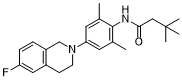
Physicochemical Properties
| Molecular Formula | C23H29FN2O |
| Molecular Weight | 368.5 |
| Exact Mass | 368.226 |
| Elemental Analysis | C, 74.97; H, 7.93; F, 5.16; N, 7.60; O, 4.34 |
| CAS # | 1009344-33-5 |
| PubChem CID | 24743936 |
| Appearance | Off-white to gray solid powder |
| Density | 1.1±0.1 g/cm3 |
| Boiling Point | 541.8±50.0 °C at 760 mmHg |
| Flash Point | 281.4±30.1 °C |
| Vapour Pressure | 0.0±1.4 mmHg at 25°C |
| Index of Refraction | 1.579 |
| LogP | 5.28 |
| Hydrogen Bond Donor Count | 1 |
| Hydrogen Bond Acceptor Count | 3 |
| Rotatable Bond Count | 4 |
| Heavy Atom Count | 27 |
| Complexity | 505 |
| Defined Atom Stereocenter Count | 0 |
| SMILES | FC1C=CC2=C(C=1)CCN(C1C=C(C)C(=C(C)C=1)NC(CC(C)(C)C)=O)C2 |
| InChi Key | FJNPZKZPWVVSON-UHFFFAOYSA-N |
| InChi Code | InChI=1S/C23H29FN2O/c1-15-10-20(11-16(2)22(15)25-21(27)13-23(3,4)5)26-9-8-17-12-19(24)7-6-18(17)14-26/h6-7,10-12H,8-9,13-14H2,1-5H3,(H,25,27) |
| Chemical Name | N-[4-(6-fluoro-3,4-dihydroisoquinolin-2(1H)-yl)-2,6-dimethylphenyl]-3,3-dimethylbutanamide |
| Synonyms | Encukalner; XEN1101; XEN-1101 XEN 1101; 1OP 2198; VRX 621698; XPF-008; |
| HS Tariff Code | 2934.99.9001 |
| Storage |
Powder-20°C 3 years 4°C 2 years In solvent -80°C 6 months -20°C 1 month |
| Shipping Condition | Room temperature (This product is stable at ambient temperature for a few days during ordinary shipping and time spent in Customs) |
Biological Activity
| References | 1: Yang GM, Tian FY, Shen YW, Yang CY, Yuan H, Li P, Gao ZB. Functional characterization and in vitro pharmacological rescue of KCNQ2 pore mutations associated with epileptic encephalopathy. Acta Pharmacol Sin. 2023 Mar 17. doi: 10.1038/s41401-023-01073-y. Epub ahead of print. PMID: 36932231. 2: Elkommos S, Mula M. Current and future pharmacotherapy options for drug- resistant epilepsy. Expert Opin Pharmacother. 2022 Dec;23(18):2023-2034. doi: 10.1080/14656566.2022.2128670. Epub 2022 Sep 27. PMID: 36154780. 3: Bialer M, Johannessen SI, Koepp MJ, Levy RH, Perucca E, Perucca P, Tomson T, White HS. Progress report on new antiepileptic drugs: A summary of the Sixteenth Eilat Conference on New Antiepileptic Drugs and Devices (EILAT XVI): II. Drugs in more advanced clinical development. Epilepsia. 2022 Nov;63(11):2883-2910. doi: 10.1111/epi.17376. Epub 2022 Aug 11. PMID: 35950617. 4: Biondi A, Rocchi L, Santoro V, Rossini PG, Beatch GN, Richardson MP, Premoli I. Spontaneous and TMS-related EEG changes as new biomarkers to measure anti- epileptic drug effects. Sci Rep. 2022 Feb 4;12(1):1919. doi: 10.1038/s41598-022-05179-x. PMID: 35121751; PMCID: PMC8817040. 5: Bialer M, Johannessen SI, Koepp MJ, Levy RH, Perucca E, Perucca P, Tomson T, White HS. Progress report on new antiepileptic drugs: A summary of the Fifteenth Eilat Conference on New Antiepileptic Drugs and Devices (EILAT XV). I. Drugs in preclinical and early clinical development. Epilepsia. 2020 Nov;61(11):2340-2364. doi: 10.1111/epi.16725. Epub 2020 Nov 14. PMID: 33190243. 6: Premoli I, Rossini PG, Goldberg PY, Posadas K, Green L, Yogo N, Pimstone S, Abela E, Beatch GN, Richardson MP. TMS as a pharmacodynamic indicator of cortical activity of a novel anti-epileptic drug, XEN1101. Ann Clin Transl Neurol. 2019 Nov;6(11):2164-2174. doi: 10.1002/acn3.50896. Epub 2019 Sep 30. PMID: 31568714; PMCID: PMC6856596. 7: Bialer M, Johannessen SI, Koepp MJ, Levy RH, Perucca E, Tomson T, White HS. Progress report on new antiepileptic drugs: A summary of the Fourteenth Eilat Conference on New Antiepileptic Drugs and Devices (EILAT XIV). I. Drugs in preclinical and early clinical development. Epilepsia. 2018 Oct;59(10):1811-1841. doi: 10.1111/epi.14557. PMID: 30368792. |
Solubility Data
| Solubility (In Vitro) | DMSO : ~50 mg/mL (~135.69 mM) |
| Solubility (In Vivo) |
Solubility in Formulation 1: ≥ 2.5 mg/mL (6.78 mM) (saturation unknown) in 10% DMSO + 90% Corn Oil (add these co-solvents sequentially from left to right, and one by one), clear solution. For example, if 1 mL of working solution is to be prepared, you can add 100 μL of 25.0 mg/mL clear DMSO stock solution to 900 μL of corn oil and mix evenly. (Please use freshly prepared in vivo formulations for optimal results.) |
| Preparing Stock Solutions | 1 mg | 5 mg | 10 mg | |
| 1 mM | 2.7137 mL | 13.5685 mL | 27.1370 mL | |
| 5 mM | 0.5427 mL | 2.7137 mL | 5.4274 mL | |
| 10 mM | 0.2714 mL | 1.3569 mL | 2.7137 mL |