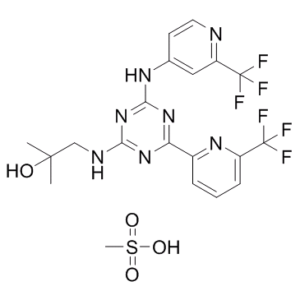
Enasidenib mesylate (formerly known as AG-221; CC-90007; AG221; CC90007; trade name Idhifa), the mesylate salt of enasidenib, is a first-in-class, oral, potent and selective IDH2 (Isocitrate dehydrogenase 2) inhibitor approved in 2017 for the treatment of relapsed or refractory acute myeloid leukemia in people with specific mutations of the IDH2 gene, determined by an FDA-approved IDH2 companion diagnostic test. It inhibits IDH2R140Q and IDH2R172K with IC50s of 100 and 400 nM, respectively.
Physicochemical Properties
| Molecular Formula | C20H21F6N7O4S | |
| Molecular Weight | 569.48 | |
| Exact Mass | 569.127 | |
| CAS # | 1650550-25-6 | |
| Related CAS # | Enasidenib;1446502-11-9 | |
| PubChem CID | 90480031 | |
| Appearance | White to off-white solid powder | |
| Hydrogen Bond Donor Count | 4 | |
| Hydrogen Bond Acceptor Count | 17 | |
| Rotatable Bond Count | 6 | |
| Heavy Atom Count | 38 | |
| Complexity | 727 | |
| Defined Atom Stereocenter Count | 0 | |
| InChi Key | ORZHZQZYWXEDDL-UHFFFAOYSA-N | |
| InChi Code | InChI=1S/C19H17F6N7O.CH4O3S/c1-17(2,33)9-27-15-30-14(11-4-3-5-12(29-11)18(20,21)22)31-16(32-15)28-10-6-7-26-13(8-10)19(23,24)25;1-5(2,3)4/h3-8,33H,9H2,1-2H3,(H2,26,27,28,30,31,32);1H3,(H,2,3,4) | |
| Chemical Name | methanesulfonic acid;2-methyl-1-[[4-[6-(trifluoromethyl)pyridin-2-yl]-6-[[2-(trifluoromethyl)pyridin-4-yl]amino]-1,3,5-triazin-2-yl]amino]propan-2-ol | |
| Synonyms |
|
|
| HS Tariff Code | 2934.99.9001 | |
| Storage |
Powder-20°C 3 years 4°C 2 years In solvent -80°C 6 months -20°C 1 month Note: Please store this product in a sealed and protected environment, avoid exposure to moisture. |
|
| Shipping Condition | Room temperature (This product is stable at ambient temperature for a few days during ordinary shipping and time spent in Customs) |
Biological Activity
| Targets |
Mutant isocitrate dehydrogenase 2 (mIDH2) (IC50 = 10 nM for IDH2-R140Q; IC50 = 40 nM for IDH2-R172K; IC50 > 1000 nM for wild-type IDH2) [2] Wild-type IDH2 (no inhibitory activity, IC50 > 1000 nM) [1] |
| ln Vitro |
In mutant stem/progenitor cells, enasidenib (AG-221) counteracts the effects of mutant IDH2 on DNA methylation. Enasidenib inhibits Flt3ITD concurrently with inducing differentiation and impairing IDH2-mutant leukemia cells' ability to self-renew. Leukemic cells undergo differentiation when treated with enasidenib (AG-221); at two weeks, the peripheral blood's CD11b+ population rises while the c-Kit+ population falls[2]. Enasidenib mesylate (AG-221) acts as a potent and selective inhibitor of mutant IDH2 (mIDH2), specifically blocking the neomorphic enzymatic activity of IDH2-R140Q and IDH2-R172K variants; in recombinant enzyme assays, it reduces the production of 2-hydroxyglutarate (2-HG) (a oncometabolite) by mIDH2 with an IC50 of 10 nM (IDH2-R140Q) and 40 nM (IDH2-R172K), while having no significant effect on wild-type IDH2 activity or 2-HG levels in wild-type IDH2-expressing cells [2] In IDH2-R140Q-mutated AML cell lines (e.g., HT-1080, MOLM-14) and primary patient blasts, Enasidenib mesylate (AG-221) (10-100 nM) dose-dependently decreases intracellular 2-HG levels by >90% within 72 hours; it also induces epigenetic remodeling, characterized by reduced global histone H3K9me3 and H3K27me3 (detected by Western blotting and chromatin immunoprecipitation (ChIP)), and upregulates differentiation-associated genes (e.g., CD11b, CD14) measured by flow cytometry and qRT-PCR [2] Enasidenib mesylate (AG-221) inhibits the proliferation of IDH2-mutant AML cells (EC50 = 50 nM for MOLM-14 cells) and induces G1 cell cycle arrest, with no significant cytotoxicity in wild-type IDH2-expressing hematopoietic cells at concentrations up to 1 μM [2] IDH mutations (including IDH2) in cancer cells lead to metabolic dysregulation by converting α-ketoglutarate (α-KG) to 2-HG, which inhibits α-KG-dependent dioxygenases (e.g., histone demethylases, DNA demethylases) and causes epigenetic silencing of tumor suppressor genes; Enasidenib mesylate (AG-221) reverses this metabolic dysfunction by restoring α-KG/2-HG ratios in mIDH2-expressing cells [1] |
| ln Vivo |
In a primary xenograft mouse model of IDH2-mutant acute myeloid leukemia (AML), treatment with enasidenib (AG-221) substantially increases survival[1]. Enasidenib (AG-221), a mutant IDH2 inhibitor, causes changes in self-renewal/differentiation in an IDH2-mutant AML model in vivo and modifies the epigenetic state of IDH2-mutant cells. 2-HG is reduced in vivo by 96.7% when enosetinib (10 mg/kg or 100 mg/kg bid) compared to pre-treatment levels. Furthermore, treatment with ezetinib restores the development of megakaryocyte-erythroid progenitor (MEP), which is inhibited by the expression of mutant IDH2 (mean MEP% mean, 39% Veh versus 50% AG-221). The effects of mutant IDH2 are reversed by ezetinib therapy; a substantial decrease in DNA methylation is seen, with 180 genes exhibiting 20 or more hypomethylated differentially methylated cytosines (DMCs) after treatment. When mice engrafted with Mx1-Cre IDH2R140QFlt3ITD AML cells are treated with enasidenib (100 mg/kg bid), 2-hydroxyglutarate (2-HG) levels are significantly reduced, which is consistent with on target inhibition. Mutant IDH2-mediated 2-HG synthesis is inhibited by énasidenib[2]. In a xenograft mouse model of IDH2-R140Q-mutated AML (MOLM-14 cells implanted into NSG mice), oral administration of Enasidenib mesylate (AG-221) (50-200 mg/kg/day) for 28 days significantly reduces peripheral blood and bone marrow 2-HG levels (by >80% at 100 mg/kg/day), induces differentiation of leukemic blasts (increased CD11b+ cells in bone marrow), and decreases leukemia burden (measured by human CD45+ cell percentage) [2] In the same AML xenograft model, Enasidenib mesylate (AG-221) (100 mg/kg/day) prolongs mouse survival by 40% compared to vehicle-treated controls; histopathological analysis of bone marrow and spleen shows reduced leukemic infiltration and restoration of normal hematopoietic architecture [2] In a patient-derived xenograft (PDX) model of IDH2-R172K-mutated AML, Enasidenib mesylate (AG-221) (150 mg/kg/day, p.o.) remodels the epigenetic state of leukemic cells (reduced H3K9me3 and H3K27me3), downregulates stem cell-associated genes (e.g., HOXA9, MEIS1) and upregulates differentiation markers, leading to a reduction in leukemia-initiating cells (LICs) in the bone marrow [2] IDH2 mutations drive leukemogenesis by promoting self-renewal of hematopoietic stem cells (HSCs) and blocking myeloid differentiation; Enasidenib mesylate (AG-221) reverses this phenotype in vivo by inhibiting 2-HG production and restoring normal epigenetic and transcriptional programs in IDH2-mutant AML cells [1] |
| Enzyme Assay |
For recombinant mIDH2 enzyme activity assay: Prepare recombinant human IDH2-R140Q and IDH2-R172K proteins (full-length, His-tagged) and dilute to a final concentration of 5 nM in assay buffer containing α-ketoglutarate (α-KG, 100 μM) and NADPH (50 μM); incubate the enzyme with serial dilutions of Enasidenib mesylate (AG-221) (10⁻¹²-10⁻⁶ M) at 37°C for 10 minutes to allow binding; initiate the reaction by adding isocitrate (200 μM) and incubate for 60 minutes; terminate the reaction with stop buffer and measure the absorbance at 340 nm (to detect NADPH oxidation) using a microplate reader; calculate IC50 values by nonlinear regression analysis of the inhibition curve for 2-HG production [2] For wild-type IDH2 activity assay: Repeat the above protocol using recombinant wild-type IDH2 protein (5 nM) and Enasidenib mesylate (AG-221) at concentrations up to 1 μM to assess selectivity; measure NADPH oxidation and calculate the percentage of enzyme activity relative to vehicle-treated controls [2] |
| Cell Assay |
For IDH2-mutant AML cell proliferation and differentiation assay: Culture MOLM-14 (IDH2-R140Q) and HT-1080 (IDH2-R172K) cells in RPMI 1640 medium supplemented with fetal bovine serum; seed cells at a density of 1×10⁴ cells/well in 96-well plates and treat with serial dilutions of Enasidenib mesylate (AG-221) (10⁻¹²-10⁻⁶ M) for 72 hours; assess cell proliferation using a bromodeoxyuridine (BrdU) incorporation assay and measure absorbance at 450 nm; for differentiation analysis, stain cells with fluorochrome-conjugated anti-CD11b and anti-CD14 antibodies after 5 days of treatment and analyze by flow cytometry; quantify mRNA expression of differentiation markers (CD11b, CSF1R) and stem cell genes (HOXA9, MEIS1) using qRT-PCR [2] For intracellular 2-HG and epigenetic modification assay: Seed IDH2-mutant AML cells (5×10⁵ cells/mL) in 6-well plates and treat with Enasidenib mesylate (AG-221) (10, 50, 100 nM) for 24, 48, 72 hours; collect cell pellets, extract metabolites via liquid-liquid extraction, and quantify 2-HG and α-KG levels using liquid chromatography-tandem mass spectrometry (LC-MS/MS); for Western blot analysis of histone modifications, extract nuclear proteins, separate by SDS-PAGE, transfer to PVDF membranes, and probe with antibodies against H3K9me3, H3K27me3, total H3, and GAPDH (loading control) [2] |
| Animal Protocol |
10 mg/kg or 100 mg/kg bid Murine models of IDH2-mutant leukemia For IDH2-R140Q AML xenograft model: Use 6-8 week-old NSG mice (female, 20-25 g); inject MOLM-14 cells (1×10⁷ cells/mouse) via tail vein to establish leukemia; 7 days post-inoculation, randomly divide mice into groups and administer Enasidenib mesylate (AG-221) via oral gavage at doses of 50, 100, 200 mg/kg/day (formulated in 0.5% methylcellulose + 0.2% Tween 80) or vehicle once daily for 28 days; collect peripheral blood samples weekly to measure 2-HG levels via LC-MS/MS and human CD45+ cell percentage via flow cytometry; at the end of the treatment period, euthanize mice, harvest bone marrow and spleen for histopathological analysis (H&E staining) and quantification of leukemic infiltration; for survival analysis, monitor mice for up to 60 days and calculate median survival time [2] For IDH2-R172K AML PDX model: Isolate primary blasts from IDH2-R172K-mutated AML patients, inject 5×10⁶ cells/mouse into NSG mice via tail vein; after engraftment (confirmed by human CD45+ cells in peripheral blood), treat mice with Enasidenib mesylate (AG-221) (150 mg/kg/day, p.o.) or vehicle for 35 days; collect bone marrow cells to assess leukemia-initiating cell frequency via limiting dilution assay, and perform ChIP-seq to analyze genome-wide histone methylation changes; measure mRNA expression of stem cell and differentiation genes via qRT-PCR and RNA-seq [2] |
| References |
[1]. Exploring the Pathway: IDH Mutations and Metabolic Dysregulation in Cancer Cells: A Novel Therapeutic Target. MAY 29, 2015. [2]. AG-221, a Small Molecule Mutant IDH2 Inhibitor, Remodels the Epigenetic State of IDH2-Mutant Cells and Induces Alterations in Self-Renewal/Differentiation in IDH2-Mutant AML Model in Vivo. Blood 2014 124:437. |
| Additional Infomation |
Enasidenib Mesylate is the mesylate salt form of enasidenib, an orally available inhibitor of specific mutant forms of the mitochondrial enzyme isocitrate dehydrogenase type 2 (IDH2), with potential antineoplastic activity. Upon administration, enasidenib specifically inhibits various mutant forms of IDH2, including the IDH2 variants R140Q, R172S, and R172K, which inhibits the formation of 2-hydroxyglutarate (2HG). This may lead to both an induction of cellular differentiation and an inhibition of cellular proliferation in IDH2-expressing tumor cells. IDH2, an enzyme in the citric acid cycle, is mutated in a variety of cancers; it initiates and drives cancer growth by blocking differentiation and the production of the oncometabolite 2HG. See also: Enasidenib (has active moiety). Background: Isocitrate dehydrogenase (IDH) mutations (IDH1/IDH2) occur in ~20% of acute myeloid leukemia (AML) cases, with IDH2 mutations (primarily R140Q and R172K) accounting for ~10% of these; IDH mutations cause a gain-of-function neomorphic activity that converts α-KG to 2-HG, a oncometabolite that disrupts epigenetic regulation and drives cancer cell proliferation and survival [1] Mechanism of action: Enasidenib mesylate (AG-221) is a first-in-class selective inhibitor of mutant IDH2 (mIDH2) that binds to the allosteric pocket of mIDH2, blocking its neomorphic enzymatic activity and reducing 2-HG production; this restores α-KG-dependent epigenetic regulation (e.g., histone and DNA demethylation), reverses the blocked differentiation of AML cells, and inhibits leukemic stem cell self-renewal [2] Clinical development: Enasidenib mesylate (AG-221) was granted orphan drug designation by the FDA for the treatment of IDH2-mutated AML in 2014; it entered Phase I/II clinical trials for relapsed/refractory IDH2-mutant AML, with preliminary data showing clinical responses (including complete remission) and reduction in serum 2-HG levels in patients [2] Therapeutic potential: Beyond AML, Enasidenib mesylate (AG-221) has potential efficacy in other IDH2-mutated cancers (e.g., chondrosarcoma, intrahepatic cholangiocarcinoma) where 2-HG-mediated metabolic dysregulation drives tumorigenesis [1] |
Solubility Data
| Solubility (In Vitro) |
|
|||
| Solubility (In Vivo) |
Solubility in Formulation 1: ≥ 2.5 mg/mL (4.39 mM) (saturation unknown) in 10% DMSO + 40% PEG300 + 5% Tween80 + 45% Saline (add these co-solvents sequentially from left to right, and one by one), clear solution. For example, if 1 mL of working solution is to be prepared, you can add 100 μL of 25.0 mg/mL clear DMSO stock solution to 400 μL PEG300 and mix evenly; then add 50 μL Tween-80 to the above solution and mix evenly; then add 450 μL normal saline to adjust the volume to 1 mL. Preparation of saline: Dissolve 0.9 g of sodium chloride in 100 mL ddH₂ O to obtain a clear solution. Solubility in Formulation 2: ≥ 2.5 mg/mL (4.39 mM) (saturation unknown) in 10% DMSO + 90% Corn Oil (add these co-solvents sequentially from left to right, and one by one), clear solution. For example, if 1 mL of working solution is to be prepared, you can add 100 μL of 25.0 mg/mL clear DMSO stock solution to 900 μL of corn oil and mix evenly. (Please use freshly prepared in vivo formulations for optimal results.) |
| Preparing Stock Solutions | 1 mg | 5 mg | 10 mg | |
| 1 mM | 1.7560 mL | 8.7799 mL | 17.5599 mL | |
| 5 mM | 0.3512 mL | 1.7560 mL | 3.5120 mL | |
| 10 mM | 0.1756 mL | 0.8780 mL | 1.7560 mL |