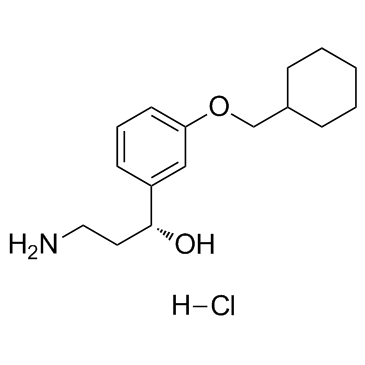
Description: Emixustat HCl, the hydrochloride salt of Emixustat (ACU-4429), is a novel and potent inhibitor of the visual cycle isomerase with an IC50 value of 4.4 nM in vitro. Emixustat is a small molecule notable for its establishment of a new class of compounds known as visual cycle modulators. Formulated as the hydrochloride salt, emixustat hydrochloride, it is the first synthetic medicinal compound shown to affect retinal disease processes when taken by mouth. Emixustat was invented by the British-American chemist, Ian L. Scott, and is currently in Phase 3 trials for dry, age-related macular degeneration.
Physicochemical Properties
| Molecular Formula | C16H26CLNO2 |
| Molecular Weight | 299.839 |
| Exact Mass | 299.165 |
| Elemental Analysis | C, 64.09; H, 8.74; Cl, 11.82; N, 4.67; O, 10.67 |
| CAS # | 1141934-97-5 |
| Related CAS # | Emixustat;1141777-14-1 |
| PubChem CID | 60162270 |
| Appearance | White to off-white solid powder |
| LogP | 4.53 |
| Hydrogen Bond Donor Count | 3 |
| Hydrogen Bond Acceptor Count | 3 |
| Rotatable Bond Count | 6 |
| Heavy Atom Count | 20 |
| Complexity | 241 |
| Defined Atom Stereocenter Count | 1 |
| SMILES | Cl[H].O(C1=C([H])C([H])=C([H])C(=C1[H])[C@@]([H])(C([H])([H])C([H])([H])N([H])[H])O[H])C([H])([H])C1([H])C([H])([H])C([H])([H])C([H])([H])C([H])([H])C1([H])[H] |
| InChi Key | BPZWRYOUJMDQSY-PKLMIRHRSA-N |
| InChi Code | InChI=1S/C16H25NO2.ClH/c17-10-9-16(18)14-7-4-8-15(11-14)19-12-13-5-2-1-3-6-13;/h4,7-8,11,13,16,18H,1-3,5-6,9-10,12,17H2;1H/t16-;/m1./s1 |
| Chemical Name | (1R)-3-amino-1-[3-(cyclohexylmethoxy)phenyl]propan-1-ol;hydrochloride |
| Synonyms | ACU4429; ACU 4429; EMIXUSTAT HYDROCHLORIDE; 1141934-97-5; ACU-4429 HCl; Emixustat Hydrochloride [USAN]; UNII-AP4OF2M98B; ACU-4429 |
| HS Tariff Code | 2934.99.9001 |
| Storage |
Powder-20°C 3 years 4°C 2 years In solvent -80°C 6 months -20°C 1 month Note: Please store this product in a sealed and protected environment, avoid exposure to moisture. |
| Shipping Condition | Room temperature (This product is stable at ambient temperature for a few days during ordinary shipping and time spent in Customs) |
Biological Activity
| Targets |
Retinal isomerase (RPE65), with an IC50 of 11 nM [2] |
| ln Vitro |
Emixustat (ACU-4429) potently inhibits isomerase activity in vitro (IC50=4.4 nM). Treatment of emixustat shows a concentration dependent reduction of 11-cis-ROL production [1]. Emixustat strongly inhibits 11-cis-retinol production with an IC50 value of 232±3 nM[2]. Emixustat (ACU-4429) potently inhibits the activity of RPE65, a key enzyme in the visual cycle responsible for converting all-trans-retinyl ester to 11-cis-retinol. In biochemical assays using purified RPE65, it blocks this isomerization reaction with high selectivity, showing no significant inhibition of other retinoid-processing enzymes [2] |
| ln Vivo |
Emixustat (ACU4429) reduces the production of visual chromophore (11-cis retinal) in wild-type mice following a single oral dose (ED50=0.18mg/kg). In albino mice, emixustat is shown to be effective in preventing photoreceptor cell death caused by intense light exposure. Pre-treatment with a single dose of emixustat (0.3 mg/kg) provids a 50%protective effect against light-induced photoreceptor cell loss, while higher doses (1-3 mg/kg) are nearly 100%effective. In Abca4-/- mice, chronic (3 month) emixustat treatment markedly reduces lipofuscin autofluorescence and reduces A2E levels by 60%( ED50=0.47 mg/kg). In the retinopathy of prematurity rodent model, treatment with emixustat during the period of ischemia and reperfusion injury produces a 30%reduction in retinal neovascularization (ED50=0.46mg/kg)[1]. In mice, oral administration of Emixustat (3-30 mg/kg) dose-dependently reduces the accumulation of all-trans-retinaldehyde, a toxic retinoid metabolite, in the retina. This reduction is associated with preserved retinal function, as measured by electroretinography (ERG), where rod and cone responses remain more stable compared to untreated controls. In a model of retinal degeneration induced by excessive vitamin A, Emixustat (10 mg/kg, daily oral) slows the loss of photoreceptor cells and maintains retinal structure [1] |
| Enzyme Assay |
For RPE65 inhibition assays, purified RPE65 protein is incubated with all-trans-retinyl ester substrate in the presence of Emixustat (0.1-1000 nM) and cofactors. The formation of 11-cis-retinol, the product of the isomerization reaction, is quantified using high-performance liquid chromatography (HPLC) or a fluorescent detection system. The IC50 value is calculated based on the concentration-dependent reduction in product formation [2] |
| Cell Assay |
Retinal pigment epithelium (RPE) cells are cultured and treated with Emixustat (1-100 nM) for 24-48 hours. The cells are then incubated with all-trans-retinol to stimulate the visual cycle. The levels of retinoids (all-trans-retinyl ester, 11-cis-retinol) in cell lysates or culture media are measured by HPLC to assess the inhibition of RPE65-mediated isomerization. Additionally, cell viability is evaluated using standard colorimetric assays to confirm that observed effects are not due to cytotoxicity [1] |
| Animal Protocol |
In mouse studies, Emixustat is dissolved in a suitable vehicle (e.g., aqueous solution with small amounts of solubilizing agents) and administered orally via gavage. Doses range from 3 to 30 mg/kg, given once daily for periods ranging from 1 week to several months. Retinal function is assessed by ERG at specified intervals, and retinal tissue is collected post-treatment for histopathological analysis (e.g., photoreceptor layer thickness) and retinoid quantification by HPLC [1] |
| References |
[1]. Visual Cycle Modulation as an Approach toward Preservation of Retinal Integrity. PLoS One. 2015 May 13;10(5):e0124940. [2]. Catalytic mechanism of a retinoid isomerase essential for vertebrate vision. Nat Chem Biol. 2015 Jun;11(6):409-15. |
| Additional Infomation |
Emixustat (ACU-4429) is a small-molecule inhibitor of the visual cycle, designed to reduce the production of toxic retinoid byproducts (e.g., all-trans-retinaldehyde) that contribute to retinal degeneration in conditions like Stargardt disease and age-related macular degeneration. By targeting RPE65, it modulates the visual cycle to prevent oxidative damage and preserve retinal integrity [1][2] Drug Indication Treatment of Stargardt disease |
Solubility Data
| Solubility (In Vitro) | DMSO : ~44 mg/mL (~146.74 mM) |
| Solubility (In Vivo) |
Note: Listed below are some common formulations that may be used to formulate products with low water solubility (e.g. < 1 mg/mL), you may test these formulations using a minute amount of products to avoid loss of samples. Injection Formulations (e.g. IP/IV/IM/SC) Injection Formulation 1: DMSO : Tween 80: Saline = 10 : 5 : 85 (i.e. 100 μL DMSO stock solution → 50 μL Tween 80 → 850 μL Saline) *Preparation of saline: Dissolve 0.9 g of sodium chloride in 100 mL ddH ₂ O to obtain a clear solution. Injection Formulation 2: DMSO : PEG300 :Tween 80 : Saline = 10 : 40 : 5 : 45 (i.e. 100 μL DMSO → 400 μLPEG300 → 50 μL Tween 80 → 450 μL Saline) Injection Formulation 3: DMSO : Corn oil = 10 : 90 (i.e. 100 μL DMSO → 900 μL Corn oil) Example: Take the Injection Formulation 3 (DMSO : Corn oil = 10 : 90) as an example, if 1 mL of 2.5 mg/mL working solution is to be prepared, you can take 100 μL 25 mg/mL DMSO stock solution and add to 900 μL corn oil, mix well to obtain a clear or suspension solution (2.5 mg/mL, ready for use in animals). Injection Formulation 4: DMSO : 20% SBE-β-CD in saline = 10 : 90 [i.e. 100 μL DMSO → 900 μL (20% SBE-β-CD in saline)] *Preparation of 20% SBE-β-CD in Saline (4°C,1 week): Dissolve 2 g SBE-β-CD in 10 mL saline to obtain a clear solution. Injection Formulation 5: 2-Hydroxypropyl-β-cyclodextrin : Saline = 50 : 50 (i.e. 500 μL 2-Hydroxypropyl-β-cyclodextrin → 500 μL Saline) Injection Formulation 6: DMSO : PEG300 : castor oil : Saline = 5 : 10 : 20 : 65 (i.e. 50 μL DMSO → 100 μLPEG300 → 200 μL castor oil → 650 μL Saline) Injection Formulation 7: Ethanol : Cremophor : Saline = 10: 10 : 80 (i.e. 100 μL Ethanol → 100 μL Cremophor → 800 μL Saline) Injection Formulation 8: Dissolve in Cremophor/Ethanol (50 : 50), then diluted by Saline Injection Formulation 9: EtOH : Corn oil = 10 : 90 (i.e. 100 μL EtOH → 900 μL Corn oil) Injection Formulation 10: EtOH : PEG300:Tween 80 : Saline = 10 : 40 : 5 : 45 (i.e. 100 μL EtOH → 400 μLPEG300 → 50 μL Tween 80 → 450 μL Saline) Oral Formulations Oral Formulation 1: Suspend in 0.5% CMC Na (carboxymethylcellulose sodium) Oral Formulation 2: Suspend in 0.5% Carboxymethyl cellulose Example: Take the Oral Formulation 1 (Suspend in 0.5% CMC Na) as an example, if 100 mL of 2.5 mg/mL working solution is to be prepared, you can first prepare 0.5% CMC Na solution by measuring 0.5 g CMC Na and dissolve it in 100 mL ddH2O to obtain a clear solution; then add 250 mg of the product to 100 mL 0.5% CMC Na solution, to make the suspension solution (2.5 mg/mL, ready for use in animals). Oral Formulation 3: Dissolved in PEG400 Oral Formulation 4: Suspend in 0.2% Carboxymethyl cellulose Oral Formulation 5: Dissolve in 0.25% Tween 80 and 0.5% Carboxymethyl cellulose Oral Formulation 6: Mixing with food powders Note: Please be aware that the above formulations are for reference only. InvivoChem strongly recommends customers to read literature methods/protocols carefully before determining which formulation you should use for in vivo studies, as different compounds have different solubility properties and have to be formulated differently. (Please use freshly prepared in vivo formulations for optimal results.) |
| Preparing Stock Solutions | 1 mg | 5 mg | 10 mg | |
| 1 mM | 3.3351 mL | 16.6756 mL | 33.3511 mL | |
| 5 mM | 0.6670 mL | 3.3351 mL | 6.6702 mL | |
| 10 mM | 0.3335 mL | 1.6676 mL | 3.3351 mL |