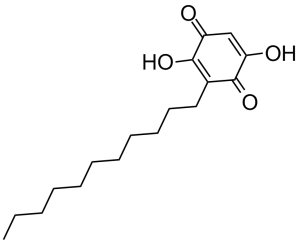
Embelin is a naturally occurring quinone compound that was isolated from the Japanese herb Ardisia. It has anti-tumor and anti-inflammatory properties, and it also functions as a powerful and cell-permeable inhibitor of XIAP (X-linked inhibitor of apoptosis), with an IC50 value of 4.1 μM in cell-free assays.
Physicochemical Properties
| Molecular Formula | C17H26O4 | |
| Molecular Weight | 294.39 | |
| Exact Mass | 294.183 | |
| Elemental Analysis | C, 69.36; H, 8.90; O, 21.74 | |
| CAS # | 550-24-3 | |
| Related CAS # |
|
|
| PubChem CID | 3218 | |
| Appearance | Yellow to orange solid powder | |
| Density | 1.131 | |
| Boiling Point | 431.9±45.0 °C at 760 mmHg | |
| Melting Point | 145-146 ºC | |
| Flash Point | 229.1±25.2 °C | |
| Vapour Pressure | 0.0±2.3 mmHg at 25°C | |
| Index of Refraction | 1.538 | |
| LogP | 5.7 | |
| Hydrogen Bond Donor Count | 2 | |
| Hydrogen Bond Acceptor Count | 4 | |
| Rotatable Bond Count | 10 | |
| Heavy Atom Count | 21 | |
| Complexity | 432 | |
| Defined Atom Stereocenter Count | 0 | |
| SMILES | O([H])C1C(C([H])=C(C(C=1C([H])([H])C([H])([H])C([H])([H])C([H])([H])C([H])([H])C([H])([H])C([H])([H])C([H])([H])C([H])([H])C([H])([H])C([H])([H])[H])=O)O[H])=O |
|
| InChi Key | IRSFLDGTOHBADP-UHFFFAOYSA-N | |
| InChi Code | InChI=1S/C17H26O4/c1-2-3-4-5-6-7-8-9-10-11-13-16(20)14(18)12-15(19)17(13)21/h12,18,21H,2-11H2,1H3 | |
| Chemical Name | 2,5-dihydroxy-3-undecylcyclohexa-2,5-diene-1,4-dione | |
| Synonyms | Embelic acid; NSC91874; NSC91874; Embelin; NSC 91874; Emberine | |
| HS Tariff Code | 2934.99.9001 | |
| Storage |
Powder-20°C 3 years 4°C 2 years In solvent -80°C 6 months -20°C 1 month Note: This product requires protection from light (avoid light exposure) during transportation and storage. |
|
| Shipping Condition | Room temperature (This product is stable at ambient temperature for a few days during ordinary shipping and time spent in Customs) |
Biological Activity
| Targets | 5-LO (IC50 = 0.06 μM); mPGES-1 (IC50 = 0.2 μM); XIAP (IC50 = 4.1 μM) | ||
| ln Vitro | Embelin from the Japanese Ardisia herb is a small-molecular inhibitor that binds to the XIAP BIR3 domain with which Smac and caspsase-9 bind. Embelin has IC50 values of 3.7 and 5.7 μM and inhibits PC-3 and LNCap cell growth in a dose-dependent manner. While Embelin's toxicity in normal PrEC and WI-38 cells is much lower, with IC50 values of 20.1 μM and 19.3 μM, respectively. When PC-3 cells are treated for 48 hours with 25 and 50 μM of embelin, 30% and 75% of the cells die, which is an increase of about 3 and 9 times more than in untreated cells.[1] Embelin selectively inhibits 5-lipoxygenase (5-LO) and Microsomal prostaglandin E2 synthase-1 (mPGES-1) with IC50 values of 0.06 and 0.2 mM, respectively, to suppress the biosynthesis of eicosanoids.[2] | ||
| ln Vivo |
|
||
| Enzyme Assay | Fluorescence polarization experiments are performed in Dynex 96-well, black, round-bottom plates. A final volume of 125 L is created by adding a 5 μL sample of Embelin dilutions in DMSO, preincubated XIAP BIR3 protein (0.06 M), and the N terminus of a Smac peptide (SM7F) (0.01 M) in the assay buffer. Both the bound peptide control (equivalent to 0% inhibition) and the free peptide control (equivalent to 100% inhibition) were used in each assay. The bound peptide control contained XIAP BIR3 protein and SM7F. To achieve equilibrium, the plates were combined and incubated for 3 hours at room temperature. | ||
| Cell Assay | The MTT-based assay, which uses Cell Proliferation Reagent WST-1 in accordance with the manufacturer's instructions, is used to measure cell growth. Cells (5000 cells/well) are grown in medium containing 10% FBS and different concentrations of Embelin. WST-1 is added to each well and incubated for 1-3 hours at 37 °C four to five days later. A plate reader is used to measure absorbance at 450 nm with a correction at 650 nm. | ||
| Animal Protocol |
|
||
| References |
[1]. J Med Chem . 2004 May 6;47(10):2430-40. [2]. Biochem Pharmacol . 2013 Aug 15;86(4):476-86. |
||
| Additional Infomation |
Embelin is a member of the class of dihydroxy-1,4-benzoquinones that is 2,5-dihydroxy-1,4-benzoquinone which is substituted by an undecyl group at position 3. Isolated from Lysimachia punctata and Embelia ribes, it exhibits antimicrobial, antineoplastic and inhibitory activity towards hepatitis C protease. It has a role as a hepatitis C protease inhibitor, an antimicrobial agent, an antineoplastic agent and a plant metabolite. Embelin has been reported in Embelia schimperi, Ardisia paniculata, and other organisms with data available. |
Solubility Data
| Solubility (In Vitro) |
|
|||
| Solubility (In Vivo) |
Solubility in Formulation 1: 2.5 mg/mL (8.49 mM) in 10% DMSO + 40% PEG300 + 5% Tween80 + 45% Saline (add these co-solvents sequentially from left to right, and one by one), suspension solution; with sonication. For example, if 1 mL of working solution is to be prepared, you can add 100 μL of 25.0 mg/mL clear DMSO stock solution to 400 μL PEG300 and mix evenly; then add 50 μL Tween-80 to the above solution and mix evenly; then add 450 μL normal saline to adjust the volume to 1 mL. Preparation of saline: Dissolve 0.9 g of sodium chloride in 100 mL ddH₂ O to obtain a clear solution. Solubility in Formulation 2: ≥ 2.5 mg/mL (8.49 mM) (saturation unknown) in 10% DMSO + 90% Corn Oil (add these co-solvents sequentially from left to right, and one by one), clear solution. For example, if 1 mL of working solution is to be prepared, you can add 100 μL of 25.0 mg/mL clear DMSO stock solution to 900 μL of corn oil and mix evenly. (Please use freshly prepared in vivo formulations for optimal results.) |
| Preparing Stock Solutions | 1 mg | 5 mg | 10 mg | |
| 1 mM | 3.3969 mL | 16.9843 mL | 33.9685 mL | |
| 5 mM | 0.6794 mL | 3.3969 mL | 6.7937 mL | |
| 10 mM | 0.3397 mL | 1.6984 mL | 3.3969 mL |