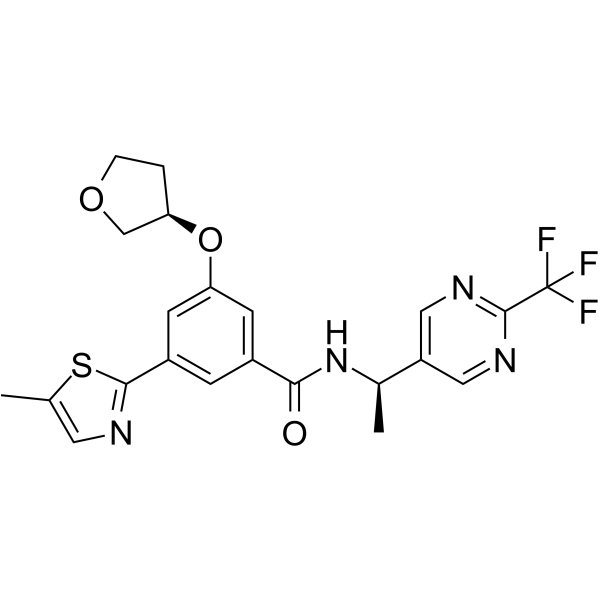
Eliapixant (BAY-1817080) is a potent and selective antagonist of P2X3 purinoreceptor (IC50 = 8 nM) and may be used for treating refractory chronic cough.
Physicochemical Properties
| Molecular Formula | C22H21F3N4O3S |
| Molecular Weight | 478.4874 |
| Exact Mass | 478.13 |
| Elemental Analysis | C, 55.22; H, 4.42; F, 11.91; N, 11.71; O, 10.03; S, 6.70 |
| CAS # | 1948229-21-7 |
| PubChem CID | 121397587 |
| Appearance | White to off-white solid powder |
| Density | 1.360±0.06 g/cm3(Predicted) |
| LogP | 3.4 |
| Hydrogen Bond Donor Count | 1 |
| Hydrogen Bond Acceptor Count | 10 |
| Rotatable Bond Count | 6 |
| Heavy Atom Count | 33 |
| Complexity | 665 |
| Defined Atom Stereocenter Count | 2 |
| SMILES | S1C(C([H])([H])[H])=C([H])N=C1C1=C([H])C(C(N([H])[C@]([H])(C([H])([H])[H])C2=C([H])N=C(C(F)(F)F)N=C2[H])=O)=C([H])C(=C1[H])O[C@@]1([H])C([H])([H])OC([H])([H])C1([H])[H] |
| InChi Key | GTQPEQGDLVSFJO-CXAGYDPISA-N |
| InChi Code | InChI=1S/C22H21F3N4O3S/c1-12-8-26-20(33-12)15-5-14(6-18(7-15)32-17-3-4-31-11-17)19(30)29-13(2)16-9-27-21(28-10-16)22(23,24)25/h5-10,13,17H,3-4,11H2,1-2H3,(H,29,30)/t13-,17-/m1/s1 |
| Chemical Name | 3-(5-methyl-1,3-thiazol-2-yl)-5-[(3R)-oxolan-3-yl]oxy-N-[(1R)-1-[2-(trifluoromethyl)pyrimidin-5-yl]ethyl]benzamide |
| Synonyms | Eliapixant; BAY 1817080; BAY-1817080; BAY1817080; |
| HS Tariff Code | 2934.99.9001 |
| Storage |
Powder-20°C 3 years 4°C 2 years In solvent -80°C 6 months -20°C 1 month |
| Shipping Condition | Room temperature (This product is stable at ambient temperature for a few days during ordinary shipping and time spent in Customs) |
Biological Activity
| Targets |
|
|
| ln Vivo | Eliapixant has applications in the research of cough and diabetic problems [1]. | |
| References |
[1]. P2X3 Receptor Ligands: Structural Features and Potential Therapeutic Applications. Front Pharmacol. 2021 Apr 13;12:653561. [2]. Eliapixant (BAY 1817080), a P2X3 receptor antagonist, in refractory chronic cough: a randomised, placebo-controlled, crossover phase 2a study. Eur Respir J. 2021 May 13;2004240. |
|
| Additional Infomation |
Eliapixant is an orally bioavailable antagonist of the purinergic receptor P2X ligand-gated ion channel 3 (P2RX3), which may potentially be used to suppress pain and chronic cough. Upon oral administration, eliapixant selectively binds to and inhibits P2RX3 expressed on sensory nerve fibers. This may inhibit P2RX3-mediated afferent nerve fiber signaling including respiratory tract afferent nerve fiber signaling, and result in the suppression of pain and chronic cough. P2RX3 plays an important role in the cough reflex. It is also a natural mediator of pain and neurogenic inflammation. Drug Indication Treatment of unexplained or chronic refractory cough |
Solubility Data
| Solubility (In Vitro) | DMSO : ~33.33 mg/mL (~69.66 mM) |
| Solubility (In Vivo) |
Solubility in Formulation 1: ≥ 2.5 mg/mL (5.22 mM) (saturation unknown) in 10% DMSO + 90% Corn Oil (add these co-solvents sequentially from left to right, and one by one), clear solution. For example, if 1 mL of working solution is to be prepared, you can add 100 μL of 25.0 mg/mL clear DMSO stock solution to 900 μL of corn oil and mix evenly. (Please use freshly prepared in vivo formulations for optimal results.) |
| Preparing Stock Solutions | 1 mg | 5 mg | 10 mg | |
| 1 mM | 2.0899 mL | 10.4495 mL | 20.8991 mL | |
| 5 mM | 0.4180 mL | 2.0899 mL | 4.1798 mL | |
| 10 mM | 0.2090 mL | 1.0450 mL | 2.0899 mL |