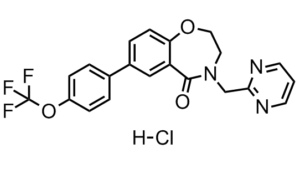
Eleclazine hydrochloride (also known as GS-6615) is a novel late Na+ current inhibitor with IC50 value of 0.7 uM. Enhanced late Na+ current (late INa ) in the myocardium is pro-arrhythmic. Inhibition of this current is a promising strategy to stabilize ventricular repolarization and suppress arrhythmias. Eleclazine was a selective inhibitor of late INa , stabilizes the ventricular repolarization and suppresses arrhythmias in a model of LQT3. The concentrations at which the electrophysiological effects of Eleclazine were observed are comparable to plasma levels associated with QTc shortening in patients with LQT3, indicating that these effects are clinically relevant. Eleclazine is currently in clinical development for the treatment of long QT syndrome 3 (LQT3).
Physicochemical Properties
| Molecular Formula | C₂₁H₁₇CLF₃N₃O₃ | |
| Molecular Weight | 451.83 | |
| Exact Mass | 451.091 | |
| Elemental Analysis | C, 55.82; H, 3.79; Cl, 7.85; F, 12.61; N, 9.30; O, 10.62 | |
| CAS # | 1448754-43-5 | |
| Related CAS # | 1443211-72-0;1448754-43-5 (HCl); | |
| PubChem CID | 90479986 | |
| Appearance | White to off-white solid powder | |
| Hydrogen Bond Donor Count | 1 | |
| Hydrogen Bond Acceptor Count | 8 | |
| Rotatable Bond Count | 4 | |
| Heavy Atom Count | 31 | |
| Complexity | 578 | |
| Defined Atom Stereocenter Count | 0 | |
| SMILES | Cl[H].FC(OC1C([H])=C([H])C(=C([H])C=1[H])C1C([H])=C([H])C2=C(C=1[H])C(N(C([H])([H])C1=NC([H])=C([H])C([H])=N1)C([H])([H])C([H])([H])O2)=O)(F)F |
|
| InChi Key | ZRYHNOXHGYUHFF-UHFFFAOYSA-N | |
| InChi Code | InChI=1S/C21H16F3N3O3.ClH/c22-21(23,24)30-16-5-2-14(3-6-16)15-4-7-18-17(12-15)20(28)27(10-11-29-18)13-19-25-8-1-9-26-19;/h1-9,12H,10-11,13H2;1H | |
| Chemical Name | 4-(pyrimidin-2-ylmethyl)-7-[4-(trifluoromethoxy)phenyl]-2,3-dihydro-1,4-benzoxazepin-5-one;hydrochloride | |
| Synonyms |
|
|
| HS Tariff Code | 2934.99.03.00 | |
| Storage |
Powder-20°C 3 years 4°C 2 years In solvent -80°C 6 months -20°C 1 month Note: Please store this product in a sealed and protected environment, avoid exposure to moisture. |
|
| Shipping Condition | Room temperature (This product is stable at ambient temperature for a few days during ordinary shipping and time spent in Customs) |
Biological Activity
| Targets |
Cardiac Late Sodium Current (INa,L) (IC50 = 0.3 μM, hiPSC-CMs voltage-clamp assay for INa,L inhibition; IC50 for peak sodium current (INa,peak) = 32 μM, hiPSC-CMs), indicating >100-fold selectivity for INa,L over INa,peak [3] Sodium Channel (Nav1.5, cardiac isoform) [2][3] |
| ln Vitro |
With an IC50 of 2.5 μM, eleclazine inhibits sodium current in cardiomyocytes derived from hiPSCs[3]. 1. Inhibition of late sodium current (INa,L) in hiPSC-CMs: Eleclazine HCl dose-dependently inhibited INa,L in human induced pluripotent stem cell-derived cardiomyocytes (hiPSC-CMs) with an IC50 of 0.3 μM, while showing minimal effect on peak sodium current (INa,peak) (IC50 = 32 μM), resulting in >100-fold selectivity for INa,L. At 1 μM, it reduced INa,L by 85% without significant inhibition of INa,peak (<10% reduction) (whole-cell voltage-clamp technique) [3] 2. Anti-arrhythmic effects in rabbit isolated hearts: Eleclazine HCl (0.1, 0.3, 1.0 μM) suppressed ouabain-induced ventricular arrhythmias in rabbit isolated hearts in a dose-dependent manner. At 1.0 μM, it completely prevented the occurrence of ventricular tachycardia (VT) and fibrillation (VF) in 8/8 hearts, compared to 2/8 hearts in the vehicle group. It also reduced action potential duration (APD90) by 15-20% without prolonging QT interval [2] 3. Superiority over flecainide in inhibiting INa,L: In hiPSC-CMs, Eleclazine HCl (1 μM) inhibited INa,L by 85%, while flecainide (10 μM) only reduced INa,L by 40%, demonstrating higher potency for INa,L inhibition. Unlike flecainide, Eleclazine HCl did not significantly slow conduction velocity in rabbit isolated hearts (assessed by ECG interval measurements) [2][3] 4. Reduction of calcium overload in cardiomyocytes: Eleclazine HCl (0.3 μM) decreased intracellular calcium transients (Ca2+ i) in hiPSC-CMs under conditions of oxidative stress (H2O2 treatment) by 35%, preventing calcium overload-induced cellular dysfunction (fluorescent Ca2+ indicator assay) [3] |
| ln Vivo |
Eleclazine (0.3 and 0.9 mg/kg; IV; infused over 15 minutes) shortens the atrial PTa and ventricular QT intervals and lowers the frequency of ventricular premature beats and couplets caused by epinephrine[1]. 1. Suppression of catecholamine-induced VT and T-wave alternans in pigs: Anesthetized pigs were administered Eleclazine HCl (0.3, 1.0 mg/kg, i.v.) or flecainide (2 mg/kg, i.v.) 30 minutes before infusion of isoproterenol (0.4 μg/kg/min) + epinephrine (0.2 μg/kg/min) to induce VT. Eleclazine HCl dose-dependently suppressed VT: 0.3 mg/kg reduced VT episodes by 55%, 1.0 mg/kg reduced VT episodes by 90%, and eliminated T-wave alternans (a predictor of arrhythmic risk) in all animals. In contrast, flecainide reduced VT episodes by only 30% and did not eliminate T-wave alternans. Eleclazine HCl had no significant effect on mean arterial pressure or heart rate, while flecainide increased QRS duration by 25% [1] |
| Enzyme Assay |
1. hiPSC-CMs late sodium current (INa,L) recording assay: Human induced pluripotent stem cell-derived cardiomyocytes (hiPSC-CMs) were cultured on glass coverslips and allowed to mature for 30-45 days. Whole-cell voltage-clamp recordings were performed at 37℃ using a patch-clamp amplifier. The pipette solution contained CsCl-based buffer, and the extracellular solution contained NaCl-based buffer. Eleclazine HCl (0.01-100 μM) was added to the extracellular solution, and INa,L was elicited by a voltage protocol consisting of a 50-ms depolarization to -20 mV from a holding potential of -80 mV, followed by a repolarization to -40 mV for 500 ms. INa,peak was recorded during the initial depolarization, and INa,L was measured as the sustained current during the repolarization phase. Current amplitudes were normalized to cell capacitance, and IC50 values were derived from dose-response curves [3] 2. Rabbit ventricular myocyte sodium current assay: Isolated rabbit ventricular myocytes were enzymatically dissociated and maintained in a physiological buffer. Whole-cell voltage-clamp was used to record INa,L and INa,peak in the presence of Eleclazine HCl (0.1-10 μM). The voltage protocol was identical to that used for hiPSC-CMs, and selectivity for INa,L was calculated as the ratio of IC50 for INa,peak to IC50 for INa,L [2] |
| Cell Assay |
1. hiPSC-CMs calcium transient assay: Mature hiPSC-CMs were loaded with a fluorescent Ca2+ indicator for 30 minutes at 37℃. Cells were treated with Eleclazine HCl (0.1-3 μM) for 1 hour, then exposed to H2O2 (100 μM) to induce oxidative stress. Calcium transients were recorded using a fluorescence microscope, and peak fluorescence intensity and decay time were quantified to assess intracellular calcium handling [3] 2. hiPSC-CMs viability assay: hiPSC-CMs were seeded in 96-well plates and treated with Eleclazine HCl (0.01-100 μM) for 24 hours. Cell viability was assessed by MTT assay, and absorbance at 570 nm was measured. No significant cytotoxicity was observed at concentrations up to 30 μM [3] |
| Animal Protocol |
Animal/Disease Models: Male Yorkshire pigs (35.20 ± 0.46 kg; injected with epinephrine via a jugular vein)[1] Doses: 0.3 and 0.9 mg/kg Route of Administration: IV; infused over 15 minutes Experimental Results: decreased the incidence of epinephrine-induced ventricular premature beats and couplets by 51% (from 31.3 shortened ventricular QT and atrial PTa intervals by 7%, and decreased atrial repolarization alternans and heterogeneity without attenuation of the inotropic response to catecholamine. 1. Porcine in vivo arrhythmia model: Female domestic pigs (25-30 kg) were anesthetized with isoflurane, intubated, and instrumented with ECG leads and arterial catheters for hemodynamic monitoring. After a 30-minute stabilization period, pigs were randomly divided into 3 groups (n=6/group): vehicle control (saline), Eleclazine HCl 0.3 mg/kg, Eleclazine HCl 1.0 mg/kg, or flecainide 2 mg/kg (positive control). Drugs were administered intravenously over 10 minutes. Thirty minutes after drug administration, a catecholamine challenge (isoproterenol 0.4 μg/kg/min + epinephrine 0.2 μg/kg/min) was infused for 30 minutes to induce VT. ECG was continuously recorded, and VT episodes (duration >5 seconds) and T-wave alternans were quantified. Hemodynamic parameters (mean arterial pressure, heart rate) were measured at baseline and every 15 minutes during the experiment [1] 2. Rabbit isolated heart preparation: New Zealand White rabbits (2.0-2.5 kg) were euthanized, and hearts were rapidly excised and mounted on a Langendorff perfusion system. Hearts were perfused with oxygenated Krebs-Henseleit buffer at 37℃. A pacing electrode was placed on the right atrium to maintain a heart rate of 240 beats/min. After stabilization, Eleclazine HCl (0.1, 0.3, 1.0 μM) was added to the perfusate. Ouabain (1 μM) was added to induce arrhythmias. ECG was recorded, and the incidence of VT/VF, action potential duration, and QRS interval were measured [2] |
| Toxicity/Toxicokinetics |
1. Cardiac safety profile: In porcine in vivo studies, Eleclazine HCl (0.3-1.0 mg/kg, i.v.) did not significantly prolong QRS duration or QT interval, while flecainide (2 mg/kg) increased QRS duration by 25% [1] 2. No hemodynamic toxicity: Eleclazine HCl (0.3-1.0 mg/kg, i.v.) had no significant effect on mean arterial pressure or heart rate in anesthetized pigs, indicating minimal impact on systemic hemodynamics [1] 3. Cellular toxicity: Eleclazine HCl at concentrations up to 30 μM did not reduce viability of hiPSC-CMs (MTT assay), suggesting low cytotoxicity [3] |
| References |
[1]. Eleclazine, an inhibitor of the cardiac late sodium current, is superior to flecainide in suppressing catecholamine-induced ventricular tachycardia and T-wave alternans in an intact porcine model. Heart Rhythm. 2017 Mar;14(3):448-454. [2]. The novel late Na+ current inhibitor, GS-6615 (eleclazine) and its anti-arrhythmic effects in rabbit isolated heart preparations. Br J Pharmacol. 2016 Jul 23. [3]. Potet F, Egecioglu DE, Burridge PW, George AL Jr. GS-967 and Eleclazine Block Sodium Channels in Human Induced Pluripotent Stem Cell-Derived Cardiomyocytes. Mol Pharmacol. 2020 Nov;98(5):540-547. |
| Additional Infomation |
1. Eleclazine HCl (formerly GS-6615) is a selective inhibitor of the cardiac late sodium current (INa,L), a small inward sodium current that persists during the plateau phase of the cardiac action potential. Abnormal enhancement of INa,L leads to intracellular calcium overload, which contributes to arrhythmias, particularly in conditions of catecholamine stress [1][2][3] 2. Its mechanism of action involves blocking the late component of the cardiac sodium channel (Nav1.5), reducing intracellular sodium accumulation and subsequent calcium overload via the Na+/Ca2+ exchanger. This mechanism suppresses arrhythmic substrates such as T-wave alternans and ventricular tachycardia [1][3] 3. Eleclazine HCl exhibits superior anti-arrhythmic efficacy compared to flecainide (a class Ic anti-arrhythmic) in preclinical models, with higher selectivity for INa,L over peak sodium current, resulting in fewer conduction abnormalities (e.g., QRS prolongation) [1][2] 4. Potential therapeutic applications include the treatment of catecholamine-induced ventricular arrhythmias, such as those associated with long QT syndrome type 3 (LQT3) or myocardial ischemia. Its favorable cardiac safety profile supports further clinical development for life-threatening ventricular arrhythmias [1][3] |
Solubility Data
| Solubility (In Vitro) |
|
|||
| Solubility (In Vivo) |
Solubility in Formulation 1: ≥ 2.5 mg/mL (5.53 mM) (saturation unknown) in 10% DMSO + 40% PEG300 + 5% Tween80 + 45% Saline (add these co-solvents sequentially from left to right, and one by one), clear solution. For example, if 1 mL of working solution is to be prepared, you can add 100 μL of 25.0 mg/mL clear DMSO stock solution to 400 μL PEG300 and mix evenly; then add 50 μL Tween-80 to the above solution and mix evenly; then add 450 μL normal saline to adjust the volume to 1 mL. Preparation of saline: Dissolve 0.9 g of sodium chloride in 100 mL ddH₂ O to obtain a clear solution. Solubility in Formulation 2: ≥ 2.5 mg/mL (5.53 mM) (saturation unknown) in 10% DMSO + 90% (20% SBE-β-CD in Saline) (add these co-solvents sequentially from left to right, and one by one), clear solution. For example, if 1 mL of working solution is to be prepared, you can add 100 μL of 25.0 mg/mL clear DMSO stock solution to 900 μL of 20% SBE-β-CD physiological saline solution and mix evenly. Preparation of 20% SBE-β-CD in Saline (4°C,1 week): Dissolve 2 g SBE-β-CD in 10 mL saline to obtain a clear solution. Solubility in Formulation 3: ≥ 2.5 mg/mL (5.53 mM) (saturation unknown) in 10% DMSO + 90% Corn Oil (add these co-solvents sequentially from left to right, and one by one), clear solution. For example, if 1 mL of working solution is to be prepared, you can add 100 μL of 25.0 mg/mL clear DMSO stock solution to 900 μL of corn oil and mix evenly. (Please use freshly prepared in vivo formulations for optimal results.) |
| Preparing Stock Solutions | 1 mg | 5 mg | 10 mg | |
| 1 mM | 2.2132 mL | 11.0661 mL | 22.1322 mL | |
| 5 mM | 0.4426 mL | 2.2132 mL | 4.4264 mL | |
| 10 mM | 0.2213 mL | 1.1066 mL | 2.2132 mL |