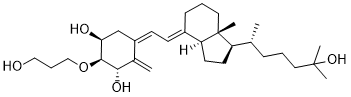
Eldecalcitol is a medication used to treat osteoporosis in Japan. It functions as a vitamin D analog. Eldecalcitol is a medication that patients take orally. It binds to binding proteins and vitamin D receptors in an effort to increase the specificity of the binding of calcium for absorption. This higher affinity is 2.7 times greater than that of calcitriol's active vitamin D form. Eldecalcitol has a long elimination half-life of more than eight hours and is easily absorbed by the body, reaching maximum absorption in 3.4 hours.
Physicochemical Properties
| Molecular Formula | C30H50O5 |
| Molecular Weight | 490.725 |
| Exact Mass | 490.365 |
| Elemental Analysis | C, 73.43; H, 10.27; O, 16.30 |
| CAS # | 104121-92-8 |
| Related CAS # | Eldecalcitol-d6 |
| PubChem CID | 6918141 |
| Appearance | White to off-white solid powder |
| Density | 1.1±0.1 g/cm3 |
| Boiling Point | 655.7±55.0 °C at 760 mmHg |
| Melting Point | 126-128ºC |
| Flash Point | 350.3±31.5 °C |
| Vapour Pressure | 0.0±4.5 mmHg at 25°C |
| Index of Refraction | 1.550 |
| LogP | 5.84 |
| Hydrogen Bond Donor Count | 4 |
| Hydrogen Bond Acceptor Count | 5 |
| Rotatable Bond Count | 10 |
| Heavy Atom Count | 35 |
| Complexity | 784 |
| Defined Atom Stereocenter Count | 7 |
| SMILES | O([H])C(C([H])([H])[H])(C([H])([H])[H])C([H])([H])C([H])([H])C([H])([H])[C@@]([H])(C([H])([H])[H])[C@@]1([H])C([H])([H])C([H])([H])[C@@]2([H])/C(=C(\[H])/C(/[H])=C3\C(=C([H])[H])[C@]([H])([C@@]([H])([C@@]([H])(C\3([H])[H])O[H])OC([H])([H])C([H])([H])C([H])([H])O[H])O[H])/C([H])([H])C([H])([H])C([H])([H])[C@]12C([H])([H])[H] |
| InChi Key | FZEXGDDBXLBRTD-AYIMTCTASA-N |
| InChi Code | InChI=1S/C30H50O5/c1-20(9-6-15-29(3,4)34)24-13-14-25-22(10-7-16-30(24,25)5)11-12-23-19-26(32)28(27(33)21(23)2)35-18-8-17-31/h11-12,20,24-28,31-34H,2,6-10,13-19H2,1,3-5H3/b22-11+,23-12-/t20-,24-,25+,26-,27-,28-,30-/m1/s1 |
| Chemical Name | (1R,2R,3R,5Z)-5-[(2E)-2-[(1R,3aS,7aR)-1-[(2R)-6-hydroxy-6-methylheptan-2-yl]-7a-methyl-2,3,3a,5,6,7-hexahydro-1H-inden-4-ylidene]ethylidene]-2-(3-hydroxypropoxy)-4-methylidenecyclohexane-1,3-diol |
| Synonyms | Eldecalcitol; ED 71; ED-71; ED71; Edirol; 1,25-dihydroxyvitamin D3; 2-(3-Hydroxypropoxy)calcitriol |
| HS Tariff Code | 2934.99.9001 |
| Storage |
Powder-20°C 3 years 4°C 2 years In solvent -80°C 6 months -20°C 1 month Note: (1). This product requires protection from light (avoid light exposure) during transportation and storage.(2). Please store this product in a sealed and protected environment (e.g. under nitrogen), avoid exposure to moisture. |
| Shipping Condition | Room temperature (This product is stable at ambient temperature for a few days during ordinary shipping and time spent in Customs) |
Biological Activity
| ln Vitro | Eldecalcitol is non-cytotoxic and can decrease LPS (5 μg/mL)-induced cell death (0.5–50 nM; 24 hours) [2]. By activating Eldecalcitol (0.5-50 nM; 24 h), Eldecalcitol (5 nM; 24 h) exhibits anti-pyroptotic ability and induces dose-wise decrease of NLRP3, caspase-1, and IL. LPS-induced pyroptosis is inhibited by Nrf2 and its effector molecule HO-1[2]. Eldecalcitol (0.04–40 nM; 0-48 h) prevents SCC-15 and CAL-27 cells from proliferating and migrating [3]. Cell cycle curve expression at -1β is induced by edecalcitol (0.4 nM; 48 h) [3]. G0/G1 phase, as well as by preventing cells from expressing glutathione peroxidase, or GPx-1 [3]. |
| ln Vivo | By inhibiting GPx-1 (glutathione peroxidase), eldecalcitol (0.5 μg/kg; channel; twice weekly for 4 weeks) has anticancer effects [3]. Eldecalcitol, a more potent vitamin D3 analogue that promotes focal bone (miniature model) and is more efficient than bone Chetriol in inhibiting bone resorption, (10, 30, or 90 ng/kg; lateral; 5 times weekly for 12 weeks). |
| Cell Assay |
Western Blot analysis [2] Cell Types: Human gingival fibroblasts (HGFs) Tested Concentrations: 0, 0.5, 5 and 50 nM Incubation Duration: 24 hrs (hours) Experimental Results: Compared with LPS treatment group, TLR4, NLRP3, caspase-1 p20, ASC and GSDMD-N levels were diminished in a dose-dependent manner. LPS-induced IL-1β and IL-18 release was diminished to normal levels. Cell proliferation assay [3] Cell Types: SCC-15 and CAL-27 Cell Tested Concentrations: 0, 0.04, 0.4, 4 and 40 nM Incubation Duration: 6, 8, 12, 24, 48 hrs (hours) Experimental Results: Inhibition of cell viability using 0.4 nM , OSCC cells reached 50% within 24 hrs (hours). Cell proliferation analysis [3] Cell Types: OSCC Cell Tested Concentrations: 0.4 nM Incubation Duration: 48 hrs (hours) Experimental Results: The proportion of late-stage apoptotic cells increased from 7.1% to 16.1%. Bax and caspase-3 were upregulated, and Bcl-2 was downregulated. Dramatically triggers apoptosis of SCC-15 and CAL-27 cells. |
| Animal Protocol |
Animal/Disease Models: Mouse xenograft tumor model (male athymic nude BALB/c mouse) [3] Doses: 0.5 μg/kg Route of Administration: po (oral gavage); [4]. Twice a week for 4 weeks. Experimental Results: diminished tumor growth rate, down-regulated the expression levels of PCNA and MMP-2 in tumors, and up-regulated Bax expression. Resulting in diminished proliferation, inhibition of migration, and promotion of apoptosis. Animal/Disease Models: Ovariectomized (OVX) rat model [4] Doses: 10, 30 or 90 ng/kg Route of Administration: po (oral gavage); 5 times per week for 12 weeks Experimental Results: Lumbar spine and femur BMD in a dose-dependent manner way increased. The stimulation of local bone formation begins without prior bone resorption, a process called bone micromodelling. |
| References |
[1]. Matsumoto T.Osteoporosis Treatment by a New Active Vitamin D3 Compound, Eldecalcitol, in Japan.Curr Osteoporos Rep. 2012 Aug 24. [2]. Eldecalcitol Inhibits LPS-Induced NLRP3 Inflammasome-Dependent Pyroptosis in Human Gingival Fibroblasts by Activating the Nrf2/HO-1 Signaling Pathway. Drug Des Devel Ther. 2020 Nov 13;14:4901-4913. [3]. Eldecalcitol inhibits the progression of oral cancer by suppressing the expression of GPx-1. Oral Dis. 2021 Aug 24. [4]. Eldecalcitol and calcitriol stimulates 'bone minimodeling,' focal bone formation without prior bone resorption, in rat trabecular bone. J Steroid Biochem Mol Biol. 2013 Jul;136:178-82. |
| Additional Infomation |
1alpha,25-dihydroxy-2beta-(3-hydroxypropoxy)vitamin D3 is a hydroxycalciol that is calcitriol with a 3-hydroxypropoxy group at position 2. It has a role as a metabolite. It is a tetrol, a member of D3 vitamins and a hydroxycalciol. It is functionally related to a calcitriol. Eldecalcitol (ED-71), a vitamin D analog, is a more potent inhibitor of bone resorption than alfacalcidol in an estrogen-deficient rat model of osteoporosis. Eldecalcitol, effectively and safely increased lumbar and hip bone mineral density (BMD) in osteoporotic patients who also received vitamin D3 supplementation. Drug Indication Investigated for use/treatment in osteoporosis. Mechanism of Action Eldecalcitol [1a,25-DIHYDROXY-2ß-(3-hydroxypropoxy)vitamin D3] is an analog of 1a,25-dihydroxyvitamin D3 [1,25(OH)2D3], bearing a hydroxypropoxy residue at the 2b position. Eldecalcitol is also effective in increasing bone mass and was able to enhance bone strength in rodents. It binds to the vitamin D receptor (VDR) with less affinity but binds to vitamin D-binding protein with higher affinity than 1,25(OH)2D, showing a long half-life in plasma. |
Solubility Data
| Solubility (In Vitro) |
Methanol: ~8.3 mg/mL (~17 mM) DMSO: ~3.3 mg/mL (~6.8 mM) |
| Solubility (In Vivo) |
Note: Listed below are some common formulations that may be used to formulate products with low water solubility (e.g. < 1 mg/mL), you may test these formulations using a minute amount of products to avoid loss of samples. Injection Formulations (e.g. IP/IV/IM/SC) Injection Formulation 1: DMSO : Tween 80: Saline = 10 : 5 : 85 (i.e. 100 μL DMSO stock solution → 50 μL Tween 80 → 850 μL Saline) *Preparation of saline: Dissolve 0.9 g of sodium chloride in 100 mL ddH ₂ O to obtain a clear solution. Injection Formulation 2: DMSO : PEG300 :Tween 80 : Saline = 10 : 40 : 5 : 45 (i.e. 100 μL DMSO → 400 μLPEG300 → 50 μL Tween 80 → 450 μL Saline) Injection Formulation 3: DMSO : Corn oil = 10 : 90 (i.e. 100 μL DMSO → 900 μL Corn oil) Example: Take the Injection Formulation 3 (DMSO : Corn oil = 10 : 90) as an example, if 1 mL of 2.5 mg/mL working solution is to be prepared, you can take 100 μL 25 mg/mL DMSO stock solution and add to 900 μL corn oil, mix well to obtain a clear or suspension solution (2.5 mg/mL, ready for use in animals). Injection Formulation 4: DMSO : 20% SBE-β-CD in saline = 10 : 90 [i.e. 100 μL DMSO → 900 μL (20% SBE-β-CD in saline)] *Preparation of 20% SBE-β-CD in Saline (4°C,1 week): Dissolve 2 g SBE-β-CD in 10 mL saline to obtain a clear solution. Injection Formulation 5: 2-Hydroxypropyl-β-cyclodextrin : Saline = 50 : 50 (i.e. 500 μL 2-Hydroxypropyl-β-cyclodextrin → 500 μL Saline) Injection Formulation 6: DMSO : PEG300 : castor oil : Saline = 5 : 10 : 20 : 65 (i.e. 50 μL DMSO → 100 μLPEG300 → 200 μL castor oil → 650 μL Saline) Injection Formulation 7: Ethanol : Cremophor : Saline = 10: 10 : 80 (i.e. 100 μL Ethanol → 100 μL Cremophor → 800 μL Saline) Injection Formulation 8: Dissolve in Cremophor/Ethanol (50 : 50), then diluted by Saline Injection Formulation 9: EtOH : Corn oil = 10 : 90 (i.e. 100 μL EtOH → 900 μL Corn oil) Injection Formulation 10: EtOH : PEG300:Tween 80 : Saline = 10 : 40 : 5 : 45 (i.e. 100 μL EtOH → 400 μLPEG300 → 50 μL Tween 80 → 450 μL Saline) Oral Formulations Oral Formulation 1: Suspend in 0.5% CMC Na (carboxymethylcellulose sodium) Oral Formulation 2: Suspend in 0.5% Carboxymethyl cellulose Example: Take the Oral Formulation 1 (Suspend in 0.5% CMC Na) as an example, if 100 mL of 2.5 mg/mL working solution is to be prepared, you can first prepare 0.5% CMC Na solution by measuring 0.5 g CMC Na and dissolve it in 100 mL ddH2O to obtain a clear solution; then add 250 mg of the product to 100 mL 0.5% CMC Na solution, to make the suspension solution (2.5 mg/mL, ready for use in animals). Oral Formulation 3: Dissolved in PEG400 Oral Formulation 4: Suspend in 0.2% Carboxymethyl cellulose Oral Formulation 5: Dissolve in 0.25% Tween 80 and 0.5% Carboxymethyl cellulose Oral Formulation 6: Mixing with food powders Note: Please be aware that the above formulations are for reference only. InvivoChem strongly recommends customers to read literature methods/protocols carefully before determining which formulation you should use for in vivo studies, as different compounds have different solubility properties and have to be formulated differently. (Please use freshly prepared in vivo formulations for optimal results.) |
| Preparing Stock Solutions | 1 mg | 5 mg | 10 mg | |
| 1 mM | 2.0378 mL | 10.1889 mL | 20.3778 mL | |
| 5 mM | 0.4076 mL | 2.0378 mL | 4.0756 mL | |
| 10 mM | 0.2038 mL | 1.0189 mL | 2.0378 mL |