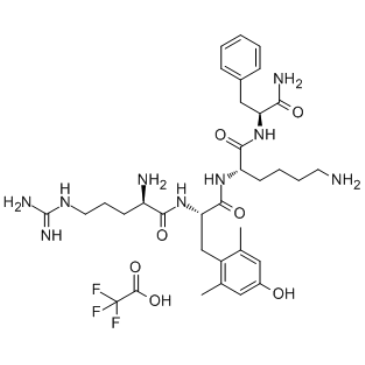
Elamipretide TFA (MTP-131 trfluoroacetic acid; RX-31; SS-31) is a novel and potent cardiolipin peroxidase inhibitor. It is a novel mitochondria-targeting peptide, that improves left ventricular and mitochondrial function in dogs with advanced heart failure.
On September 19, 2025, the U.S. Food and Drug Administration granted accelerated approval to Forzinity (elamipretide) injection as the first treatment for Barth syndrome, in patients weighing at least 30 kg. Barth syndrome is a rare, serious and life-threatening disease of the mitochondria (the energy-producing parts of cells). “The FDA remains committed to facilitating the development of effective and safe therapies for rare diseases and will continue to work diligently to help ensure patients with rare diseases have access to innovative treatments," said George Tidmarsh, M.D., Ph.D., Director of the FDA’s Center for Drug Evaluation and Research.Physicochemical Properties
| Molecular Formula | C34H50F3N9O7 |
| Molecular Weight | 753.812118053436 |
| Exact Mass | 753.378 |
| CAS # | 1606994-55-1 |
| Related CAS # | 736992-21-5;1334953-95-5 (acetate);2244098-12-0 (HCl); 1606994-55-1 |
| PubChem CID | 137795331 |
| Sequence | D-arginyl-2,6-dimethyl-D-tyrosyl-D-lysyl-L-phenylalaninamide trifluoroacetic acid; H-D-Arg-D-Tyr(2,6-diMe)-D-Lys-Phe-NH2.2TFA |
| SequenceShortening | RXKF |
| Appearance | White to off-white solid powder |
| Hydrogen Bond Donor Count | 10 |
| Hydrogen Bond Acceptor Count | 13 |
| Rotatable Bond Count | 19 |
| Heavy Atom Count | 53 |
| Complexity | 1070 |
| Defined Atom Stereocenter Count | 0 |
| SMILES | FC(C(=O)O)(F)F.O=C(C(CC1C(C)=CC(=CC=1C)O)NC(C(CCC/N=C(\N)/N)N)=O)NC(C(NC(C(N)=O)CC1C=CC=CC=1)=O)CCCCN |
| InChi Key | WLZHRKGRZBGUJU-UHFFFAOYSA-N |
| InChi Code | InChI=1S/C32H49N9O5.C2HF3O2/c1-19-15-22(42)16-20(2)23(19)18-27(41-29(44)24(34)11-8-14-38-32(36)37)31(46)39-25(12-6-7-13-33)30(45)40-26(28(35)43)17-21-9-4-3-5-10-21;3-2(4,5)1(6)7/h3-5,9-10,15-16,24-27,42H,6-8,11-14,17-18,33-34H2,1-2H3,(H2,35,43)(H,39,46)(H,40,45)(H,41,44)(H4,36,37,38);(H,6,7) |
| Chemical Name | 6-amino-2-[[2-[[2-amino-5-(diaminomethylideneamino)pentanoyl]amino]-3-(4-hydroxy-2,6-dimethylphenyl)propanoyl]amino]-N-(1-amino-1-oxo-3-phenylpropan-2-yl)hexanamide;2,2,2-trifluoroacetic acid |
| Synonyms | MTP-131 TFA; 1334953-96-6; Elamipretide 2TFA; Elamipretide ditrifluoroacetate; MTP131 trfluoroacetic acid; RX31; SS31 |
| HS Tariff Code | 2934.99.9001 |
| Storage |
Powder-20°C 3 years 4°C 2 years In solvent -80°C 6 months -20°C 1 month |
| Shipping Condition | Room temperature (This product is stable at ambient temperature for a few days during ordinary shipping and time spent in Customs) |
Biological Activity
| Targets | Mitochondrial cardiolipin |
| ln Vitro | Barth syndrome is a rare X-linked genetic disorder characterized by mitochondrial dysfunction. Elamipretide is a mitochondrial cardiolipin binder that penetrates cells and accumulates in the mitochondria: It localizes to the inner mitochondrial membrane, improving mitochondrial morphology and function. Elamipretide's mechanism of action involves electrostatic interactions with cardiolipin, a phospholipid critical for mitochondrial structure and electron transport chain function. By binding to cardiolipin, elamipretide stabilizes the mitochondrial membrane, prevents oxidative damage, and maintains membrane potential. This interaction preserves cristae integrity, reduces reactive oxygen species (ROS) production, and maintains ATP production. Elamipretide also enhances the activity of mitochondrial respiratory complexes, facilitating efficient electron transfer and ATP synthesis. Furthermore, elamipretide inhibits the opening of the mitochondrial permeability transition pore (mPTP), protecting against mitochondrial damage during reperfusion and reducing cell death in ischemic conditions. |
| ln Vivo | Elamipretide is a mitochondrial cardiolipin binder that localizes to the inner mitochondrial membrane to improve mitochondrial morphology and function. Elamipretide was shown to attenuate neuronal oxidative stress and neuroinflammation, activate neural mitochondrial biogenesis, enhance mitochondrial respiration, and protect against neural apoptosis. Protective effects of elamipretide against neuronal loss and inflammation have been reported in traumatic brain injury, hind limb ischemia–reperfusion injury, type II diabetes, and spinal cord injury. Clinically significant QTc interval prolongation was not observed at three times the peak concentration of the maximum recommended dose. Elamipretide is a mitochondrial cardiolipin binder being investigated for diseases involving mitochondrial dysfunction. Elamipretide is a synthetic tetrapeptide that selectively binds to cardiolipin, a phospholipid in the inner mitochondrial membrane. This interaction improves mitochondrial morphology and function. In September 2025, the U.S. Food and Drug Administration (FDA) granted accelerated approval for FORZINITY™ (elamipretide) to improve muscle strength in adult and pediatric patients with Barth syndrome weighing at least 30 kg. ELAMIPRETIDE is a Protein drug with a maximum clinical trial phase of III (across all indications) and has 10 investigational indications. |
| ADME/Pharmacokinetics |
Absorption Elamipretide exposure increases proportionally over a dose range of 2 to 80 mg following daily subcutaneous injections with minimal accumulation. Maximum elamipretide concentrations were reached between 0.5 to 1 hour after subcutaneous administration. The absolute bioavailability following subcutaneous administration is approximately 92%. Elamipretide exposure is comparable after subcutaneous injection to the thigh or to the abdomen. Route of Elimination Elamipretide and its metabolites M1 and M2 are excreted in the urine. At 48 hours post-dose, approximately 100% of the elamipretide dose was recovered in the urine as either elamipretide, M1, or M2 in patients with normal renal function. Volume of Distribution Elamipretide is distributed throughout total body water with an approximate volume of distribution of 0.5 L/kg. Protein Binding Protein binding is approximately 39%. Metabolism / Metabolites Elamipretide is metabolized via sequential C-terminal degradation to the M1 tripeptide and M2 dipeptide metabolites, which do not have pharmacological activity. The metabolic pathways have not been fully characterized. |
| References | Chronic Therapy With Elamipretide (MTP-131), a Novel Mitochondria-Targeting Peptide, Improves Left Ventricular and Mitochondrial Function in Dogs With Advanced Heart Failure. Circ Heart Fail. 2016 Feb;9(2):e002206.cc |
| Additional Infomation | Barth syndrome primarily affects males, typically starts with severe heart failure in infancy, and causes premature death. Patients who survive into adolescence and adulthood often have fatigue, poor stamina, and exercise intolerance. The quality of life and daily functioning of patients with Barth syndrome are significantly affected throughout their lives. Forzinity works by binding to the inner part of the mitochondria, improving mitochondrial structure and function. FDA granted Forzinity accelerated approval. This pathway can allow earlier approval of medications that treat serious conditions and fill an unmet medical need on the basis of a measure that is considered reasonably likely to predict patient benefit but does not directly assess the benefit to the patient. Forzinity’s accelerated approval is based on improved strength of the muscle used to straighten the leg at the knee. FDA considers this improvement reasonably likely to predict patient benefit, such as an ability to stand more easily or walk farther. As a condition of accelerated approval, FDA is requiring the manufacturer of Forzinity to conduct a post-approval randomized, double-blind, placebo-controlled trial to confirm that the changes seen on knee muscle strength translate into patient benefit. Forzinity is administered subcutaneously (under the skin) once daily. The most common side effects identified in clinical trials were mild-to-moderate injection site reactions. Serious reactions to Forzinity have also been reported. |
Solubility Data
| Solubility (In Vitro) | May dissolve in DMSO (in most cases), if not, try other solvents such as H2O, Ethanol, or DMF with a minute amount of products to avoid loss of samples |
| Solubility (In Vivo) |
Note: Listed below are some common formulations that may be used to formulate products with low water solubility (e.g. < 1 mg/mL), you may test these formulations using a minute amount of products to avoid loss of samples. Injection Formulations (e.g. IP/IV/IM/SC) Injection Formulation 1: DMSO : Tween 80: Saline = 10 : 5 : 85 (i.e. 100 μL DMSO stock solution → 50 μL Tween 80 → 850 μL Saline) *Preparation of saline: Dissolve 0.9 g of sodium chloride in 100 mL ddH ₂ O to obtain a clear solution. Injection Formulation 2: DMSO : PEG300 :Tween 80 : Saline = 10 : 40 : 5 : 45 (i.e. 100 μL DMSO → 400 μLPEG300 → 50 μL Tween 80 → 450 μL Saline) Injection Formulation 3: DMSO : Corn oil = 10 : 90 (i.e. 100 μL DMSO → 900 μL Corn oil) Example: Take the Injection Formulation 3 (DMSO : Corn oil = 10 : 90) as an example, if 1 mL of 2.5 mg/mL working solution is to be prepared, you can take 100 μL 25 mg/mL DMSO stock solution and add to 900 μL corn oil, mix well to obtain a clear or suspension solution (2.5 mg/mL, ready for use in animals). Injection Formulation 4: DMSO : 20% SBE-β-CD in saline = 10 : 90 [i.e. 100 μL DMSO → 900 μL (20% SBE-β-CD in saline)] *Preparation of 20% SBE-β-CD in Saline (4°C,1 week): Dissolve 2 g SBE-β-CD in 10 mL saline to obtain a clear solution. Injection Formulation 5: 2-Hydroxypropyl-β-cyclodextrin : Saline = 50 : 50 (i.e. 500 μL 2-Hydroxypropyl-β-cyclodextrin → 500 μL Saline) Injection Formulation 6: DMSO : PEG300 : castor oil : Saline = 5 : 10 : 20 : 65 (i.e. 50 μL DMSO → 100 μLPEG300 → 200 μL castor oil → 650 μL Saline) Injection Formulation 7: Ethanol : Cremophor : Saline = 10: 10 : 80 (i.e. 100 μL Ethanol → 100 μL Cremophor → 800 μL Saline) Injection Formulation 8: Dissolve in Cremophor/Ethanol (50 : 50), then diluted by Saline Injection Formulation 9: EtOH : Corn oil = 10 : 90 (i.e. 100 μL EtOH → 900 μL Corn oil) Injection Formulation 10: EtOH : PEG300:Tween 80 : Saline = 10 : 40 : 5 : 45 (i.e. 100 μL EtOH → 400 μLPEG300 → 50 μL Tween 80 → 450 μL Saline) Oral Formulations Oral Formulation 1: Suspend in 0.5% CMC Na (carboxymethylcellulose sodium) Oral Formulation 2: Suspend in 0.5% Carboxymethyl cellulose Example: Take the Oral Formulation 1 (Suspend in 0.5% CMC Na) as an example, if 100 mL of 2.5 mg/mL working solution is to be prepared, you can first prepare 0.5% CMC Na solution by measuring 0.5 g CMC Na and dissolve it in 100 mL ddH2O to obtain a clear solution; then add 250 mg of the product to 100 mL 0.5% CMC Na solution, to make the suspension solution (2.5 mg/mL, ready for use in animals). Oral Formulation 3: Dissolved in PEG400 Oral Formulation 4: Suspend in 0.2% Carboxymethyl cellulose Oral Formulation 5: Dissolve in 0.25% Tween 80 and 0.5% Carboxymethyl cellulose Oral Formulation 6: Mixing with food powders Note: Please be aware that the above formulations are for reference only. InvivoChem strongly recommends customers to read literature methods/protocols carefully before determining which formulation you should use for in vivo studies, as different compounds have different solubility properties and have to be formulated differently. (Please use freshly prepared in vivo formulations for optimal results.) |
| Preparing Stock Solutions | 1 mg | 5 mg | 10 mg | |
| 1 mM | 1.3266 mL | 6.6330 mL | 13.2659 mL | |
| 5 mM | 0.2653 mL | 1.3266 mL | 2.6532 mL | |
| 10 mM | 0.1327 mL | 0.6633 mL | 1.3266 mL |