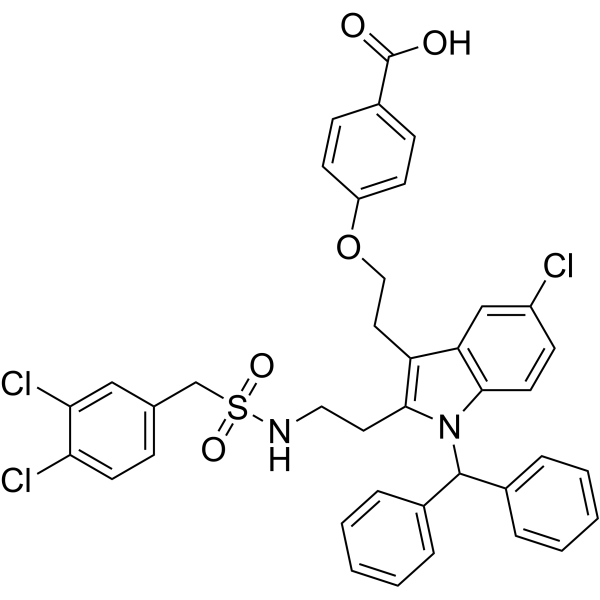
Physicochemical Properties
| Molecular Formula | C39H33N2O5SCL3 |
| Molecular Weight | 748.11372 |
| Exact Mass | 746.118 |
| CAS # | 381683-92-7 |
| PubChem CID | 204106 |
| Appearance | White to off-white solid powder |
| Density | 1.35g/cm3 |
| Boiling Point | 912.3ºC at 760 mmHg |
| Flash Point | 505.5ºC |
| Index of Refraction | 1.646 |
| LogP | 10.692 |
| Hydrogen Bond Donor Count | 2 |
| Hydrogen Bond Acceptor Count | 6 |
| Rotatable Bond Count | 14 |
| Heavy Atom Count | 50 |
| Complexity | 1150 |
| Defined Atom Stereocenter Count | 0 |
| InChi Key | FMMCHWHNSUBYAV-UHFFFAOYSA-N |
| InChi Code | InChI=1S/C39H33Cl3N2O5S/c40-30-14-18-36-33(24-30)32(20-22-49-31-15-12-29(13-16-31)39(45)46)37(19-21-43-50(47,48)25-26-11-17-34(41)35(42)23-26)44(36)38(27-7-3-1-4-8-27)28-9-5-2-6-10-28/h1-18,23-24,38,43H,19-22,25H2,(H,45,46) |
| Chemical Name | 4-[2-[1-benzhydryl-5-chloro-2-[2-[(3,4-dichlorophenyl)methylsulfonylamino]ethyl]indol-3-yl]ethoxy]benzoic acid |
| HS Tariff Code | 2934.99.9001 |
| Storage |
Powder-20°C 3 years 4°C 2 years In solvent -80°C 6 months -20°C 1 month |
| Shipping Condition | Room temperature (This product is stable at ambient temperature for a few days during ordinary shipping and time spent in Customs) |
Biological Activity
| Targets |
- The target of Ecopladib is cytosolic phospholipase A2alpha (cPLA2α), with an IC50 value of 0.8 nM against human recombinant cPLA2α [1] |
| ln Vitro |
In the PAPE liposome experiment, Ecopladib reduced cPLA2α by 73% at 37 nM and inhibited sPLA2 by 16% at 1 μM. Ecopladib suppresses the generation of prostaglandins (PGF2α) and leukotrienes (LTB4 and LTC4/D4/E4) with an IC50 of 20−30 nM. Ecopladib is inactive against COX-1 and COX-2 at 20 μM and is over 100-fold the IC50 in MC-9 cells. Ecopladib inhibits 12- and 15-HETE, which are generated from arachidonic acid via the 12- and 15-lipoxygenase pathways, with an IC50 of around 0.3 μM [1]. - In enzyme activity assays, Ecopladib inhibited cPLA2α-mediated arachidonic acid (AA) release with high selectivity, showing no significant inhibition on other phospholipases (e.g., sPLA2, iPLA2) at concentrations up to 10 μM [1] - In human neutrophils and THP-1 monocytic cells stimulated with N-formylmethionyl-leucyl-phenylalanine (fMLP) or calcium ionophore A23187, Ecopladib (1–100 nM) dose-dependently reduced AA release and the subsequent production of prostaglandin E2 (PGE2) and leukotriene B4 (LTB4) [1] |
| ln Vivo |
In this model, ecopladib showed an ED50 of 8 mg/kg when taken orally, suggesting that it prevents the in vivo production of PGE2 produced from COX-2. Ecopladib administered orally effectively reduces paw edema caused by carrageenan; an ED50 of 40 mg/kg was found [1] based on a dose-response trial. - In a carrageenan-induced rat paw edema model, oral administration of Ecopladib (3, 10, 30 mg/kg) dose-dependently inhibited paw swelling, with an ED50 value of 8.2 mg/kg; the inhibitory effect lasted for more than 6 hours at the 30 mg/kg dose [1] - In a lipopolysaccharide (LPS)-induced mouse endotoxemia model, Ecopladib (10 mg/kg, ip) significantly reduced serum levels of PGE2 and tumor necrosis factor-alpha (TNF-α) by 65% and 42%, respectively, compared with the vehicle control group [1] |
| Enzyme Assay |
- For the cPLA2α activity assay: Phosphatidylcholine (PC) vesicles containing [1-14C]arachidonic acid were prepared as substrates. The reaction system (total volume 100 μL) contained 50 mM Tris-HCl buffer (pH 7.5), 10 mM CaCl2, 100 μM PC vesicles, 0.5 μg human recombinant cPLA2α, and different concentrations of Ecopladib. The reaction was initiated by adding the enzyme, incubated at 37°C for 30 minutes, and terminated by adding 200 μL of chloroform/methanol (2:1, v/v). The organic phase was separated by centrifugation, and the radioactivity of [1-14C]arachidonic acid in the organic phase was measured using a liquid scintillation counter to calculate the enzyme inhibition rate [1] |
| Cell Assay |
- For human neutrophil AA release assay: Neutrophils were isolated from human peripheral blood by density gradient centrifugation and resuspended in Hank's balanced salt solution (HBSS) containing 10 mM HEPES. Cells were preincubated with Ecopladib (0.1–100 nM) for 15 minutes, then stimulated with 1 μM fMLP or 1 μM A23187 for 30 minutes. [3H]arachidonic acid was added to the cell suspension 1 hour before stimulation to label cellular lipids. After stimulation, the reaction was terminated by adding ice-cold HBSS, and the supernatant was collected by centrifugation. The radioactivity of [3H]arachidonic acid in the supernatant was measured to determine the release rate [1] - For THP-1 cell PGE2 detection: THP-1 cells were cultured in RPMI 1640 medium supplemented with 10% fetal bovine serum. Cells were seeded in 24-well plates (1×10⁶ cells/well) and differentiated into macrophages with 100 nM phorbol 12-myristate 13-acetate (PMA) for 48 hours. Differentiated cells were treated with Ecopladib (0.1–100 nM) for 15 minutes, then stimulated with 1 μg/mL LPS for 24 hours. The supernatant was collected, and PGE2 levels were measured using a competitive enzyme-linked immunosorbent assay (ELISA) kit [1] |
| Animal Protocol |
- For carrageenan-induced rat paw edema model: Male Sprague-Dawley rats (200–250 g) were randomly divided into 5 groups (n=6/group). Ecopladib was dissolved in 0.5% methylcellulose to prepare oral suspensions at concentrations of 3, 10, and 30 mg/mL. Rats in the treatment groups received oral gavage of Ecopladib at doses of 3, 10, or 30 mg/kg, while the vehicle control group received 0.5% methylcellulose. One hour after administration, 0.1 mL of 1% carrageenan solution was injected subcutaneously into the right hind paw of each rat. The paw volume was measured using a plethysmometer before carrageenan injection and at 1, 2, 4, 6, and 8 hours after injection. The degree of paw edema was calculated as the difference between the right and left paw volumes [1] - For LPS-induced mouse endotoxemia model: Male C57BL/6 mice (20–22 g) were divided into 3 groups (n=8/group). Ecopladib was dissolved in dimethyl sulfoxide (DMSO) and diluted with saline (final DMSO concentration ≤5%) to a concentration of 2 mg/mL. Mice in the treatment group received intraperitoneal (ip) injection of Ecopladib at 10 mg/kg, the vehicle control group received ip injection of the same volume of DMSO/saline, and the normal control group received no treatment. Thirty minutes after injection, all mice except the normal control group were injected ip with 10 mg/kg LPS. Six hours after LPS injection, mice were anesthetized, and blood was collected by orbital venous plexus puncture. Serum was separated by centrifugation, and PGE2 and TNF-α levels were detected by ELISA [1] |
| ADME/Pharmacokinetics |
- In rats: After oral administration of Ecopladib at 10 mg/kg, the maximum plasma concentration (Cmax) was 850 ng/mL, the time to reach Cmax (Tmax) was 1.2 hours, the area under the plasma concentration-time curve (AUC0–24h) was 3200 ng·h/mL, and the oral bioavailability was approximately 35%. The elimination half-life (t1/2) was 2.5 hours, and the apparent volume of distribution (Vd) was 0.4 L/kg [1] - In dogs: Intravenous administration of Ecopladib at 2 mg/kg showed a t1/2 of 3.1 hours and a clearance (CL) of 15 mL/min/kg. Oral administration at 5 mg/kg resulted in a Cmax of 620 ng/mL, Tmax of 1.5 hours, and oral bioavailability of ~42% [1] - Metabolism: Ecopladib was mainly metabolized in the liver via cytochrome P450 enzymes (CYP3A4 and CYP2D6), producing two major metabolites (M1 and M2) which were excreted primarily in feces (accounting for ~70% of the administered dose) within 72 hours [1] |
| Toxicity/Toxicokinetics |
- Acute toxicity: In mice and rats, oral administration of Ecopladib at doses up to 2000 mg/kg did not cause any mortality or obvious toxic symptoms (e.g., weight loss, abnormal behavior) within 14 days [1] - Subacute toxicity: In rats treated with oral Ecopladib (10, 50, 100 mg/kg/day) for 14 days, no significant changes were observed in body weight, food intake, or serum biochemical parameters (ALT, AST, BUN, creatinine) compared with the control group. Histopathological examination of the liver, kidney, and spleen also showed no abnormal lesions [1] - Plasma protein binding: Ecopladib had high plasma protein binding in human, rat, and dog plasma, with binding rates of >99%, 98.5%, and 99.2%, respectively [1] |
| References |
[1]. Discovery of Ecopladib, an indole inhibitor of cytosolic phospholipase A2alpha. J Med Chem. 2007 Mar 22;50(6):1380-400. Epub 2007 Feb 17. |
| Additional Infomation |
Ecopladib is an indole inhibitor of cytosolic phospholipase A2alpha (cPLA2alpha, type IVA phospholipase) with antiinflammatory activity. - Ecopladib is an indole-derived selective inhibitor of cPLA2α, designed for the treatment of inflammatory diseases (e.g., rheumatoid arthritis, asthma) by blocking the release of arachidonic acid and the synthesis of proinflammatory lipid mediators [1] - The structure-activity relationship (SAR) study of Ecopladib showed that the indole core and the 4-(4-fluorophenyl)piperazine side chain are critical for its high affinity and selectivity for cPLA2α [1] |
Solubility Data
| Solubility (In Vitro) | May dissolve in DMSO (in most cases), if not, try other solvents such as H2O, Ethanol, or DMF with a minute amount of products to avoid loss of samples |
| Solubility (In Vivo) |
Note: Listed below are some common formulations that may be used to formulate products with low water solubility (e.g. < 1 mg/mL), you may test these formulations using a minute amount of products to avoid loss of samples. Injection Formulations (e.g. IP/IV/IM/SC) Injection Formulation 1: DMSO : Tween 80: Saline = 10 : 5 : 85 (i.e. 100 μL DMSO stock solution → 50 μL Tween 80 → 850 μL Saline) *Preparation of saline: Dissolve 0.9 g of sodium chloride in 100 mL ddH ₂ O to obtain a clear solution. Injection Formulation 2: DMSO : PEG300 :Tween 80 : Saline = 10 : 40 : 5 : 45 (i.e. 100 μL DMSO → 400 μLPEG300 → 50 μL Tween 80 → 450 μL Saline) Injection Formulation 3: DMSO : Corn oil = 10 : 90 (i.e. 100 μL DMSO → 900 μL Corn oil) Example: Take the Injection Formulation 3 (DMSO : Corn oil = 10 : 90) as an example, if 1 mL of 2.5 mg/mL working solution is to be prepared, you can take 100 μL 25 mg/mL DMSO stock solution and add to 900 μL corn oil, mix well to obtain a clear or suspension solution (2.5 mg/mL, ready for use in animals). Injection Formulation 4: DMSO : 20% SBE-β-CD in saline = 10 : 90 [i.e. 100 μL DMSO → 900 μL (20% SBE-β-CD in saline)] *Preparation of 20% SBE-β-CD in Saline (4°C,1 week): Dissolve 2 g SBE-β-CD in 10 mL saline to obtain a clear solution. Injection Formulation 5: 2-Hydroxypropyl-β-cyclodextrin : Saline = 50 : 50 (i.e. 500 μL 2-Hydroxypropyl-β-cyclodextrin → 500 μL Saline) Injection Formulation 6: DMSO : PEG300 : castor oil : Saline = 5 : 10 : 20 : 65 (i.e. 50 μL DMSO → 100 μLPEG300 → 200 μL castor oil → 650 μL Saline) Injection Formulation 7: Ethanol : Cremophor : Saline = 10: 10 : 80 (i.e. 100 μL Ethanol → 100 μL Cremophor → 800 μL Saline) Injection Formulation 8: Dissolve in Cremophor/Ethanol (50 : 50), then diluted by Saline Injection Formulation 9: EtOH : Corn oil = 10 : 90 (i.e. 100 μL EtOH → 900 μL Corn oil) Injection Formulation 10: EtOH : PEG300:Tween 80 : Saline = 10 : 40 : 5 : 45 (i.e. 100 μL EtOH → 400 μLPEG300 → 50 μL Tween 80 → 450 μL Saline) Oral Formulations Oral Formulation 1: Suspend in 0.5% CMC Na (carboxymethylcellulose sodium) Oral Formulation 2: Suspend in 0.5% Carboxymethyl cellulose Example: Take the Oral Formulation 1 (Suspend in 0.5% CMC Na) as an example, if 100 mL of 2.5 mg/mL working solution is to be prepared, you can first prepare 0.5% CMC Na solution by measuring 0.5 g CMC Na and dissolve it in 100 mL ddH2O to obtain a clear solution; then add 250 mg of the product to 100 mL 0.5% CMC Na solution, to make the suspension solution (2.5 mg/mL, ready for use in animals). Oral Formulation 3: Dissolved in PEG400 Oral Formulation 4: Suspend in 0.2% Carboxymethyl cellulose Oral Formulation 5: Dissolve in 0.25% Tween 80 and 0.5% Carboxymethyl cellulose Oral Formulation 6: Mixing with food powders Note: Please be aware that the above formulations are for reference only. InvivoChem strongly recommends customers to read literature methods/protocols carefully before determining which formulation you should use for in vivo studies, as different compounds have different solubility properties and have to be formulated differently. (Please use freshly prepared in vivo formulations for optimal results.) |
| Preparing Stock Solutions | 1 mg | 5 mg | 10 mg | |
| 1 mM | 1.3367 mL | 6.6835 mL | 13.3670 mL | |
| 5 mM | 0.2673 mL | 1.3367 mL | 2.6734 mL | |
| 10 mM | 0.1337 mL | 0.6684 mL | 1.3367 mL |