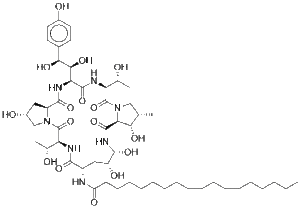
Echinocandin B is a novel and potent cyclic hexapeptide echinocandin antibiotic originally isolated from Aspergillus nidulans var. echinulatus with specific anti-yeast activity. It inhibits beta-1,3-glucan synthesis and thus attacks the cell wall of fungi. Echinocandin B is an inhibitor of 1,3-β glucan synthase, and it inhibits incorporation of radiolabeled glucose into alkali-insoluble glucan by S. cerevisiae spheroplasts in a dose-dependent manner. It inhibits growth of C. albicans in vitro with an MIC value of 3.9 µg/ml after 2 days.
Physicochemical Properties
| Molecular Formula | C52H81N7O16 |
| Molecular Weight | 1060.2 |
| Exact Mass | 1059.57 |
| CAS # | 54651-05-7 |
| PubChem CID | 9898144 |
| Appearance | Typically exists as solid at room temperature |
| LogP | 0.251 |
| Hydrogen Bond Donor Count | 14 |
| Hydrogen Bond Acceptor Count | 16 |
| Rotatable Bond Count | 20 |
| Heavy Atom Count | 75 |
| Complexity | 1940 |
| Defined Atom Stereocenter Count | 15 |
| SMILES | OC1C2C(NC(C(CC(C(NC(C(C)O)C(N3CC(CC3C(NC(C(C(C3C=CC(=CC=3)O)O)O)C(NC(C(C)O)C(N2CC1C)=O)=O)=O)O)=O)=O)NC(CCCCCCCC=CCC=CCCCCC)=O)O)O)=O |
| InChi Key | FAUOJMHVEYMQQG-HVYQDZECSA-N |
| InChi Code | 1S/C52H81N7O16/c1-5-6-7-8-9-10-11-12-13-14-15-16-17-18-19-20-38(65)53-35-26-37(64)48(71)57-50(73)42-43(66)29(2)27-59(42)52(75)40(31(4)61)55-49(72)41(45(68)44(67)32-21-23-33(62)24-22-32)56-47(70)36-25-34(63)28-58(36)51(74)39(30(3)60)54-46(35)69/h9-10,12-13,21-24,29-31,34-37,39-45,48,60-64,66-68,71H,5-8,11,14-20,25-28H2,1-4H3,(H,53,65)(H,54,69)(H,55,72)(H,56,70)(H,57,73)/b10-9-,13-12-/t29-,30+,31+,34+,35-,36-,37+,39-,40-,41-,42-,43-,44-,45-,48+/m0/s1 |
| Chemical Name | (9Z,12Z)-N-((2R,6S,9S,11R,12R,14aS,15S,16S,20S,23S,25aS)-23-((1S,2S)-1,2-dihydroxy-2-(4-hydroxyphenyl)ethyl)-2,11,12,15-tetrahydroxy-6,20-bis((R)-1-hydroxyethyl)-16-methyl-5,8,14,19,22,25-hexaoxotetracosahydro-1H-dipyrrolo[2,1-c:2',1'-l][1,4,7,10,13,16]hexaazacyclohenicosin-9-yl)octadeca-9,12-dienamide |
| Synonyms | A30912A; A 30912A; A-30912A; A22082; A 22082; A-22082; Echinocandin B; NSC 287461; |
| HS Tariff Code | 2934.99.9001 |
| Storage |
Powder-20°C 3 years 4°C 2 years In solvent -80°C 6 months -20°C 1 month |
| Shipping Condition | Room temperature (This product is stable at ambient temperature for a few days during ordinary shipping and time spent in Customs) |
Biological Activity
| ln Vitro | Echinocandin B belongs to lipopeptide antifungal antibiotic bearing five types of direct precursor amino acids including proline, ornithine, tyrosine, threonine, and leucine. The objective of this study is to screen over-producing mutant in order to improve echinocandin B production; a stable mutant Aspergillus nidulans ZJB12073, which can use fructose as optimal carbon source instead of expensive mannitol, was selected from thousand isolates after several cycles of UV and microwave irradiation in turn. The results showed that mutant strain ZJB12073 exhibited 1.9-fold improvement in echinocandin B production to 1656.3 ± 40.3 mg/L when compared with the parent strain. Furthermore, the effects of precursor amino acids and some chemicals on echinocandin B biosynthesis in A. nidulans were investigated, respectively. Tyrosine, leucine, and biotin were selected as key factors to optimize the medium employing uniform design method. The results showed that the optimized fermentation medium provided another 63.1 % increase to 2701.6 ± 31.7 mg/L in final echinocandin B concentration compared to that of unoptimized medium.[2] |
| References |
[1]. J. Antibiot. (Tokyo)48(4),306-310(1995). [2]. Enhancement of Echinocandin B Production by a UV- and Microwave-Induced Mutant of Aspergillus nidulans with Precursor- and Biotin-Supplying Strategy. Appl Biochem Biotechnol. 2016 Aug;179(7):1213-26. |
| Additional Infomation |
Echinocandin B is a cyclic hexapeptide echinocandin antibiotic isolated from Aspergillus nidulans var. echinulatus with specific anti-yeast activity. It has a role as an antiinfective agent. Echinocandin B has been reported in Streptomyces, Aspergillus spinulosporus, and Aspergillus nidulans with data available. |
Solubility Data
| Solubility (In Vitro) | May dissolve in DMSO (in most cases), if not, try other solvents such as H2O, Ethanol, or DMF with a minute amount of products to avoid loss of samples |
| Solubility (In Vivo) |
Note: Listed below are some common formulations that may be used to formulate products with low water solubility (e.g. < 1 mg/mL), you may test these formulations using a minute amount of products to avoid loss of samples. Injection Formulations (e.g. IP/IV/IM/SC) Injection Formulation 1: DMSO : Tween 80: Saline = 10 : 5 : 85 (i.e. 100 μL DMSO stock solution → 50 μL Tween 80 → 850 μL Saline) *Preparation of saline: Dissolve 0.9 g of sodium chloride in 100 mL ddH ₂ O to obtain a clear solution. Injection Formulation 2: DMSO : PEG300 :Tween 80 : Saline = 10 : 40 : 5 : 45 (i.e. 100 μL DMSO → 400 μLPEG300 → 50 μL Tween 80 → 450 μL Saline) Injection Formulation 3: DMSO : Corn oil = 10 : 90 (i.e. 100 μL DMSO → 900 μL Corn oil) Example: Take the Injection Formulation 3 (DMSO : Corn oil = 10 : 90) as an example, if 1 mL of 2.5 mg/mL working solution is to be prepared, you can take 100 μL 25 mg/mL DMSO stock solution and add to 900 μL corn oil, mix well to obtain a clear or suspension solution (2.5 mg/mL, ready for use in animals). Injection Formulation 4: DMSO : 20% SBE-β-CD in saline = 10 : 90 [i.e. 100 μL DMSO → 900 μL (20% SBE-β-CD in saline)] *Preparation of 20% SBE-β-CD in Saline (4°C,1 week): Dissolve 2 g SBE-β-CD in 10 mL saline to obtain a clear solution. Injection Formulation 5: 2-Hydroxypropyl-β-cyclodextrin : Saline = 50 : 50 (i.e. 500 μL 2-Hydroxypropyl-β-cyclodextrin → 500 μL Saline) Injection Formulation 6: DMSO : PEG300 : castor oil : Saline = 5 : 10 : 20 : 65 (i.e. 50 μL DMSO → 100 μLPEG300 → 200 μL castor oil → 650 μL Saline) Injection Formulation 7: Ethanol : Cremophor : Saline = 10: 10 : 80 (i.e. 100 μL Ethanol → 100 μL Cremophor → 800 μL Saline) Injection Formulation 8: Dissolve in Cremophor/Ethanol (50 : 50), then diluted by Saline Injection Formulation 9: EtOH : Corn oil = 10 : 90 (i.e. 100 μL EtOH → 900 μL Corn oil) Injection Formulation 10: EtOH : PEG300:Tween 80 : Saline = 10 : 40 : 5 : 45 (i.e. 100 μL EtOH → 400 μLPEG300 → 50 μL Tween 80 → 450 μL Saline) Oral Formulations Oral Formulation 1: Suspend in 0.5% CMC Na (carboxymethylcellulose sodium) Oral Formulation 2: Suspend in 0.5% Carboxymethyl cellulose Example: Take the Oral Formulation 1 (Suspend in 0.5% CMC Na) as an example, if 100 mL of 2.5 mg/mL working solution is to be prepared, you can first prepare 0.5% CMC Na solution by measuring 0.5 g CMC Na and dissolve it in 100 mL ddH2O to obtain a clear solution; then add 250 mg of the product to 100 mL 0.5% CMC Na solution, to make the suspension solution (2.5 mg/mL, ready for use in animals). Oral Formulation 3: Dissolved in PEG400 Oral Formulation 4: Suspend in 0.2% Carboxymethyl cellulose Oral Formulation 5: Dissolve in 0.25% Tween 80 and 0.5% Carboxymethyl cellulose Oral Formulation 6: Mixing with food powders Note: Please be aware that the above formulations are for reference only. InvivoChem strongly recommends customers to read literature methods/protocols carefully before determining which formulation you should use for in vivo studies, as different compounds have different solubility properties and have to be formulated differently. (Please use freshly prepared in vivo formulations for optimal results.) |
| Preparing Stock Solutions | 1 mg | 5 mg | 10 mg | |
| 1 mM | 0.9432 mL | 4.7161 mL | 9.4322 mL | |
| 5 mM | 0.1886 mL | 0.9432 mL | 1.8864 mL | |
| 10 mM | 0.0943 mL | 0.4716 mL | 0.9432 mL |