|
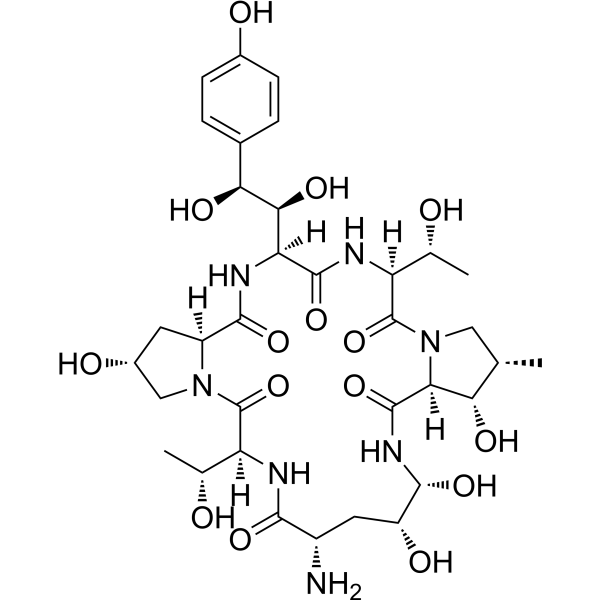
Echinocandin B nucleus (A-30912 A nucleus) is the product of the decarboxylase-catalyzed reaction from Echinocandin B. It serves as an intermediate for semi-synthetic antifungal agents.
|
Physicochemical Properties
| Molecular Formula |
C34H51N7O15
|
| Molecular Weight |
797.81
|
| Exact Mass |
797.344
|
| CAS # |
79411-15-7
|
| PubChem CID |
12760595
|
| Appearance |
Typically exists as solid at room temperature
|
| Density |
1.6±0.1 g/cm3
|
| Boiling Point |
1330.8±65.0 °C at 760 mmHg
|
| Flash Point |
758.6±34.3 °C
|
| Vapour Pressure |
0.0±0.3 mmHg at 25°C
|
| Index of Refraction |
1.690
|
| LogP |
-10.63
|
| Hydrogen Bond Donor Count |
14
|
| Hydrogen Bond Acceptor Count |
16
|
| Rotatable Bond Count |
5
|
| Heavy Atom Count |
56
|
| Complexity |
1450
|
| Defined Atom Stereocenter Count |
0
|
| InChi Key |
BLKJKIJFNJAQIZ-UHFFFAOYSA-N
|
| InChi Code |
InChI=1S/C34H51N7O15/c1-12-10-41-24(25(12)47)32(54)39-30(52)20(46)9-18(35)28(50)36-21(13(2)42)33(55)40-11-17(45)8-19(40)29(51)38-23(31(53)37-22(14(3)43)34(41)56)27(49)26(48)15-4-6-16(44)7-5-15/h4-7,12-14,17-27,30,42-49,52H,8-11,35H2,1-3H3,(H,36,50)(H,37,53)(H,38,51)(H,39,54)
|
| Chemical Name |
18-amino-6-[1,2-dihydroxy-2-(4-hydroxyphenyl)ethyl]-11,20,21,25-tetrahydroxy-3,15-bis(1-hydroxyethyl)-26-methyl-1,4,7,13,16,22-hexazatricyclo[22.3.0.09,13]heptacosane-2,5,8,14,17,23-hexone
|
| HS Tariff Code |
2934.99.9001
|
|
Biological Activity
|
Solubility Data
| Preparing Stock Solutions |
|
1 mg |
5 mg |
10 mg |
| 1 mM |
1.2534 mL |
6.2672 mL |
12.5343 mL |
| 5 mM |
0.2507 mL |
1.2534 mL |
2.5069 mL |
| 10 mM |
0.1253 mL |
0.6267 mL |
1.2534 mL |
*Note: Please select an appropriate solvent for the preparation of stock solution based on your experiment needs. For most products, DMSO can be used for preparing stock solutions (e.g. 5 mM, 10 mM, or 20 mM concentration); some products with high aqueous solubility may be dissolved in water directly. Solubility information is available at the above Solubility Data section. Once the stock solution is prepared, aliquot it to routine usage volumes and store at -20°C or -80°C. Avoid repeated freeze and thaw cycles. |