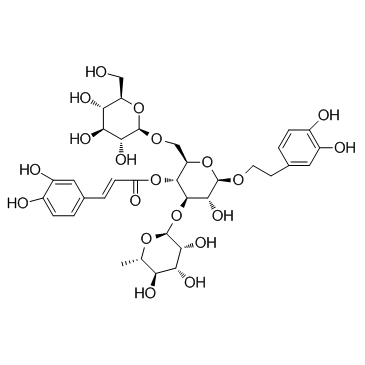
Echinacoside is a naturally occurring polyphenolic compound and a caffeic acid glycoside with various biological activities including antibiotic, antioxidative, neuroprotective, anti-inflammatory, hepatoprotective, nitric oxide radical-scavenging and vasodilative effects.
Physicochemical Properties
| Molecular Formula | C35H46O20 |
| Molecular Weight | 786.73 |
| Exact Mass | 786.258 |
| CAS # | 82854-37-3 |
| PubChem CID | 5281771 |
| Appearance | Off-white to yellow solid powder |
| Density | 1.7±0.1 g/cm3 |
| Boiling Point | 1062.7±65.0 °C at 760 mmHg |
| Flash Point | 327.9±27.8 °C |
| Vapour Pressure | 0.0±0.3 mmHg at 25°C |
| Index of Refraction | 1.698 |
| LogP | 0.14 |
| Hydrogen Bond Donor Count | 12 |
| Hydrogen Bond Acceptor Count | 20 |
| Rotatable Bond Count | 14 |
| Heavy Atom Count | 55 |
| Complexity | 1230 |
| Defined Atom Stereocenter Count | 15 |
| SMILES | C[C@H]1[C@@H]([C@H]([C@H]([C@@H](O1)O[C@@H]2[C@H]([C@@H](O[C@@H]([C@H]2OC(=O)/C=C/C3=CC(=C(C=C3)O)O)CO[C@H]4[C@@H]([C@H]([C@@H]([C@H](O4)CO)O)O)O)OCCC5=CC(=C(C=C5)O)O)O)O)O)O |
| InChi Key | FSBUXLDOLNLABB-ISAKITKMSA-N |
| InChi Code | InChI=1S/C35H46O20/c1-14-24(42)26(44)29(47)35(51-14)55-32-30(48)34(49-9-8-16-3-6-18(38)20(40)11-16)53-22(13-50-33-28(46)27(45)25(43)21(12-36)52-33)31(32)54-23(41)7-4-15-2-5-17(37)19(39)10-15/h2-7,10-11,14,21-22,24-40,42-48H,8-9,12-13H2,1H3/b7-4+/t14-,21+,22+,24-,25+,26+,27-,28+,29+,30+,31+,32+,33+,34+,35-/m0/s1 |
| Chemical Name | [(2R,3R,4R,5R,6R)-6-[2-(3,4-dihydroxyphenyl)ethoxy]-5-hydroxy-2-[[(2R,3R,4S,5S,6R)-3,4,5-trihydroxy-6-(hydroxymethyl)oxan-2-yl]oxymethyl]-4-[(2S,3R,4R,5R,6S)-3,4,5-trihydroxy-6-methyloxan-2-yl]oxyoxan-3-yl] (E)-3-(3,4-dihydroxyphenyl)prop-2-enoate |
| HS Tariff Code | 2934.99.9001 |
| Storage |
Powder-20°C 3 years 4°C 2 years In solvent -80°C 6 months -20°C 1 month |
| Shipping Condition | Room temperature (This product is stable at ambient temperature for a few days during ordinary shipping and time spent in Customs) |
Biological Activity
| ln Vivo | When taken daily for 12 weeks, the Echinacea series (30-270 mg/kg body weight; face) dramatically reverses weight gain, serum supplemental proline (HOP) levels, wet skin weight, and bone mineral density (BMD) in women who have been castrated (OVX). |
| Animal Protocol |
Animal/Disease Models: 56 6-month-old female SD (SD (Sprague-Dawley)) rats (OVX rat model) [3] Doses: 30, 90, 270 mg/kg body weight Route of Administration: po; ) Ratio [3]. one time/day for 12 weeks Experimental Results: Increases in body weight, serum hydroxyproline (HOP) levels, and decreases in uterine wet weight and bone density were Dramatically reversed. |
| ADME/Pharmacokinetics |
Absorption, Distribution and Excretion Animal studies suggest an oral bioavailability of 0.83%. Metabolism / Metabolites The metabolism of echinacoside has been investigated in rats and is thought to involve catechol O-methyltransferase as well as unspecified UDP-gluc- uronosyltransferases and sulfotransferases. A study of echinacoside's metabolism by human intestinal flora identified 13 metabolites which are produced independantly of human metabolism. |
| References |
[1]. Echinacoside ameliorates D-galactosamine plus lipopolysaccharide-induced acute liver injury in mice via inhibition of apoptosis and inflammation. Scand J Gastroenterol. 2014 Aug;49(8):993-1000. [2]. Echinacoside inhibits breast cancer cells by suppressing the Wnt/β-catenin signaling pathway. Biochem Biophys Res Commun. 2020 Mar 19. pii: S0006-291X(20)30530-1. [3]. Antiosteoporotic activity of echinacoside in ovariectomized rats. Phytomedicine. 2013 Apr 15;20(6):549-57. [4]. Echinacoside inhibits amyloid fibrillization of HEWL and protects against Aβ-induced neurotoxicity. Int J Biol Macromol. 2014 Sep 2;72C:243-253. [5]. Transient exposure to echinacoside is sufficient to activate Trk signaling and protect neuronal cells from rotenone. J Neurochem. 2013 Feb;124(4):571-80. [6]. Echinacoside promotes bone regeneration by increasing OPG/RANKL ratio in MC3T3-E1 cells. Fitoterapia. 2012 Dec;83(8):1443-50. |
| Additional Infomation |
Echinacoside is an oligosaccharide. Echinacoside is a phenylethanoid glycoside isolated from Echinacea angustifolia in 1950, and currently being investigated for the treatment of Parkinson's, Alzheimer's, atherosclerosis, osteoporosis, acute colitis, wound treatment, and hepatitis. Echinacoside has demonstrated inhibition of apoptosis in neural cell lines, demonstrating potential for use in the treatment of neurological conditions. Echinacoside has been reported in Jasminum mesnyi, Echinacea angustifolia, and other organisms with data available. Mechanism of Action The neuroprotective effects are thought to be mediated via effects on mitogen-activated protein kinase, nuclear factor kappa-B, caspases 3 and 8, as well as CHOP pathways. |
Solubility Data
| Solubility (In Vitro) |
DMSO : ~50 mg/mL (~63.55 mM) H2O : ~35.71 mg/mL (~45.39 mM) |
| Solubility (In Vivo) |
Solubility in Formulation 1: ≥ 2.5 mg/mL (3.18 mM) (saturation unknown) in 10% DMSO + 40% PEG300 + 5% Tween80 + 45% Saline (add these co-solvents sequentially from left to right, and one by one), clear solution. For example, if 1 mL of working solution is to be prepared, you can add 100 μL of 25.0 mg/mL clear DMSO stock solution to 400 μL PEG300 and mix evenly; then add 50 μL Tween-80 to the above solution and mix evenly; then add 450 μL normal saline to adjust the volume to 1 mL. Preparation of saline: Dissolve 0.9 g of sodium chloride in 100 mL ddH₂ O to obtain a clear solution. Solubility in Formulation 2: ≥ 2.5 mg/mL (3.18 mM) (saturation unknown) in 10% DMSO + 90% (20% SBE-β-CD in Saline) (add these co-solvents sequentially from left to right, and one by one), clear solution. For example, if 1 mL of working solution is to be prepared, you can add 100 μL of 25.0 mg/mL clear DMSO stock solution to 900 μL of 20% SBE-β-CD physiological saline solution and mix evenly. Preparation of 20% SBE-β-CD in Saline (4°C,1 week): Dissolve 2 g SBE-β-CD in 10 mL saline to obtain a clear solution. Solubility in Formulation 3: ≥ 2.5 mg/mL (3.18 mM) (saturation unknown) in 10% DMSO + 90% Corn Oil (add these co-solvents sequentially from left to right, and one by one), clear solution. For example, if 1 mL of working solution is to be prepared, you can add 100 μL of 25.0 mg/mL clear DMSO stock solution to 900 μL of corn oil and mix evenly. Solubility in Formulation 4: 100 mg/mL (127.11 mM) in PBS (add these co-solvents sequentially from left to right, and one by one), clear solution; with ultrasonication. (Please use freshly prepared in vivo formulations for optimal results.) |
| Preparing Stock Solutions | 1 mg | 5 mg | 10 mg | |
| 1 mM | 1.2711 mL | 6.3554 mL | 12.7108 mL | |
| 5 mM | 0.2542 mL | 1.2711 mL | 2.5422 mL | |
| 10 mM | 0.1271 mL | 0.6355 mL | 1.2711 mL |