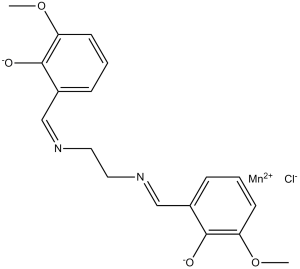
PD: EUK 134 (EUK-134; EUK134), a synthetic and cell permeable superoxide dismutase (SOD)/catalase mimetic, is a novel antioxidant compound that exhibits potent antioxidant activities. It inhibits the formation of β-amyloid and related amyloid fibril. In SK-N-MC cells, EUK134 protects neuronal cells against H2O2 toxicity by attenuating oxidative stress through inhibition of MAPK pathway, and also results in decreased expression of pro-apoptotic genes p53 and Bax as well as enhanced expression of anti-apoptotic Bcl-2 gene. Pretreatment with EUK-134 (10 μM) was effective in the prevention of hypertrophic changes in H9C2 cells, reduction of oxidative stress, and prevention of metabolic shift. EUK-134 treatment improved the oxidative status of mitochondria and reversed hypertrophy-induced reduction of mitochondrial membrane potential. Supplementation with EUK-134 is therefore identified as a novel approach to attenuate cardiac hypertrophy and lends scope for the development of EUK-134 as a therapeutic agent in the management of human cardiovascular disease.
Physicochemical Properties
| Molecular Formula | C18H18CLMNN2O4 | |
| Molecular Weight | 416.74 | |
| Exact Mass | 416.033 | |
| CAS # | 81065-76-1 | |
| Related CAS # |
|
|
| PubChem CID | 9823233 | |
| Appearance | Brown to reddish brown solid powder | |
| LogP | 3.09 | |
| Hydrogen Bond Donor Count | 0 | |
| Hydrogen Bond Acceptor Count | 7 | |
| Rotatable Bond Count | 7 | |
| Heavy Atom Count | 26 | |
| Complexity | 378 | |
| Defined Atom Stereocenter Count | 0 | |
| InChi Key | YUZJJFWCXJDFOQ-UHFFFAOYSA-K | |
| InChi Code | InChI=1S/C18H20N2O4.ClH.Mn/c1-23-15-7-3-5-13(17(15)21)11-19-9-10-20-12-14-6-4-8-16(24-2)18(14)22;;/h3-8,11-12,21-22H,9-10H2,1-2H3;1H;/q;;+3/p-3 | |
| Chemical Name | manganese(3+);2-methoxy-6-[2-[(3-methoxy-2-oxidophenyl)methylideneamino]ethyliminomethyl]phenolate;chloride | |
| Synonyms |
|
|
| HS Tariff Code | 2934.99.9001 | |
| Storage |
Powder-20°C 3 years 4°C 2 years In solvent -80°C 6 months -20°C 1 month Note: This product requires protection from light (avoid light exposure) during transportation and storage. |
|
| Shipping Condition | Room temperature (This product is stable at ambient temperature for a few days during ordinary shipping and time spent in Customs) |
Biological Activity
| Targets |
EUK-134 acts as a synthetic mimetic of superoxide dismutase (SOD) and catalase [1] |
| ln Vitro |
If EUK-134 (10-300 μM) is able to mutate or scavenge superoxide anions, it can limit the generation of hydroxyl radicals, and greatly reduce paraquat (1 mm)-induced cell death [2]. Cell viability is slightly but significantly reduced at high concentrations of EUK-134 (30-300 μM); however, cell death studies at these concentrations do not show this effect [2]. A manganese salt compound having catalase and superoxide dismutase activity is called EUK-134. Consequently, it was determined that supplementing with EUK-134 was a novel way to reduce cardiac hypertrophy and open the door for EUK-134 to be developed as a treatment for cardiovascular illness in humans. With catalase and manganese superoxide dismutase (Mn SOD) activity, EUK-134 is a mitogenic protective antioxidant [3]. In H9C2 cardiomyoblast cells treated with phenylephrine (PE, 10 μM) to induce hypertrophy, EUK-134 (10, 50, 100 μM) dose-dependently inhibited cell enlargement. At 100 μM, it reduced cell surface area by 42% and decreased the expression of hypertrophy markers (ANP, BNP) at both mRNA (by 58% and 63%, respectively) and protein levels (by 51% and 56%, respectively) [3] - In H9C2 cells, EUK-134 (50 μM) stimulated fatty acid oxidation by increasing the activity of carnitine palmitoyltransferase 1 (CPT1) by 47% and upregulating the expression of peroxisome proliferator-activated receptor α (PPARα) mRNA by 68% and protein by 59% [3] - In LLC-PK1 renal tubular epithelial cells exposed to paraquat (PQ, 1 mM) to induce oxidative stress, EUK-134 (10, 25, 50 μM) dose-dependently increased cell viability. At 50 μM, it improved cell viability from 45% (PQ-only group) to 82% and reduced intracellular reactive oxygen species (ROS) levels by 65% [2] |
| ln Vivo |
EUK 134 (2.5 mg/kg), in a middle cerebral artery occlusion model, significantly reduces brain infarct size, and apparently prevents further infarct growth. EUK-134 prevents oxidative stress and attenuates rat brain damage induced by systemic administration of systemic kainic acid (KA). In rats subjected to renal ischemia-reperfusion (I/R) injury (45 minutes of ischemia followed by 24 hours of reperfusion), intravenous administration of EUK-134 (5 mg/kg) 15 minutes before reperfusion significantly improved renal function. It reduced serum creatinine (by 52%) and blood urea nitrogen (BUN) (by 48%) compared to vehicle-treated I/R rats, and attenuated renal tissue necrosis and neutrophil infiltration [1] - In rats with paraquat-induced nephrotoxicity (single intraperitoneal injection of PQ, 20 mg/kg), oral administration of EUK-134 (10 mg/kg/day) for 7 days dose-dependently protected renal function. It decreased serum creatinine (by 49%) and BUN (by 43%), reduced renal malondialdehyde (MDA) levels (by 57%), and increased renal SOD activity (by 62%) and glutathione (GSH) levels (by 54%) compared to PQ-only group [2] |
| Enzyme Assay |
SOD mimetic activity assay: EUK-134 (0.1-100 μM) was incubated with xanthine and xanthine oxidase in assay buffer at 37°C for 30 minutes. The formation of superoxide anion was detected using a chromogenic substrate, and the inhibition rate was calculated to assess SOD-like activity [1] - Catalase mimetic activity assay: Various concentrations of EUK-134 (0.1-100 μM) were mixed with hydrogen peroxide (H₂O₂) in buffer at 25°C. The decomposition of H₂O₂ was monitored by measuring absorbance at 240 nm over 10 minutes, and the reaction rate was used to evaluate catalase-like activity [1] |
| Cell Assay |
Cell Viability Assay[2] Cell Types: NRK-52E cells Tested Concentrations: 0, 1, 3, 10, 30, 100, and 300 μM Incubation Duration: 24 hrs (hours) Experimental Results: Co-incubation with Paraquat (1 mM) and increasing concentrations of EUK-134 (1-300 μM) resulted in a significant reduction in paraquat-induced cellular injury and death at 100 and 300 μM. H9C2 cell hypertrophy assay: H9C2 cells were seeded in 6-well plates at 2×10⁵ cells/well and cultured for 24 hours. Cells were pretreated with EUK-134 (10, 50, 100 μM) for 1 hour, then stimulated with PE (10 μM) for 48 hours. Cell surface area was measured by phase-contrast microscopy. ANP and BNP mRNA levels were detected by RT-PCR, and protein levels were analyzed by Western blot [3] - H9C2 cell fatty acid oxidation assay: H9C2 cells were seeded in 24-well plates and treated with EUK-134 (10, 50, 100 μM) for 24 hours. CPT1 activity was measured using a colorimetric assay kit. PPARα mRNA and protein levels were determined by RT-PCR and Western blot, respectively [3] - LLC-PK1 cell oxidative stress assay: LLC-PK1 cells were plated in 96-well plates at 5×10³ cells/well. After 24 hours, cells were pretreated with EUK-134 (10, 25, 50 μM) for 1 hour, then exposed to PQ (1 mM) for 24 hours. Cell viability was assessed by MTT assay, and intracellular ROS levels were detected using DCFH-DA fluorescent probe [2] |
| Animal Protocol |
Dissolved in 0.9% saline; 2.5 mg/kg; i.v. injection Rat model in stroke. Rats (renal I/R injury model): Male Sprague-Dawley rats (250-300 g) were anesthetized. The left renal artery was clamped for 45 minutes to induce ischemia, followed by reperfusion. EUK-134 was dissolved in saline and administered intravenously at 5 mg/kg 15 minutes before reperfusion. Vehicle-treated rats received saline alone. After 24 hours of reperfusion, blood samples were collected to measure serum creatinine and BUN, and renal tissue was excised for histopathological analysis [1] - Rats (paraquat-induced nephrotoxicity model): Male Wistar rats (200-250 g) were randomly divided into control, PQ, and PQ+EUK-134 groups. Rats in PQ and PQ+EUK-134 groups received a single intraperitoneal injection of PQ (20 mg/kg). EUK-134 was dissolved in 0.5% carboxymethylcellulose sodium and administered orally at 10 mg/kg/day for 7 days, starting 1 hour after PQ injection. Control and PQ groups received vehicle. On day 8, serum and renal tissue were collected to measure renal function parameters, oxidative stress markers (MDA, SOD, GSH) [2] |
| Toxicity/Toxicokinetics |
In the in vivo studies, EUK-134 at the tested doses (5 mg/kg IV, 10 mg/kg/day PO) did not cause overt toxicity in rats. No significant changes in body weight, liver function tests (ALT, AST), or renal function (in non-injured rats) were observed [1][2] - In vitro, EUK-134 (up to 100 μM) did not affect the viability of H9C2 or LLC-PK1 cells in the absence of oxidative stress or hypertrophy stimuli [2][3] |
| References |
[1]. EUK-134, a synthetic superoxide dismutase and catalase mimetic, protects rat kidneys from ischemia-reperfusion-induced damage. Transplantation. 1996 Dec 15;62(11):1664-6. [2]. Comparison of the effects of the superoxide dismutase mimetics EUK-134 and tempol on paraquat-induced nephrotoxicity. Free Radic Biol Med. 2007 Aug 15;43(4):528-34. [3]. Mitoprotective antioxidant EUK-134 stimulates fatty acid oxidation and prevents hypertrophy in H9C2 cells. Mol Cell Biochem. 2016 Sep;420(1-2):185-94. |
| Additional Infomation |
EUK-134 is a synthetic organoselenium compound that mimics the catalytic activities of both SOD and catalase, enabling it to scavenge superoxide anions (O₂⁻) and hydrogen peroxide (H₂O₂) [1] - Its protective mechanism involves reducing oxidative stress, inhibiting lipid peroxidation, and preserving antioxidant defense systems (SOD, GSH) in target tissues [2] - EUK-134 has potential therapeutic applications in oxidative stress-related diseases, including ischemia-reperfusion injury, nephrotoxicity, and cardiac hypertrophy [1][2][3] |
Solubility Data
| Solubility (In Vitro) |
|
|||
| Solubility (In Vivo) |
Note: Listed below are some common formulations that may be used to formulate products with low water solubility (e.g. < 1 mg/mL), you may test these formulations using a minute amount of products to avoid loss of samples. Injection Formulations (e.g. IP/IV/IM/SC) Injection Formulation 1: DMSO : Tween 80: Saline = 10 : 5 : 85 (i.e. 100 μL DMSO stock solution → 50 μL Tween 80 → 850 μL Saline) *Preparation of saline: Dissolve 0.9 g of sodium chloride in 100 mL ddH ₂ O to obtain a clear solution. Injection Formulation 2: DMSO : PEG300 :Tween 80 : Saline = 10 : 40 : 5 : 45 (i.e. 100 μL DMSO → 400 μLPEG300 → 50 μL Tween 80 → 450 μL Saline) Injection Formulation 3: DMSO : Corn oil = 10 : 90 (i.e. 100 μL DMSO → 900 μL Corn oil) Example: Take the Injection Formulation 3 (DMSO : Corn oil = 10 : 90) as an example, if 1 mL of 2.5 mg/mL working solution is to be prepared, you can take 100 μL 25 mg/mL DMSO stock solution and add to 900 μL corn oil, mix well to obtain a clear or suspension solution (2.5 mg/mL, ready for use in animals). Injection Formulation 4: DMSO : 20% SBE-β-CD in saline = 10 : 90 [i.e. 100 μL DMSO → 900 μL (20% SBE-β-CD in saline)] *Preparation of 20% SBE-β-CD in Saline (4°C,1 week): Dissolve 2 g SBE-β-CD in 10 mL saline to obtain a clear solution. Injection Formulation 5: 2-Hydroxypropyl-β-cyclodextrin : Saline = 50 : 50 (i.e. 500 μL 2-Hydroxypropyl-β-cyclodextrin → 500 μL Saline) Injection Formulation 6: DMSO : PEG300 : castor oil : Saline = 5 : 10 : 20 : 65 (i.e. 50 μL DMSO → 100 μLPEG300 → 200 μL castor oil → 650 μL Saline) Injection Formulation 7: Ethanol : Cremophor : Saline = 10: 10 : 80 (i.e. 100 μL Ethanol → 100 μL Cremophor → 800 μL Saline) Injection Formulation 8: Dissolve in Cremophor/Ethanol (50 : 50), then diluted by Saline Injection Formulation 9: EtOH : Corn oil = 10 : 90 (i.e. 100 μL EtOH → 900 μL Corn oil) Injection Formulation 10: EtOH : PEG300:Tween 80 : Saline = 10 : 40 : 5 : 45 (i.e. 100 μL EtOH → 400 μLPEG300 → 50 μL Tween 80 → 450 μL Saline) Oral Formulations Oral Formulation 1: Suspend in 0.5% CMC Na (carboxymethylcellulose sodium) Oral Formulation 2: Suspend in 0.5% Carboxymethyl cellulose Example: Take the Oral Formulation 1 (Suspend in 0.5% CMC Na) as an example, if 100 mL of 2.5 mg/mL working solution is to be prepared, you can first prepare 0.5% CMC Na solution by measuring 0.5 g CMC Na and dissolve it in 100 mL ddH2O to obtain a clear solution; then add 250 mg of the product to 100 mL 0.5% CMC Na solution, to make the suspension solution (2.5 mg/mL, ready for use in animals). Oral Formulation 3: Dissolved in PEG400 Oral Formulation 4: Suspend in 0.2% Carboxymethyl cellulose Oral Formulation 5: Dissolve in 0.25% Tween 80 and 0.5% Carboxymethyl cellulose Oral Formulation 6: Mixing with food powders Note: Please be aware that the above formulations are for reference only. InvivoChem strongly recommends customers to read literature methods/protocols carefully before determining which formulation you should use for in vivo studies, as different compounds have different solubility properties and have to be formulated differently. (Please use freshly prepared in vivo formulations for optimal results.) |
| Preparing Stock Solutions | 1 mg | 5 mg | 10 mg | |
| 1 mM | 2.3996 mL | 11.9979 mL | 23.9958 mL | |
| 5 mM | 0.4799 mL | 2.3996 mL | 4.7992 mL | |
| 10 mM | 0.2400 mL | 1.1998 mL | 2.3996 mL |