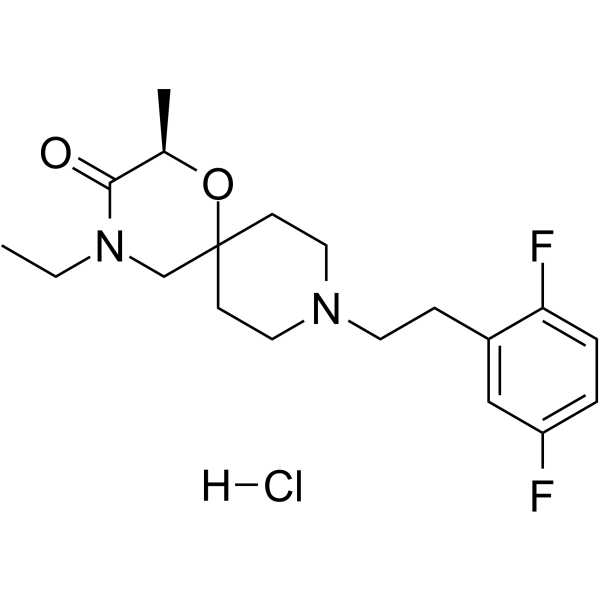
Physicochemical Properties
| Molecular Formula | C19H27CLF2N2O2 |
| Molecular Weight | 388.879691362381 |
| Exact Mass | 388.172 |
| CAS # | 2535970-65-9 |
| Related CAS # | EST73502;1838622-25-5 |
| PubChem CID | 153535293 |
| Appearance | White to off-white solid powder |
| Hydrogen Bond Donor Count | 1 |
| Hydrogen Bond Acceptor Count | 5 |
| Rotatable Bond Count | 4 |
| Heavy Atom Count | 26 |
| Complexity | 468 |
| Defined Atom Stereocenter Count | 1 |
| SMILES | Cl.FC1C=CC(=CC=1CCN1CCC2(CN(CC)C([C@@H](C)O2)=O)CC1)F |
| InChi Key | WZJJIHSIBMZUIN-PFEQFJNWSA-N |
| InChi Code | InChI=1S/C19H26F2N2O2.ClH/c1-3-23-13-19(25-14(2)18(23)24)7-10-22(11-8-19)9-6-15-12-16(20)4-5-17(15)21;/h4-5,12,14H,3,6-11,13H2,1-2H3;1H/t14-;/m1./s1 |
| Chemical Name | (2R)-9-[2-(2,5-difluorophenyl)ethyl]-4-ethyl-2-methyl-1-oxa-4,9-diazaspiro[5.5]undecan-3-one;hydrochloride |
| HS Tariff Code | 2934.99.9001 |
| Storage |
Powder-20°C 3 years 4°C 2 years In solvent -80°C 6 months -20°C 1 month Note: Please store this product in a sealed and protected environment, avoid exposure to moisture. |
| Shipping Condition | Room temperature (This product is stable at ambient temperature for a few days during ordinary shipping and time spent in Customs) |
Biological Activity
| Targets | Ki: 64 nM (MOR), 118 nM (σ1R)[1] |
| ln Vivo | In the paw pressure test, EST73502 monohydrochloride (10–40 mg/kg; po) exhibits a dose-response analgesic effect with a maximum of 64% and an EC50 of 14 mg/kg in CD1 male mice[1]. In male CD1 mice, mechanical allodynia caused by partial sciatic nerve ligation (PSNL) is lessened by EST73502 monohydrochloride (5 mg/kg; ip; twice a day; for 10 days)[1]. |
| Animal Protocol |
Animal/Disease Models: Male CD1 mice, PSNL model[1] Doses: 5 mg /kg Route of Administration: intraperitoneal (ip) injection, twice a day, for 10 days Experimental Results: Attenuated the expression of mechanical allodynia induced by PSNL, reaching a maximal effect of 56%. |
| References |
[1]. Discovery of EST73502, a Dual μ-Opioid Receptor Agonist and σ 1 Receptor Antagonist Clinical Candidate for the Treatment of Pain. J Med Chem. 2020 Oct 16. |
Solubility Data
| Solubility (In Vitro) | DMSO: 50 mg/mL (128.57 mM) |
| Solubility (In Vivo) |
Solubility in Formulation 1: ≥ 2.5 mg/mL (6.43 mM) (saturation unknown) in 10% DMSO + 40% PEG300 + 5% Tween80 + 45% Saline (add these co-solvents sequentially from left to right, and one by one), clear solution. For example, if 1 mL of working solution is to be prepared, you can add 100 μL of 25.0 mg/mL clear DMSO stock solution to 400 μL PEG300 and mix evenly; then add 50 μL Tween-80 to the above solution and mix evenly; then add 450 μL normal saline to adjust the volume to 1 mL. Preparation of saline: Dissolve 0.9 g of sodium chloride in 100 mL ddH₂ O to obtain a clear solution. Solubility in Formulation 2: ≥ 2.5 mg/mL (6.43 mM) (saturation unknown) in 10% DMSO + 90% (20% SBE-β-CD in Saline) (add these co-solvents sequentially from left to right, and one by one), clear solution. For example, if 1 mL of working solution is to be prepared, you can add 100 μL of 25.0 mg/mL clear DMSO stock solution to 900 μL of 20% SBE-β-CD physiological saline solution and mix evenly. Preparation of 20% SBE-β-CD in Saline (4°C,1 week): Dissolve 2 g SBE-β-CD in 10 mL saline to obtain a clear solution. Solubility in Formulation 3: ≥ 2.5 mg/mL (6.43 mM) (saturation unknown) in 10% DMSO + 90% Corn Oil (add these co-solvents sequentially from left to right, and one by one), clear solution. For example, if 1 mL of working solution is to be prepared, you can add 100 μL of 25.0 mg/mL clear DMSO stock solution to 900 μL of corn oil and mix evenly. (Please use freshly prepared in vivo formulations for optimal results.) |
| Preparing Stock Solutions | 1 mg | 5 mg | 10 mg | |
| 1 mM | 2.5715 mL | 12.8574 mL | 25.7149 mL | |
| 5 mM | 0.5143 mL | 2.5715 mL | 5.1430 mL | |
| 10 mM | 0.2571 mL | 1.2857 mL | 2.5715 mL |