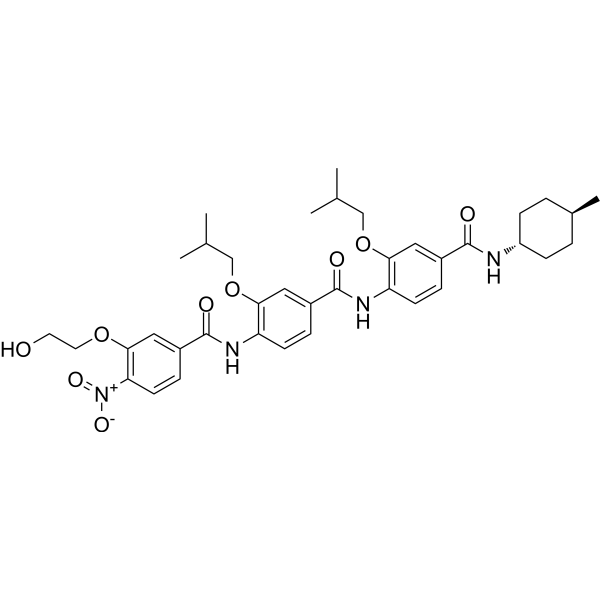
Physicochemical Properties
| Molecular Formula | C38H48N4O9 |
| Molecular Weight | 704.80913066864 |
| Exact Mass | 704.342 |
| CAS # | 2440087-54-5 |
| PubChem CID | 153603617 |
| Appearance | Off-white to light yellow solid powder |
| LogP | 6.7 |
| Hydrogen Bond Donor Count | 4 |
| Hydrogen Bond Acceptor Count | 9 |
| Rotatable Bond Count | 15 |
| Heavy Atom Count | 51 |
| Complexity | 1130 |
| Defined Atom Stereocenter Count | 0 |
| InChi Key | QOYORXKDWMJNHD-UHFFFAOYSA-N |
| InChi Code | InChI=1S/C38H48N4O9/c1-23(2)21-50-33-18-26(36(44)39-29-11-6-25(5)7-12-29)8-13-30(33)40-37(45)27-9-14-31(34(19-27)51-22-24(3)4)41-38(46)28-10-15-32(42(47)48)35(20-28)49-17-16-43/h8-10,13-15,18-20,23-25,29,43H,6-7,11-12,16-17,21-22H2,1-5H3,(H,39,44)(H,40,45)(H,41,46) |
| Chemical Name | 4-[[4-[[3-(2-hydroxyethoxy)-4-nitrobenzoyl]amino]-3-(2-methylpropoxy)benzoyl]amino]-N-(4-methylcyclohexyl)-3-(2-methylpropoxy)benzamide |
| HS Tariff Code | 2934.99.9001 |
| Storage |
Powder-20°C 3 years 4°C 2 years In solvent -80°C 6 months -20°C 1 month Note: (1). This product requires protection from light (avoid light exposure) during transportation and storage.(2). Please store this product in a sealed and protected environment (e.g. under nitrogen), avoid exposure to moisture. |
| Shipping Condition | Room temperature (This product is stable at ambient temperature for a few days during ordinary shipping and time spent in Customs) |
Biological Activity
| Targets | Lysosomal acid lipase A (LIPA)[1] |
| ln Vitro | ERX-41 (1 μM; 0-30 h) causes MDA-MB-231 cells to die, while normal human mammary epithelial cells (HMECs) are not significantly affected [1]. Peripheral endoplasmic reticulum disorder is caused within 2 hours of exposure to ERX-41 (1 μM; 2 h, 4 h) and causes a dramatic expansion of the endoplasmic reticulum within 4 hours [1]. The downstream unfolded protein response (UPR) pathway is induced by ERX-41 (1 μM; 0.5–4 h) through the induction of p-PERK and p-eIF2-α [1]. |
| ln Vivo | ERX-41 (10 mg/kg; oral or intraperitoneal injection; single dose) is seen in tumors 1.5 hours after intraperitoneal or oral administration[1]. In the MDA-MB-231 xenograft mouse model, ERX-41 (10 mg/kg; oral; single dose) effectively reduces tumor development without altering animal body weight[1]. In D2A1 xenograft animal models, ERX-41 (10 mg/kg; oral; single dosage) dramatically slows the course of the disease[1]. |
| Cell Assay |
Cell Viability Assay[1] Cell Types: MDA-MB-231 and HMEC cells Tested Concentrations: 1 μM Incubation Duration: 0, 20 h, 30 h Experimental Results: demonstrated potent antiproliferative activity against TNBC cell within 30 h. Western Blot Analysis[1] Cell Types: SUM-159 cells Tested Concentrations: 1 μM Incubation Duration: 0.5 h, 1 h, 2 h, and 4 h Experimental Results: Increased the protein level of p-PERK, p-eIF2-α and CHOP at 4 h. Cell Cytotoxicity Assay[1] Cell Types: SUM-159 and MDA-MB-436 Tested Concentrations: 0.125, 0.25, 0.50, 1.0, 2.0, and 4.0 μM Incubation Duration: 0h and 30 h Experimental Results: Caused cell death. |
| Animal Protocol |
Animal/Disease Models: Mouse models with D2A1 xenografts and MDA-MB-231 xenografts (sc), respectively[1] Doses: 10 mg/kg Route of Administration: Oral gavage; one time/day for 25 days Experimental Results: decreased tumor growth against MDA-MB-231 xenograft without affecting body weight. And enhanced p-PERK and p-eIF2-α staining within 24 h. Dramatically decreased the growth of D2A1 xenografts in syngeneic mice without affecting body weight. |
| References |
[1]. Targeting LIPA independent of its lipase activity is a therapeutic strategy in solid tumors via induction of endoplasmic reticulum stress. Nat Cancer. 2022 Jul;3(7):866-884. |
Solubility Data
| Solubility (In Vitro) | DMSO: 25 mg/mL (35.47 mM) |
| Solubility (In Vivo) |
Solubility in Formulation 1: ≥ 2.5 mg/mL (3.55 mM) (saturation unknown) in 10% DMSO + 90% Corn Oil (add these co-solvents sequentially from left to right, and one by one), clear solution. For example, if 1 mL of working solution is to be prepared, you can add 100 μL of 25.0 mg/mL clear DMSO stock solution to 900 μL of corn oil and mix evenly. (Please use freshly prepared in vivo formulations for optimal results.) |
| Preparing Stock Solutions | 1 mg | 5 mg | 10 mg | |
| 1 mM | 1.4188 mL | 7.0941 mL | 14.1882 mL | |
| 5 mM | 0.2838 mL | 1.4188 mL | 2.8376 mL | |
| 10 mM | 0.1419 mL | 0.7094 mL | 1.4188 mL |