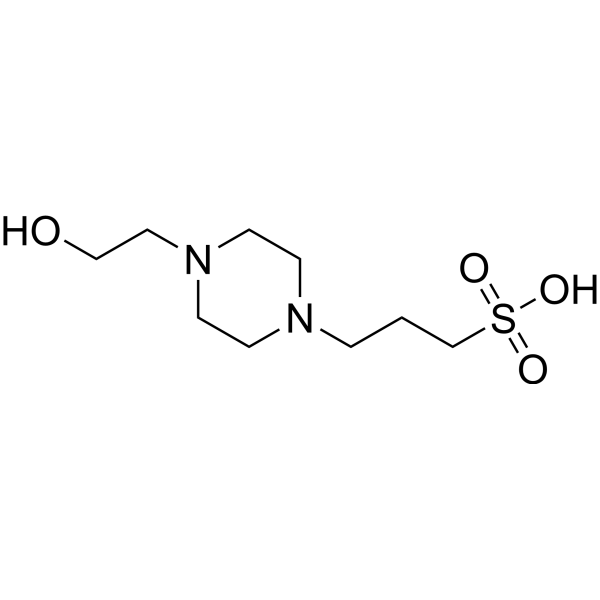
Physicochemical Properties
| Molecular Formula | C9H20N2O4S |
| Molecular Weight | 252.3311 |
| Exact Mass | 252.114 |
| CAS # | 16052-06-5 |
| PubChem CID | 85255 |
| Appearance | White to off-white solid powder |
| Density | 1.3±0.1 g/cm3 |
| Melting Point | 237-239 °C(lit.) |
| Index of Refraction | 1.537 |
| LogP | -2.46 |
| Hydrogen Bond Donor Count | 2 |
| Hydrogen Bond Acceptor Count | 6 |
| Rotatable Bond Count | 6 |
| Heavy Atom Count | 16 |
| Complexity | 280 |
| Defined Atom Stereocenter Count | 0 |
| InChi Key | OWXMKDGYPWMGEB-UHFFFAOYSA-N |
| InChi Code | InChI=1S/C9H20N2O4S/c12-8-7-11-5-3-10(4-6-11)2-1-9-16(13,14)15/h12H,1-9H2,(H,13,14,15) |
| Chemical Name | 3-[4-(2-hydroxyethyl)piperazin-1-yl]propane-1-sulfonic acid |
| HS Tariff Code | 2934.99.9001 |
| Storage |
Powder-20°C 3 years 4°C 2 years In solvent -80°C 6 months -20°C 1 month |
| Shipping Condition | Room temperature (This product is stable at ambient temperature for a few days during ordinary shipping and time spent in Customs) |
Biological Activity
| References |
[1]. EPPS rescues hippocampus-dependent cognitive deficits in APP/PS1 mice by disaggregation of amyloid-β oligomers and plaques. Nat Commun. 2015 Dec 8;6:8997. |
| Additional Infomation | HEPPS is a N-(sulfoalkyl)piperazine and a N-(2-hydroxyethyl)piperazine. |
Solubility Data
| Solubility (In Vitro) | H2O : ~250 mg/mL (~990.77 mM) |
| Solubility (In Vivo) |
Solubility in Formulation 1: 100 mg/mL (396.31 mM) in PBS (add these co-solvents sequentially from left to right, and one by one), clear solution; with sonication. (Please use freshly prepared in vivo formulations for optimal results.) |
| Preparing Stock Solutions | 1 mg | 5 mg | 10 mg | |
| 1 mM | 3.9631 mL | 19.8153 mL | 39.6306 mL | |
| 5 mM | 0.7926 mL | 3.9631 mL | 7.9261 mL | |
| 10 mM | 0.3963 mL | 1.9815 mL | 3.9631 mL |