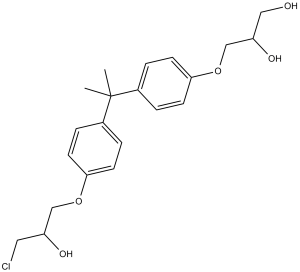
EPI-001 (EPI001; EPI 001) is a novel, potent small-molecule antagonist of AR-androgen receptor N-terminal domain (NTD) with potential antineoplastic activity. It inhibits AR-NTD with an IC50 of ∼6 μM and also serves as a selective PPAR-gamma modulator. AR is involved in mediating the actions of male sex steroids and over-expression of AR may lead to hormone-refractory prostate cancer.
Physicochemical Properties
| Molecular Formula | C21H27CLO5 | |
| Molecular Weight | 394.89 | |
| Exact Mass | 394.154 | |
| CAS # | 227947-06-0 | |
| Related CAS # |
|
|
| PubChem CID | 4166922 | |
| Appearance | White to off-white solid powder | |
| Density | 1.2±0.1 g/cm3 | |
| Boiling Point | 601.0±55.0 °C at 760 mmHg | |
| Flash Point | 317.2±31.5 °C | |
| Vapour Pressure | 0.0±1.8 mmHg at 25°C | |
| Index of Refraction | 1.571 | |
| LogP | 2.98 | |
| Hydrogen Bond Donor Count | 3 | |
| Hydrogen Bond Acceptor Count | 5 | |
| Rotatable Bond Count | 10 | |
| Heavy Atom Count | 27 | |
| Complexity | 403 | |
| Defined Atom Stereocenter Count | 0 | |
| InChi Key | HDTYUHNZRYZEEB-UHFFFAOYSA-N | |
| InChi Code | InChI=1S/C21H27ClO5/c1-21(2,15-3-7-19(8-4-15)26-13-17(24)11-22)16-5-9-20(10-6-16)27-14-18(25)12-23/h3-10,17-18,23-25H,11-14H2,1-2H3 | |
| Chemical Name | 3-[4-[1-[4-(3-chloro-2-hydroxypropoxy)phenyl]-1-methylethyl]phenoxy]-1,2-propanediol | |
| Synonyms |
|
|
| HS Tariff Code | 2934.99.9001 | |
| Storage |
Powder-20°C 3 years 4°C 2 years In solvent -80°C 6 months -20°C 1 month |
|
| Shipping Condition | Room temperature (This product is stable at ambient temperature for a few days during ordinary shipping and time spent in Customs) |
Biological Activity
| ln Vitro | In a dose-dependent manner, EPI-001 (5-100 μM; 7 d) suppresses the development of PCa/CRPC cells [2]. In PCa and CRPC cell lines, endogenous AR mRNA and protein expression are inhibited by EPI-001 (50 μM) [2]. AR TAU1 and TAU5 transcriptional activity is inhibited by EPI-001 (50 μM) [2]. |
| ln Vivo | In vivo tumor growth is inhibited by EPI-00 (20 mg/kg; iv every 5 days for 25 days) without causing general toxicity [1]. The androgen axis is blocked by EPI-00 (50 mg/kg; IV), which also prevents androgen-dependent tumor growth [1]. |
| Cell Assay |
Cell Proliferation Assay[2] Cell Types: PCa, CRPC, PC-3, DU 145, and T47D cell lines Tested Concentrations: 0, 5, 10, 25, 50, 100 μM Incubation Duration: 7 days Experimental Results: Inhibited growth of LNCaP cells at low concentrations. Inhibited growth of AR-negative PC-3 and DU 145 cell lines as well as the T47D breast carcinoma cell line. Western Blot Analysis[2] Cell Types: LNCaP, VCaP LAPC4, C4-2,22Rv1, and CWR -R1 cells Tested Concentrations: 50 μM Incubation Duration: 8-16 hrs (hours) Experimental Results: diminished expression of full-length AR protein to varying degrees. |
| Animal Protocol |
Animal/Disease Models: Male NOD-SCID (severe combined immunodeficient) mouse (6-8 weeks) bearing LNCaP[1] Doses: 20 mg/kg Route of Administration: Iv every 5 days for 25 days Experimental Results: decreased tumors from 100.3±1.72 mm3 to 73.03±29.6 mm3 within 2 weeks. Did not cause general toxicity indicated by no change in animal behavior or body weight. |
| References |
[1]. Regression of castrate-recurrent prostate cancer by a small-molecule inhibitor of the amino-terminus domain of the androgen receptor. Cancer Cell. 2010 Jun 15; 17(6): 535-46. [2]. EPI-001 is a selective peroxisome proliferator-activated receptor-gamma modulator with inhibitory effects on androgen receptor expression and activity in prostate cancer. Oncotarget. 2015 Feb 28; 6(6): 3811-24. [3]. EPI-001, A Compound Active against Castration-Resistant Prostate Cancer, Targets Transactivation Unit 5 of the Androgen Receptor. ACS Chem Biol. 2016 Sep 16;11(9):2499-505. |
| Additional Infomation | Bisphenol A (3-chloro-2-hydroxypropyl) (2,3-dihydroxypropyl) ether is the (3-chloro-2-hydroxypropyl) (2,3-dihydroxypropyl) diether of bisphenol A; a small molecule that inhibits transactivation of the AR amino-terminal domain (NTD). It has a role as an androgen antagonist. It is an organochlorine compound and a diether. It is functionally related to a bisphenol A and a glycerol. |
Solubility Data
| Solubility (In Vitro) |
|
|||
| Solubility (In Vivo) |
Solubility in Formulation 1: ≥ 2.5 mg/mL (6.33 mM) (saturation unknown) in 10% DMSO + 40% PEG300 + 5% Tween80 + 45% Saline (add these co-solvents sequentially from left to right, and one by one), clear solution. For example, if 1 mL of working solution is to be prepared, you can add 100 μL of 25.0 mg/mL clear DMSO stock solution to 400 μL PEG300 and mix evenly; then add 50 μL Tween-80 to the above solution and mix evenly; then add 450 μL normal saline to adjust the volume to 1 mL. Preparation of saline: Dissolve 0.9 g of sodium chloride in 100 mL ddH₂ O to obtain a clear solution. Solubility in Formulation 2: ≥ 2.5 mg/mL (6.33 mM) (saturation unknown) in 10% DMSO + 90% (20% SBE-β-CD in Saline) (add these co-solvents sequentially from left to right, and one by one), clear solution. For example, if 1 mL of working solution is to be prepared, you can add 100 μL of 25.0 mg/mL clear DMSO stock solution to 900 μL of 20% SBE-β-CD physiological saline solution and mix evenly. Preparation of 20% SBE-β-CD in Saline (4°C,1 week): Dissolve 2 g SBE-β-CD in 10 mL saline to obtain a clear solution. Solubility in Formulation 3: ≥ 2.5 mg/mL (6.33 mM) (saturation unknown) in 10% DMSO + 90% Corn Oil (add these co-solvents sequentially from left to right, and one by one), clear solution. For example, if 1 mL of working solution is to be prepared, you can add 100 μL of 25.0 mg/mL clear DMSO stock solution to 900 μL of corn oil and mix evenly. (Please use freshly prepared in vivo formulations for optimal results.) |
| Preparing Stock Solutions | 1 mg | 5 mg | 10 mg | |
| 1 mM | 2.5324 mL | 12.6618 mL | 25.3235 mL | |
| 5 mM | 0.5065 mL | 2.5324 mL | 5.0647 mL | |
| 10 mM | 0.2532 mL | 1.2662 mL | 2.5324 mL |