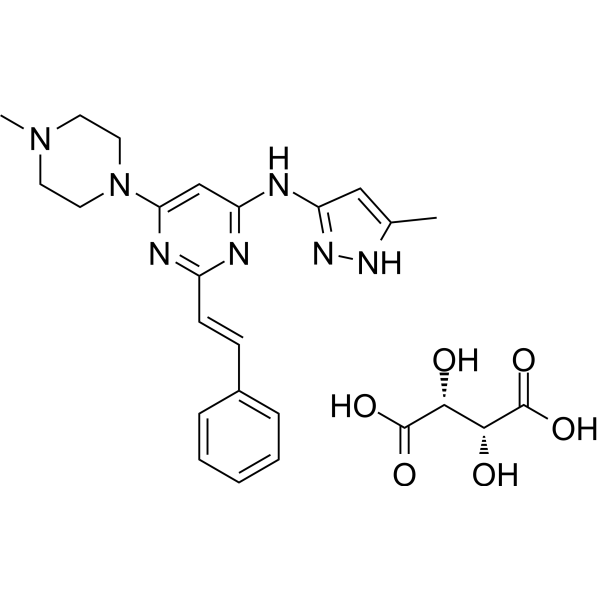
ENMD-2076 Tartrate, the tartrate salt of ENMD-981693 (MKC-1693), is a novel, potent and orally bioactive multi-kinase inhibitor with potential antineoplastic activity. With IC50 values of 14 nM and 1.86 nM, it suppresses Aurora A and Flt3, exhibiting a 25-fold preference for Aurora A over Aurora B. ENMD-2076 exhibits strong in vivo antitumor efficacy as well as strong anti-proliferative activity in vitro.
Physicochemical Properties
| Molecular Formula | C25H31N7O6 | |
| Molecular Weight | 525.56 | |
| Exact Mass | 525.233 | |
| CAS # | 1291074-87-7 | |
| Related CAS # | ENMD-2076;934353-76-1 | |
| PubChem CID | 16041424 | |
| Appearance | Light brown to khaki solid | |
| LogP | 0.476 | |
| Hydrogen Bond Donor Count | 2 | |
| Hydrogen Bond Acceptor Count | 6 | |
| Rotatable Bond Count | 5 | |
| Heavy Atom Count | 28 | |
| Complexity | 499 | |
| Defined Atom Stereocenter Count | 0 | |
| SMILES | O[C@H](C(O)=O)[C@@H](C(O)=O)O.CC1=CC(NC2=NC(/C=C/C3=CC=CC=C3)=NC(N4CCN(CC4)C)=C2)=NN1 |
|
| InChi Key | KGWWHPZQLVVAPT-PCWHHUEVSA-N | |
| InChi Code | InChI=1S/C21H25N7.C4H6O6/c1-16-14-20(26-25-16)23-19-15-21(28-12-10-27(2)11-13-28)24-18(22-19)9-8-17-6-4-3-5-7-17;5-1(3(7)8)2(6)4(9)10/h3-9,14-15H,10-13H2,1-2H3,(H2,22,23,24,25,26);1-2,5-6H,(H,7,8)(H,9,10)/b9-8+;/t;1-,2-/m.0/s1 | |
| Chemical Name | (2S,3S)-2,3-dihydroxybutanedioic acid;6-(4-methylpiperazin-1-yl)-N-(5-methyl-1H-pyrazol-3-yl)-2-[(E)-2-phenylethenyl]pyrimidin-4-amine | |
| Synonyms |
|
|
| HS Tariff Code | 2934.99.9001 | |
| Storage |
Powder-20°C 3 years 4°C 2 years In solvent -80°C 6 months -20°C 1 month Note: Please store this product in a sealed and protected environment, avoid exposure to moisture. |
|
| Shipping Condition | Room temperature (This product is stable at ambient temperature for a few days during ordinary shipping and time spent in Customs) |
Biological Activity
| Targets |
Aurora A (IC50 = 1.86 nM); KDR (IC50 = 58.2 nM); Flt-4 (IC50 = 15.9 nM); FGFR1 (IC50 = 92.7 nM); FGFR2 (IC50 = 70.8 nM); PDGFRα (IC50 = 56.4 nM); Flt3 (IC50 = 14 nM) ENMD-2076 Tartrate inhibits VEGFR2 (IC₅₀ = 0.05 μM), Aurora A (IC₅₀ = 0.12 μM), Aurora B (IC₅₀ = 1.5 μM), FGFR1 (IC₅₀ = 0.2 μM), and PDGFRβ (IC₅₀ = 0.3 μM) [1] ENMD-2076 Tartrate shows inhibitory activity against JAK2 (IC₅₀ = 0.4 μM) and STAT3 (IC₅₀ = 0.6 μM) in multiple myeloma cells [2] |
| ln Vitro |
ENMD-2076 is selective for Aurora A than for Aurora B (IC50=350 nM). HUVEC growth is inhibited by ENMD-2076 at an IC50 of 0.15 mM. The IC50 values range from 0.025 to 0.53 mM against ten human leukemia cell lines. The most sensitive cells in this panel by a factor bigger than four are MV4:11 cells. ENMD-2076 treatment of the lymphoma-derived U937 cell line results in a dose-dependent increase in both the induction of apoptosis and G2-M-phase arrest. In THP-1 cells, which have been demonstrated to express FL-responsive wild-type Flt-3 (18), ENMD-2076 inhibits Flt3 autophosphorylation induced by cellular Flt3 ligand (FL) at an IC50 value of 28 nM. For MO7e cells, ENMD-2076 has an IC50 value of 40 nM, which inhibits the autophosphorylation of Kit induced by stem cell factor (SCF). The IC50 value of ENMD-2076 is 7 nM, which is sufficient to inhibit VEGFR2/KDR autophosphorylation. ENMD-2076 Tartrate dose-dependently inhibited the proliferation of human umbilical vein endothelial cells (HUVECs) induced by VEGF, with an IC₅₀ of 0.1 μM. At 1 μM, it suppressed VEGF-mediated HUVEC migration by ~88% and tube formation by ~92%. It also blocked VEGF-induced phosphorylation of VEGFR2 and downstream signaling (Akt, ERK1/2) in HUVECs at concentrations ≥ 0.2 μM [1] ENMD-2076 Tartrate inhibited the proliferation of various tumor cell lines, including A549 (lung cancer, IC₅₀ = 2.3 μM), HT-29 (colorectal cancer, IC₅₀ = 3.1 μM), and MDA-MB-231 (breast cancer, IC₅₀ = 2.8 μM). It induced G2/M phase cell cycle arrest and apoptosis in A549 cells at 2 μM [1] ENMD-2076 Tartrate suppressed the growth of multiple myeloma cell lines (RPMI 8226, IC₅₀ = 0.8 μM; U266, IC₅₀ = 1.2 μM). It inhibited JAK2/STAT3 signaling, reduced the expression of anti-apoptotic proteins (Bcl-2, Mcl-1), and increased cleaved caspase-3 levels in RPMI 8226 cells at 1 μM [2] |
| ln Vivo |
ENMD-2076 treatment causes tumor growth or regression to be statistically significantly inhibited in a dose-dependent manner. Furthermore, while slow-growing (like A375 melanoma) and fast-growing (like HT29 colon carcinoma) tumors are both inhibited by ENMD-2076, there is no correlation between the rate of tumor growth and the antitumor efficacy, which is theoretically expected for a mitotic kinase inhibitor. With the exception of the A375 model, studies have not found any weight loss or indications of morbidity at daily doses of up to 302 mg/kg (equivalent to 200 mg/kg of the free base) for ENMD-2076. ENMD-2076 Tartrate inhibited tumor growth and angiogenesis in nude mice bearing MDA-MB-231 breast cancer xenografts when administered orally at 50 mg/kg/day for 28 days. Tumor volume was reduced by ~70% compared to the control group, and intratumoral microvessel density (CD31-positive) decreased by ~75% [1] ENMD-2076 Tartrate prolonged the survival of C.B-17 SCID mice bearing RPMI 8226 multiple myeloma xenografts. Oral administration of 30 mg/kg/day for 35 days increased the median survival time from 42 days to 68 days, and reduced tumor burden in the bone marrow by ~65% [2] |
| Enzyme Assay |
Recombinant Aurora A and B kinase enzyme assays are conducted in kinase assay buffer, which is supplemented with 2 mM of DTT and contains 50 mM of HEPES, pH 7.5, 10 mM of MgCl2, 5 mM of EGTA, and 0.05% Brij-35. The enzyme concentration that causes the peptide substrate to phosphorylate by about 30% after an hour and the ATP concentration that corresponds to each enzyme's apparent Km are used to calculate activities. Grafit is used to plot relative enzyme activity versus ENMD-2076 concentration on dose-response curves, which are then used to determine IC50 values[1]. Recombinant VEGFR2, Aurora A, Aurora B, FGFR1, and PDGFRβ kinase domains were individually incubated with ATP and specific peptide substrates in the presence of serial dilutions of ENMD-2076 Tartrate. Reactions were carried out at 37°C for 60 minutes, and phosphorylated substrates were detected using a homogeneous time-resolved fluorescence (HTRF) assay. Inhibition rates were calculated by comparing fluorescence intensity with vehicle controls, and IC₅₀ values were derived from dose-response curves [1] Recombinant JAK2 kinase domain was incubated with ATP and a fluorescently labeled substrate in the presence of ENMD-2076 Tartrate. The reaction was conducted at 30°C for 45 minutes, and the fluorescence resonance energy transfer (FRET) signal was measured to quantify kinase activity. IC₅₀ was determined by plotting inhibition percentage against drug concentration [2] |
| Cell Assay |
In a 96-well plate, 500 cells are plated per well, and the compound is incubated with 9 doses (ranging from 0.3 nM to 125 mM) for 96 hours to determine the antiproliferative effect on adherent tumor cell lines. Using the sulforhodamine B assay, cellular proliferation is quantified[1]. HUVECs were seeded in 96-well plates at 5×10³ cells/well and cultured overnight. ENMD-2076 Tartrate (0.01-2 μM) was added 1 hour before stimulation with VEGF (50 ng/mL). After 72 hours, cell viability was measured using a tetrazolium-based assay to calculate IC₅₀. For Western blot, HUVECs were treated with 0.2-1 μM drug and VEGF, then lysed and probed with antibodies against phosphorylated VEGFR2, Akt, ERK1/2, and GAPDH [1] Tumor cells (A549, HT-29, MDA-MB-231) were seeded in 96-well plates and treated with ENMD-2076 Tartrate (0.1-10 μM) for 72 hours. Cell viability was assessed by MTT assay. A549 cells were treated with 2 μM drug for 24 hours, fixed, stained with propidium iodide, and analyzed by flow cytometry for cell cycle distribution. Apoptosis was detected by Annexin V-FITC/PI staining [1] Multiple myeloma cells (RPMI 8226, U266) were treated with ENMD-2076 Tartrate (0.1-5 μM) for 48 hours. Cell viability was measured by CCK-8 assay. Western blot was used to detect phosphorylated JAK2, STAT3, Bcl-2, Mcl-1, and cleaved caspase-3. RT-PCR was performed to quantify the mRNA expression of STAT3 target genes (c-Myc, cyclin D1) [2] |
| Animal Protocol |
Mice: In 5- to 6-week-old CB.17 SCID or NCr nude mice, cell lines are injected subcutaneously or into the mammary fat pad (MDA-MB-231 only). Before receiving medication, tumors are left to grow for a period of 10 to 50 days. ENMD-2076 in water or ENMD-2076 free base in CMC-Tween vehicle (0.085% Tween 80 in water and 0.075% carboxymethylcellulose) is used orally for all treatments. One computes the percent inhibition of tumor growth[1]. Nude mice bearing MDA-MB-231 breast cancer xenografts (100-150 mm³) were randomly divided into control and treatment groups. ENMD-2076 Tartrate was suspended in 0.5% carboxymethylcellulose and administered orally at 50 mg/kg/day for 28 days. Tumor volume was measured every 3 days, and mice were euthanized to collect tumors for CD31 immunostaining and Western blot analysis [1] C.B-17 SCID mice were intravenously injected with RPMI 8226 multiple myeloma cells. Seven days later, mice were treated with ENMD-2076 Tartrate orally at 30 mg/kg/day for 35 days. Survival time was recorded daily. At the end of the study, bone marrow samples were collected to assess tumor burden by flow cytometry [2] |
| ADME/Pharmacokinetics |
ENMD-2076 Tartrate had an oral bioavailability of ~48% in mice after a single dose of 50 mg/kg. The plasma half-life was approximately 7.2 hours, and the maximum plasma concentration (Cmax) was 3.5 μg/mL achieved at 2 hours post-administration [1] In rats, oral administration of ENMD-2076 Tartrate at 30 mg/kg resulted in an AUC₀-24h of 26.8 μg·h/mL. The drug was widely distributed in the liver, kidneys, and tumor tissues, with a tumor-to-plasma concentration ratio of ~3.0 [1] |
| Toxicity/Toxicokinetics |
Mice treated with ENMD-2076 Tartrate at 50 mg/kg/day for 28 days showed mild weight loss (~9%) and transient leukopenia (15% of animals), but no significant liver or kidney toxicity. Serum ALT, AST, and creatinine levels were within normal ranges [1] The plasma protein binding rate of ENMD-2076 Tartrate was ~94% in human plasma as determined by equilibrium dialysis [2] |
| References |
[1]. ENMD-2076 is an orally active kinase inhibitor with antiangiogenic and antiproliferative mechanisms of action. Mol Cancer Ther. 2011 Jan;10(1):126-37. [2]. Preclinical activity of a novel multiple tyrosine kinase and aurora kinase inhibitor, ENMD-2076, against multiple myeloma. Br J Haematol. 2010 Aug;150(3):313-25. |
| Additional Infomation |
Aurora A Kinase/Tyrosine Kinase Inhibitor ENMD-2076 is an orally bioavailable synthetic small molecule with potential antiangiogenic and antineoplastic activities. Aurora A kinase/tyrosine kinase inhibitor ENMD-2076 selectively binds to and inhibits non-specified tyrosine kinases and Aurora kinases (AKs). The inhibition of AKs may result in the inhibition of cell division and proliferation and may induce apoptosis in tumor cells that overexpress AKs; antiangiogenic activity is related to the inhibition of angiogenic tyrosine kinases. AKs are serine-threonine kinases that play an essential role in mitotic checkpoint control during mitosis and are important regulators of cell division and proliferation. ENMD-2076 Tartrate is a multi-targeted kinase inhibitor with dual antiangiogenic and antiproliferative activities, acting by blocking VEGFR2-mediated angiogenesis and Aurora kinase-mediated cell cycle progression [1] ENMD-2076 Tartrate exhibits potential therapeutic efficacy in multiple myeloma by inhibiting the JAK2/STAT3 signaling pathway, which is critical for myeloma cell survival and proliferation [2] |
Solubility Data
| Solubility (In Vitro) |
|
|||
| Solubility (In Vivo) |
|
| Preparing Stock Solutions | 1 mg | 5 mg | 10 mg | |
| 1 mM | 1.9027 mL | 9.5137 mL | 19.0273 mL | |
| 5 mM | 0.3805 mL | 1.9027 mL | 3.8055 mL | |
| 10 mM | 0.1903 mL | 0.9514 mL | 1.9027 mL |