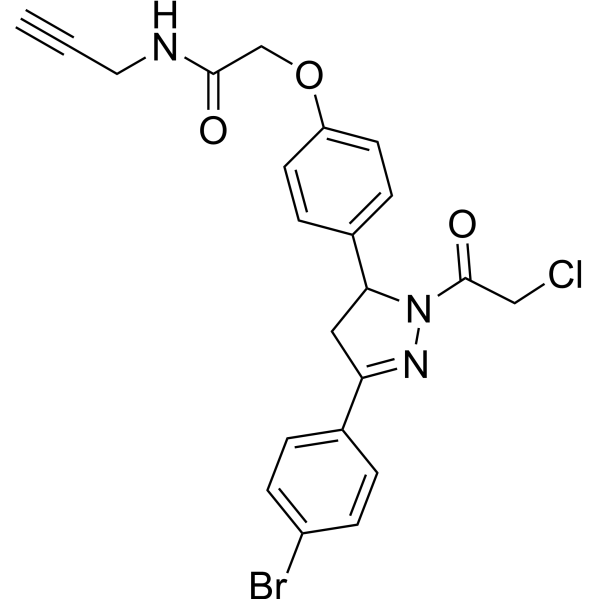
Physicochemical Properties
| Molecular Formula | C22H19BRCLN3O3 |
| Molecular Weight | 488.76 |
| Exact Mass | 487.02983 |
| Related CAS # | EN219;380351-29-1 |
| PubChem CID | 170902951 |
| Appearance | Typically exists as solid at room temperature |
| LogP | 3.4 |
| SMILES | C#CCNC(=O)COC1=CC=C(C=C1)C2CC(=NN2C(=O)CCl)C3=CC=C(C=C3)Br |
| InChi Key | FGJLZQWWDKBXBM-UHFFFAOYSA-N |
| InChi Code | nChI=1S/C22H19BrClN3O3/c1-2-11-25-21(28)14-30-18-9-5-16(6-10-18)20-12-19(26-27(20)22(29)13-24)15-3-7-17(23)8-4-15/h1,3-10,20H,11-14H2,(H,25,28) |
| Chemical Name | 2-[4-[5-(4-bromophenyl)-2-(2-chloroacetyl)-3,4-dihydropyrazol-3-yl]phenoxy]-N-prop-2-ynylacetamide |
| Synonyms | EN219-alkyne; EN-219-alkyne; EN219 alkyne |
| HS Tariff Code | 2934.99.9001 |
| Storage |
Powder-20°C 3 years 4°C 2 years In solvent -80°C 6 months -20°C 1 month |
| Shipping Condition | Room temperature (This product is stable at ambient temperature for a few days during ordinary shipping and time spent in Customs) |
Biological Activity
| ln Vitro |
EN219-alkyne probe In-situ labeling and pull-down studies (using 231MFP cells as an example)[1] 1. 231MFP cells were treated with DMSO vector or 50 μM EN219-alkyne probe for 90 min. 2. The cells were collected in PBS and cleaved by ultrasonic treatment. 3. Prepare the western blot sample: divide the lysate (1 mg protein in 500 μL) into each sample in equal amounts, and then add in order: 10 μL 5 mM biotin pyridinium azide, 50 μL click-reaction mixture (i.e., three parts TBTA 5 mM TBTA butanol, which consists of one part DMSO (4:1, v/v), one part Cu(II)SO4 solution, and one part 50 mM TCEP). 4. Stir the sample gently and incubate at room temperature for 1 hour. 5. After CuAAC, the protein was precipitated by centrifugation at 6,500 g and washed twice in pre-cooled methanol (500 μL). 6. The sample was centrifuged at 6,500 g in a precooled 4℃ centrifuge for 4 min. The excess methanol was sucked out and then the recombinant protein was precipitated in 250 μL PBS containing 1.2% SDS by probe ultrasound. 7. The proteome was denatured at 90℃ for 5 min, the insoluble components were precipitated by 6,500g centrifugation, and the soluble proteome was diluted in 1.2 mL PBS (the final concentration of SDS in the sample was 0.2%) to a total volume of 1450 μL, with 50 μL retained as input. 8. 85 μL pre-washed 50% streptavidin agarose beads were added to each sample and the sample was gently stirred at room temperature to incubate overnight. 9. After rotating the beads at 6,500 g at room temperature for 2 minutes, suck out the supernatant from each sample. 10. Transfer the beads to the rotating column and wash with PBS 3 times. To eluate, the beads are boiled in 50 μL LDS sample buffer for 5 minutes. Eluent was collected after centrifugation and analyzed by western blot. |
| References | [1]. Luo M, et al. Chemoproteomics-enabled discovery of covalent RNF114-based degraders that mimic natural product function. Cell Chem Biol. 2021 Apr 15;28(4):559-566.e15. |
| Additional Infomation | The translation of functionally active natural products into fully synthetic small-molecule mimetics has remained an important process in medicinal chemistry. We recently discovered that the terpene natural product nimbolide can be utilized as a covalent recruiter of the E3 ubiquitin ligase RNF114 for use in targeted protein degradation-a powerful therapeutic modality within modern-day drug discovery. Using activity-based protein profiling-enabled covalent ligand-screening approaches, here we report the discovery of fully synthetic RNF114-based recruiter molecules that can also be exploited for PROTAC applications, and demonstrate their utility in degrading therapeutically relevant targets, such as BRD4 and BCR-ABL, in cells. The identification of simple and easily manipulated drug-like scaffolds that can mimic the function of a complex natural product is beneficial in further expanding the toolbox of E3 ligase recruiters, an area of great importance in drug discovery and chemical biology. |
Solubility Data
| Solubility (In Vitro) | May dissolve in DMSO (in most cases), if not, try other solvents such as H2O, Ethanol, or DMF with a minute amount of products to avoid loss of samples |
| Solubility (In Vivo) |
Note: Listed below are some common formulations that may be used to formulate products with low water solubility (e.g. < 1 mg/mL), you may test these formulations using a minute amount of products to avoid loss of samples. Injection Formulations (e.g. IP/IV/IM/SC) Injection Formulation 1: DMSO : Tween 80: Saline = 10 : 5 : 85 (i.e. 100 μL DMSO stock solution → 50 μL Tween 80 → 850 μL Saline) *Preparation of saline: Dissolve 0.9 g of sodium chloride in 100 mL ddH ₂ O to obtain a clear solution. Injection Formulation 2: DMSO : PEG300 :Tween 80 : Saline = 10 : 40 : 5 : 45 (i.e. 100 μL DMSO → 400 μLPEG300 → 50 μL Tween 80 → 450 μL Saline) Injection Formulation 3: DMSO : Corn oil = 10 : 90 (i.e. 100 μL DMSO → 900 μL Corn oil) Example: Take the Injection Formulation 3 (DMSO : Corn oil = 10 : 90) as an example, if 1 mL of 2.5 mg/mL working solution is to be prepared, you can take 100 μL 25 mg/mL DMSO stock solution and add to 900 μL corn oil, mix well to obtain a clear or suspension solution (2.5 mg/mL, ready for use in animals). Injection Formulation 4: DMSO : 20% SBE-β-CD in saline = 10 : 90 [i.e. 100 μL DMSO → 900 μL (20% SBE-β-CD in saline)] *Preparation of 20% SBE-β-CD in Saline (4°C,1 week): Dissolve 2 g SBE-β-CD in 10 mL saline to obtain a clear solution. Injection Formulation 5: 2-Hydroxypropyl-β-cyclodextrin : Saline = 50 : 50 (i.e. 500 μL 2-Hydroxypropyl-β-cyclodextrin → 500 μL Saline) Injection Formulation 6: DMSO : PEG300 : castor oil : Saline = 5 : 10 : 20 : 65 (i.e. 50 μL DMSO → 100 μLPEG300 → 200 μL castor oil → 650 μL Saline) Injection Formulation 7: Ethanol : Cremophor : Saline = 10: 10 : 80 (i.e. 100 μL Ethanol → 100 μL Cremophor → 800 μL Saline) Injection Formulation 8: Dissolve in Cremophor/Ethanol (50 : 50), then diluted by Saline Injection Formulation 9: EtOH : Corn oil = 10 : 90 (i.e. 100 μL EtOH → 900 μL Corn oil) Injection Formulation 10: EtOH : PEG300:Tween 80 : Saline = 10 : 40 : 5 : 45 (i.e. 100 μL EtOH → 400 μLPEG300 → 50 μL Tween 80 → 450 μL Saline) Oral Formulations Oral Formulation 1: Suspend in 0.5% CMC Na (carboxymethylcellulose sodium) Oral Formulation 2: Suspend in 0.5% Carboxymethyl cellulose Example: Take the Oral Formulation 1 (Suspend in 0.5% CMC Na) as an example, if 100 mL of 2.5 mg/mL working solution is to be prepared, you can first prepare 0.5% CMC Na solution by measuring 0.5 g CMC Na and dissolve it in 100 mL ddH2O to obtain a clear solution; then add 250 mg of the product to 100 mL 0.5% CMC Na solution, to make the suspension solution (2.5 mg/mL, ready for use in animals). Oral Formulation 3: Dissolved in PEG400 Oral Formulation 4: Suspend in 0.2% Carboxymethyl cellulose Oral Formulation 5: Dissolve in 0.25% Tween 80 and 0.5% Carboxymethyl cellulose Oral Formulation 6: Mixing with food powders Note: Please be aware that the above formulations are for reference only. InvivoChem strongly recommends customers to read literature methods/protocols carefully before determining which formulation you should use for in vivo studies, as different compounds have different solubility properties and have to be formulated differently. (Please use freshly prepared in vivo formulations for optimal results.) |
| Preparing Stock Solutions | 1 mg | 5 mg | 10 mg | |
| 1 mM | 2.0460 mL | 10.2300 mL | 20.4599 mL | |
| 5 mM | 0.4092 mL | 2.0460 mL | 4.0920 mL | |
| 10 mM | 0.2046 mL | 1.0230 mL | 2.0460 mL |