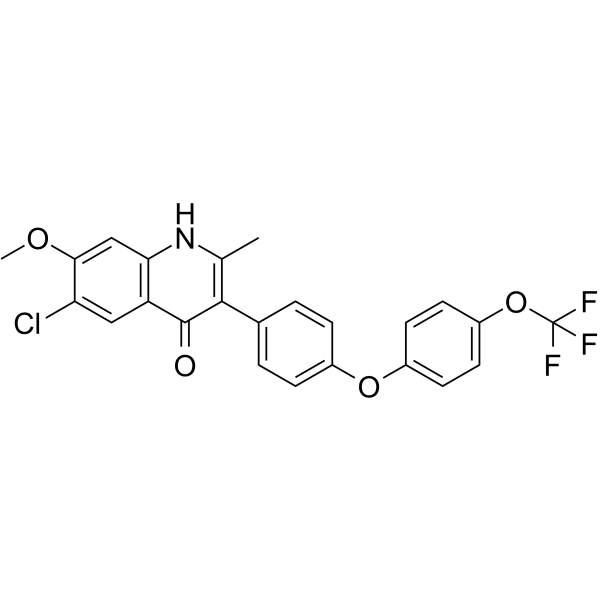
Physicochemical Properties
| Molecular Formula | C24H17CLF3NO4 |
| Molecular Weight | 475.844296216965 |
| Exact Mass | 475.079 |
| CAS # | 1354745-52-0 |
| PubChem CID | 67016608 |
| Appearance | White to off-white solid powder |
| LogP | 6.9 |
| Hydrogen Bond Donor Count | 1 |
| Hydrogen Bond Acceptor Count | 8 |
| Rotatable Bond Count | 5 |
| Heavy Atom Count | 33 |
| Complexity | 730 |
| Defined Atom Stereocenter Count | 0 |
| InChi Key | WZDNKHCQIZRDKW-UHFFFAOYSA-N |
| InChi Code | InChI=1S/C24H17ClF3NO4/c1-13-22(23(30)18-11-19(25)21(31-2)12-20(18)29-13)14-3-5-15(6-4-14)32-16-7-9-17(10-8-16)33-24(26,27)28/h3-12H,1-2H3,(H,29,30) |
| Chemical Name | 6-chloro-7-methoxy-2-methyl-3-[4-[4-(trifluoromethoxy)phenoxy]phenyl]-1H-quinolin-4-one |
| Synonyms | ELQ 300; ELQ-300; ELQ300 |
| HS Tariff Code | 2934.99.9001 |
| Storage |
Powder-20°C 3 years 4°C 2 years In solvent -80°C 6 months -20°C 1 month |
| Shipping Condition | Room temperature (This product is stable at ambient temperature for a few days during ordinary shipping and time spent in Customs) |
Biological Activity
| ln Vitro | ELQ-300 (0-70 nM, 21 d) has IC50 values of 6.6, 4.6, and 160 nM, respectively, which inhibit the growth of Plasmodium falciparum Dd2, Tm90-C2B, and D1 [1]. |
| ln Vivo | In models of acute infection, ELQ-300 (1 and 10 mg/kg; administered orally once daily for 1 or 4 days) reduces Plasmodium yoelii growth [2]. In mice, ELQ-300 (10 and 20 mg/kg; orally administered once daily for 1 or 4 days) inhibits the spread of infection [2]. |
| Animal Protocol |
Animal/Disease Models: P. yoelii-WT infected 6weeks old female CF-1 mice [2] Doses: 1 and 10 mg/kg Route of Administration: po (oral gavage); 1 mg/kg one time/day for 4 days ; 10 mg/kg, one time/day for 1 day. Experimental Results: To inhibit Plasmodium yoelii, the ED50 values of 4-day dosing and 1-day dosing were 0.04 and 0.03 mg/kg respectively. Animal/Disease Models: P. yoelii-WT infected 6weeks old female CF-1 mice [2] Doses: 10 and 20 mg/kg Route of Administration: po (oral gavage); 10 mg/kg one time/day for 4 days ; 20 mg/kg, one time/day for 1 day. Experimental Results: Effective in preventing relapse in a 4-day dosing study in infected mice. |
| References |
[1]. Stickles AM, et al. Subtle changes in endochin-like quinolone structure alter the site of inhibition within the cytochrome bc1 complex of Plasmodium falciparum. Antimicrob Agents Chemother. 2015 Apr;59(4):1977-82. [2]. Stickles AM, et al. Atovaquone and ELQ-300 Combination Therapy as a Novel Dual-Site Cytochrome bc1 Inhibition Strategy for Malaria. Antimicrob Agents Chemother. 2016 Jul 22;60(8):4853-9. |
Solubility Data
| Solubility (In Vitro) |
DMSO : ~15.62 mg/mL (~32.83 mM) H2O : < 0.1 mg/mL |
| Solubility (In Vivo) |
Solubility in Formulation 1: 2.25 mg/mL (4.73 mM) in 10% DMSO + 40% PEG300 +5% Tween-80 + 45% Saline (add these co-solvents sequentially from left to right, and one by one), suspension solution; with sonication. For example, if 1 mL of working solution is to be prepared, you can add 100 μL of 22.5 mg/mL clear DMSO stock solution to 400 μL PEG300 and mix evenly; then add 50 μL Tween-80 + to the above solution and mix evenly; then add 450 μL normal saline to adjust the volume to 1 mL. Preparation of saline: Dissolve 0.9 g of sodium chloride in 100 mL ddH₂ O to obtain a clear solution. (Please use freshly prepared in vivo formulations for optimal results.) |
| Preparing Stock Solutions | 1 mg | 5 mg | 10 mg | |
| 1 mM | 2.1015 mL | 10.5077 mL | 21.0155 mL | |
| 5 mM | 0.4203 mL | 2.1015 mL | 4.2031 mL | |
| 10 mM | 0.2102 mL | 1.0508 mL | 2.1015 mL |