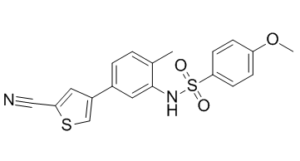
EL102, a novel toluidine sulphonamide, is a novel inhibitor of HIF1α (hypoxia inducible factor) and can also potently inhibit tubulin polymerisation and decreased microtubule stability. EL102 has in vitro activity against prostate cancer, characterised by accumulation in G2/M, induction of apoptosis, inhibition of Hif1α, and inhibition of tubulin polymerisation and decreased microtubule stability. In vivo, a combination of EL102 and docetaxel exhibits superior tumour inhibition. The DLKP cell line and multidrug-resistant DLKPA variant (which exhibits 205 to 691-fold greater resistance to docetaxel, paclitaxel, vincristine and doxorubicin) are equally sensitive to EL102. In conclusion, EL102 shows potential as both a single agent and within combination regimens for the treatment of prostate cancer, particularly in the chemoresistance setting.
Physicochemical Properties
| Molecular Formula | C19H16N2O3S2 |
| Molecular Weight | 384.472 |
| Exact Mass | 384.06 |
| CAS # | 1233948-61-2 |
| PubChem CID | 62705067 |
| Appearance | Light yellow to yellow solid powder |
| Density | 1.4±0.1 g/cm3 |
| Boiling Point | 548.1±60.0 °C at 760 mmHg |
| Flash Point | 285.3±32.9 °C |
| Vapour Pressure | 0.0±1.5 mmHg at 25°C |
| Index of Refraction | 1.669 |
| LogP | 5.01 |
| Hydrogen Bond Donor Count | 1 |
| Hydrogen Bond Acceptor Count | 6 |
| Rotatable Bond Count | 5 |
| Heavy Atom Count | 26 |
| Complexity | 616 |
| Defined Atom Stereocenter Count | 0 |
| InChi Key | STJKZARVVAISJM-UHFFFAOYSA-N |
| InChi Code | InChI=1S/C19H16N2O3S2/c1-13-3-4-14(15-9-17(11-20)25-12-15)10-19(13)21-26(22,23)18-7-5-16(24-2)6-8-18/h3-10,12,21H,1-2H3 |
| Chemical Name | N-(5-(5-cyanothiophen-3-yl)-2-methylphenyl)-4-methoxybenzenesulfonamide |
| Synonyms | EL102; EL-102; EL 102. |
| HS Tariff Code | 2934.99.9001 |
| Storage |
Powder-20°C 3 years 4°C 2 years In solvent -80°C 6 months -20°C 1 month |
| Shipping Condition | Room temperature (This product is stable at ambient temperature for a few days during ordinary shipping and time spent in Customs) |
Biological Activity
| Targets |
EL102 targets tubulin and Hif1α [1] |
| ln Vitro |
In vitro growth of prostate cancer cells is inhibited by EL-102 (0-120 nM; 72 hours) [1]. Prostate cancer cell lines are cytotoxic to EL-102 (0-100 nM; 72 hours) [1]. EL-102 (10-100 nM; 24-72 hours) alters the cell cycle and causes apoptosis [1]. In DU145 cells, EL-102 (10–100 nM; 24-48 hours) influences PARP cleavage [1]. Inhibiting tubulin polymerization activity, EL-102 (5 nM; 0-60 min) [1]. Hif1α protein expression is inhibited by EL-102 (0-100 nM; 1 hour) [1]. 1. EL102 exhibits in vitro antiproliferative activity against prostate cancer cell lines (PC-3, DU145, 22Rv1, CWR22) following 72-hour exposure, with dose-dependent effects on cell viability [1] 2. EL102 induces accumulation of prostate cancer cells in the G2/M phase of the cell cycle, as demonstrated by propidium iodide flow cytometry analysis of DU145 cells treated with 10 nM, 50 nM, 100 nM EL102 for 24, 48, and 72 hours [1] 3. EL102 triggers apoptosis in prostate cancer cell lines (CWR22, 22Rv1, PC-3, DU145), as indicated by the increased percentage of cells accumulated in subG1 phase; in DU145 cells, PARP cleavage was observed via western blot at 24 and 48 hours post-treatment with EL102 [1] 4. EL102 inhibits tubulin polymerisation and reduces microtubule stability in DU145 cells, as shown by tubulin polymerisation assays and immunofluorescence staining for β-tubulin and acetylated tubulin [1] 5. EL102 inhibits Hif1α under normoxic conditions (effective at 50 nM and 100 nM) and blocks Hif1α stabilisation induced by 100 μM cobalt chloride (hypoxia mimic) at 10 nM [1] 6. The multidrug-resistant lung cancer cell line DLKPA (with 205 to 691-fold greater resistance to docetaxel, paclitaxel, vincristine, and doxorubicin via MDR1-mediated resistance) and its parental DLKP cell line show equal sensitivity to EL102 [1] 7. Combination treatment of EL102 and docetaxel exerts synergistic effects on reducing in vitro cell viability of prostate cancer cell lines (CWR22, 22Rv1, PC-3, DU145) after 72-hour exposure [1] |
| ln Vivo |
The in vivo effects of docetaxel are enhanced by EL-102 (12 and 15 mg/kg; administered orally for 5 days, with 2 days off, 13 to 37 days following tumor transplantation) [1]. 1. In the CWR22 xenograft murine model of prostate cancer, EL102 administered at 12 mg kg⁻¹ and 15 mg kg⁻¹ as a single agent inhibits tumour growth; combination treatment with 12 mg kg⁻¹ docetaxel plus 12 mg kg⁻¹ EL102 or 12 mg kg⁻¹ docetaxel plus 15 mg kg⁻¹ EL102 demonstrates superior tumour inhibition compared to single-agent treatment with either drug [1] 2. In the CWR22 xenograft model, the vehicle group of mice was euthanised on day 24 due to excessive tumour size, while mice treated with EL102 (12 mg kg⁻¹, 15 mg kg⁻¹), docetaxel (12 mg kg⁻¹), or their combinations showed manageable body weight changes during the treatment period (5-day on/2-day off schedule) [1] |
| Enzyme Assay |
1. Tubulin polymerisation activity assay: The assay measured the change in optical density (OD) ± standard error of the mean (s.e.m.) over time (minutes) following treatment of tubulin with 5 μM EL102, 2 μM docetaxel, a combination of both EL102 and docetaxel, alongside untreated tubulin and tubulin treated with 2 μM nocodazole as controls; this setup was used to evaluate the impact of EL102 on tubulin polymerisation dynamics [1] |
| Cell Assay |
Cell Proliferation Assay[1] Cell Types: CWR22, 22Rv1, DU145, PC-3, DLKP and DLKPA Cell Line Tested Concentrations: 0-120 nM Incubation Duration: 72 hrs (hours) Experimental Results: CWR22, 22Rv1, DU145, PC-3, DLKP and DLKPA The IC50 of mycin-selected variant DLKPA cells were 24, 21.7, 40.3, 37.0, 14.4 and 16.3 nM, respectively. Cytotoxicity assay[1] Cell Types: CWR22, 22Rv1, DU145 and PC-3 cell lines Tested Concentrations: 0-100 nM Incubation Duration: 72 hrs (hours) Experimental Results: demonstrated cytotoxicity to prostate cancer cell lines and inhibited prostate cancer cell lines No additive effects on cell viability of docetaxel. Apoptosis analysis[1] Cell Types: CWR22, 22Rv1, DU145, PC-3, DLKP and DLKPA Cell line Tested Concentrations: 10 and 100 nM Incubation Duration: 24, 48 and 72 hrs (hours) Experimental Results: Induction of apoptosis with a certain dose, Inhibits cell viability 100 nm. Western Blot Analysis [1] Cell Types: DU145 Cell line Tested Concentrations: 10 and 100 nM Incubation Duration: 24 and 48 hrs (hours) Experimental Results: PARP cleavage increased in DU145 cells, and the effect was mo 1. Cell viability assay: Prostate cancer cell lines (PC-3, DU145, 22Rv1, CWR22) and lung cancer cell lines (DLKP, DLKPA) were exposed to varying concentrations of EL102 and/or docetaxel for 72 hours; subsequent assessment of cell viability was conducted to determine the dose-response effects of the compounds on cell survival [1] 2. Cell cycle analysis: DU145 prostate cancer cells were treated with different concentrations of EL102 (10 nM, 100 nM), docetaxel (1 nM, 10 nM), and their combinations for 24, 48, and 72 hours; cells were then stained with propidium iodide, and flow cytometry was used to analyse the distribution of cells in G1, S, G2/M, and subG1 phases of the cell cycle [1] 3. Apoptosis detection assay: Apoptosis in prostate cancer cell lines (CWR22, 22Rv1, PC-3, DU145) was assessed by quantifying the percentage of cells accumulated in the subG1 phase via flow cytometry; additionally, DU145 cells were treated with EL102 and docetaxel, and protein lysates were collected at 24 and 48 hours post-treatment for western blot analysis to detect PARP cleavage, a marker of apoptosis [1] 4. Immunofluorescence assay for microtubule stability: DU145 cells were treated with EL102 (0, 10, 100 nM), docetaxel (0, 1, 10 nM), and their combinations, followed by a 24-hour incubation under optimal conditions; cells were fixed with ice-cold methanol and simultaneously stained with Rabbit anti-β-tubulin and anti-acetylated tubulin antibodies; microtubules were visualised using Alexa Fluor 647 donkey anti-rabbit IgG secondary antibody and Rhodamine Red-X-AffiniPure Fab Fragment goat anti-mouse IgG, while nuclei were counterstained with DAPI to evaluate microtubule stability [1] 5. Hif1α inhibition assay: Cells were exposed to EL102 under normoxic conditions (50 nM, 100 nM) and hypoxic conditions induced by 100 μM cobalt chloride (10 nM EL102); the expression and stabilisation of Hif1α were analysed to determine the inhibitory effect of EL102 on this target [1] |
| Animal Protocol |
Animal/Disease Models: Nude mice with CWR22 xenografts [1] Doses: 12 and 15 mg/kg Route of Administration: po (oral gavage); 12 and 15 mg/kg for 5 days, 2 days off; 13 days after tumor transplantation Results by day 37: No effect on tumor growth, but enhanced the effect of docetaxel on tumors. 1. CWR22 xenograft murine model for tumour proliferation assessment: Mice bearing CWR22 prostate cancer xenografts were treated according to a 5-day on/2-day off schedule with different regimens: vehicle control, 12 mg kg⁻¹ docetaxel, 12 mg kg⁻¹ EL102, 15 mg kg⁻¹ EL102, 12 mg kg⁻¹ docetaxel plus 12 mg kg⁻¹ EL102, and 12 mg kg⁻¹ docetaxel plus 15 mg kg⁻¹ EL102; tumour volume (cm³) ± s.e.m. and mouse body weight were measured at regular time points throughout the treatment period, and the vehicle group was euthanised on day 24 due to excessive tumour size [1] |
| Toxicity/Toxicokinetics |
1. In the CWR22 xenograft murine model, mice treated with EL102 (12 mg kg⁻¹, 15 mg kg⁻¹), docetaxel (12 mg kg⁻¹), or their combinations showed body weight changes during the treatment period, with no severe weight loss or lethal toxicity observed; the vehicle group was killed on day 24 due to tumour size rather than drug-induced toxicity [1] |
| References |
[1]. The novel toluidine sulphonamide EL102 shows pre-clinical in vitro and in vivoactivity against prostate cancer and circumvents MDR1 resistance. Br J Cancer, 2013 Oct 15, 109(8): 2131-2141. |
| Additional Infomation |
1. EL102 is a novel toluidine sulphonamide compound; taxanes are commonly used for prostate cancer treatment, but most patients eventually develop resistance, making EL102 a potential therapeutic candidate for prostate cancer [1] 2. EL102 can circumvent MDR1-mediated multidrug resistance, as evidenced by the equal sensitivity of MDR1-overexpressing DLKPA cells and parental DLKP cells to EL102 [1] 3. EL102 shows potential as both a single agent and in combination regimens (with docetaxel) for the treatment of prostate cancer, particularly in the setting of chemoresistance [1] |
Solubility Data
| Solubility (In Vitro) | DMSO : ≥ 36 mg/mL (~93.64 mM) |
| Solubility (In Vivo) |
Note: Listed below are some common formulations that may be used to formulate products with low water solubility (e.g. < 1 mg/mL), you may test these formulations using a minute amount of products to avoid loss of samples. Injection Formulations (e.g. IP/IV/IM/SC) Injection Formulation 1: DMSO : Tween 80: Saline = 10 : 5 : 85 (i.e. 100 μL DMSO stock solution → 50 μL Tween 80 → 850 μL Saline) *Preparation of saline: Dissolve 0.9 g of sodium chloride in 100 mL ddH ₂ O to obtain a clear solution. Injection Formulation 2: DMSO : PEG300 :Tween 80 : Saline = 10 : 40 : 5 : 45 (i.e. 100 μL DMSO → 400 μLPEG300 → 50 μL Tween 80 → 450 μL Saline) Injection Formulation 3: DMSO : Corn oil = 10 : 90 (i.e. 100 μL DMSO → 900 μL Corn oil) Example: Take the Injection Formulation 3 (DMSO : Corn oil = 10 : 90) as an example, if 1 mL of 2.5 mg/mL working solution is to be prepared, you can take 100 μL 25 mg/mL DMSO stock solution and add to 900 μL corn oil, mix well to obtain a clear or suspension solution (2.5 mg/mL, ready for use in animals). Injection Formulation 4: DMSO : 20% SBE-β-CD in saline = 10 : 90 [i.e. 100 μL DMSO → 900 μL (20% SBE-β-CD in saline)] *Preparation of 20% SBE-β-CD in Saline (4°C,1 week): Dissolve 2 g SBE-β-CD in 10 mL saline to obtain a clear solution. Injection Formulation 5: 2-Hydroxypropyl-β-cyclodextrin : Saline = 50 : 50 (i.e. 500 μL 2-Hydroxypropyl-β-cyclodextrin → 500 μL Saline) Injection Formulation 6: DMSO : PEG300 : castor oil : Saline = 5 : 10 : 20 : 65 (i.e. 50 μL DMSO → 100 μLPEG300 → 200 μL castor oil → 650 μL Saline) Injection Formulation 7: Ethanol : Cremophor : Saline = 10: 10 : 80 (i.e. 100 μL Ethanol → 100 μL Cremophor → 800 μL Saline) Injection Formulation 8: Dissolve in Cremophor/Ethanol (50 : 50), then diluted by Saline Injection Formulation 9: EtOH : Corn oil = 10 : 90 (i.e. 100 μL EtOH → 900 μL Corn oil) Injection Formulation 10: EtOH : PEG300:Tween 80 : Saline = 10 : 40 : 5 : 45 (i.e. 100 μL EtOH → 400 μLPEG300 → 50 μL Tween 80 → 450 μL Saline) Oral Formulations Oral Formulation 1: Suspend in 0.5% CMC Na (carboxymethylcellulose sodium) Oral Formulation 2: Suspend in 0.5% Carboxymethyl cellulose Example: Take the Oral Formulation 1 (Suspend in 0.5% CMC Na) as an example, if 100 mL of 2.5 mg/mL working solution is to be prepared, you can first prepare 0.5% CMC Na solution by measuring 0.5 g CMC Na and dissolve it in 100 mL ddH2O to obtain a clear solution; then add 250 mg of the product to 100 mL 0.5% CMC Na solution, to make the suspension solution (2.5 mg/mL, ready for use in animals). Oral Formulation 3: Dissolved in PEG400 Oral Formulation 4: Suspend in 0.2% Carboxymethyl cellulose Oral Formulation 5: Dissolve in 0.25% Tween 80 and 0.5% Carboxymethyl cellulose Oral Formulation 6: Mixing with food powders Note: Please be aware that the above formulations are for reference only. InvivoChem strongly recommends customers to read literature methods/protocols carefully before determining which formulation you should use for in vivo studies, as different compounds have different solubility properties and have to be formulated differently. (Please use freshly prepared in vivo formulations for optimal results.) |
| Preparing Stock Solutions | 1 mg | 5 mg | 10 mg | |
| 1 mM | 2.6010 mL | 13.0049 mL | 26.0098 mL | |
| 5 mM | 0.5202 mL | 2.6010 mL | 5.2020 mL | |
| 10 mM | 0.2601 mL | 1.3005 mL | 2.6010 mL |