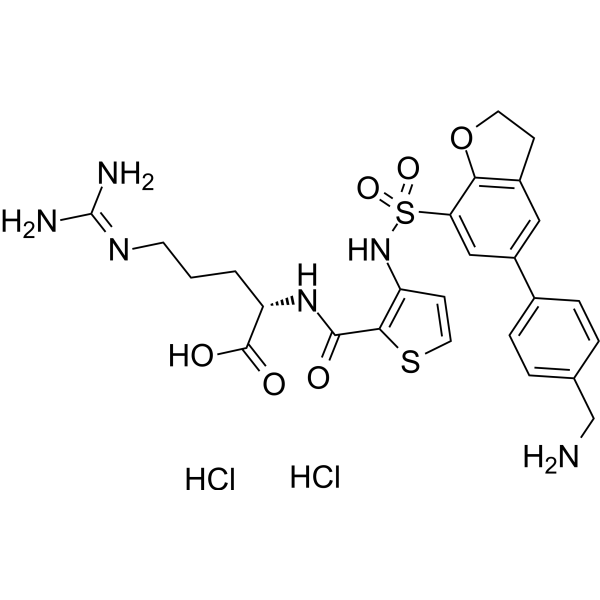
Physicochemical Properties
| Molecular Formula | C26H32CL2N6O6S2 |
| Molecular Weight | 659.604881286621 |
| Exact Mass | 658.12 |
| CAS # | 2749438-61-5 |
| Related CAS # | EG01377;2227996-00-9 |
| PubChem CID | 146681179 |
| Appearance | White to off-white solid powder |
| Hydrogen Bond Donor Count | 8 |
| Hydrogen Bond Acceptor Count | 10 |
| Rotatable Bond Count | 12 |
| Heavy Atom Count | 42 |
| Complexity | 1010 |
| Defined Atom Stereocenter Count | 1 |
| SMILES | C1COC2=C1C=C(C=C2S(=O)(=O)NC3=C(SC=C3)C(=O)N[C@@H](CCCN=C(N)N)C(=O)O)C4=CC=C(C=C4)CN.Cl.Cl |
| InChi Key | ZYFLTIBQQSYBQT-FJSYBICCSA-N |
| InChi Code | InChI=1S/C26H30N6O6S2.2ClH/c27-14-15-3-5-16(6-4-15)18-12-17-7-10-38-22(17)21(13-18)40(36,37)32-19-8-11-39-23(19)24(33)31-20(25(34)35)2-1-9-30-26(28)29;;/h3-6,8,11-13,20,32H,1-2,7,9-10,14,27H2,(H,31,33)(H,34,35)(H4,28,29,30);2*1H/t20-;;/m0../s1 |
| Chemical Name | (2S)-2-[[3-[[5-[4-(aminomethyl)phenyl]-2,3-dihydro-1-benzofuran-7-yl]sulfonylamino]thiophene-2-carbonyl]amino]-5-(diaminomethylideneamino)pentanoic acid;dihydrochloride |
| HS Tariff Code | 2934.99.9001 |
| Storage |
Powder-20°C 3 years 4°C 2 years In solvent -80°C 6 months -20°C 1 month Note: Please store this product in a sealed and protected environment (e.g. under nitrogen), avoid exposure to moisture. |
| Shipping Condition | Room temperature (This product is stable at ambient temperature for a few days during ordinary shipping and time spent in Customs) |
Biological Activity
| Targets | IC50: 609 nM (NRP1-a1 and NRP1-b)[1] |
| ln Vitro | Vascular endothelial growth factor A (VEGF-A) induced tyrosine phosphorylation of VEGF-R2/KDR is inhibited by EG01377 (3-30 μM; 30 minutes)[1]. VEGFA can considerably lessen HUVEC cell migration when EG01377 (30 μM) is applied[1]. EG01377 (30 μM; 5 days) can postpone the closure of wounds caused by VEGF[1]. The network area, length, and branching points are all decreased by EG01377 (30 μM)[1]. EG01377 (30 μM; 7 days) inhibits angiogenesis produced by VEGF [1]. When combined with VEGFA, EG01377 (30 μM; 7 days) decreases the growth of A375P (malignant melanoma) spheroid outgrowth[1]. When tumor cell-derived factors are present, EG01377 (500 nM; 2 hours) prevents Nrp1+ regulatory T-cell SMAD3/AKT (Tregs) from producing transforming growth factor beta (TGFβ)[1]. |
| ln Vivo | EG01377 (2 mg/kg; iv) has a promising half-life of 4.29 h, long enough to support treatment once daily in mice[1]. |
| Cell Assay |
Western Blot Analysis[1] Cell Types: Human umbilical vein endothelial cells (HUVECs) Tested Concentrations: 3, 10 , 30 μM Incubation Duration: 30 minutes Experimental Results: Inhibited VEGF-A stimulated tyrosine phosphorylation of VEGF-R2/KDR with an IC50 of 30 μM. |
| Animal Protocol |
Animal/Disease Models: 6-8 week-old BABL/c female mice[1] Doses: 2 mg/kg (pharmacokinetic/PK Analysis) Route of Administration: Iv administration Experimental Results: The half time (T1/2) of 4.29 h. |
| References |
[1]. Small Molecule Neuropilin-1 Antagonists Combine Antiangiogenic and Antitumor Activity with Immune Modulation through Reduction of Transforming Growth Factor Beta (TGFβ) Production in Regulatory T-Cells. J Med Chem. 2018 May 10;61(9):4135-4154. |
Solubility Data
| Solubility (In Vitro) | DMSO: 200 mg/mL (303.21 mM) |
| Solubility (In Vivo) |
Solubility in Formulation 1: ≥ 5 mg/mL (7.58 mM) (saturation unknown) in 10% DMSO + 40% PEG300 + 5% Tween80 + 45% Saline (add these co-solvents sequentially from left to right, and one by one), clear solution. For example, if 1 mL of working solution is to be prepared, you can add 100 μL of 50.0 mg/mL clear DMSO stock solution to 400 μL PEG300 and mix evenly; then add 50 μL Tween-80 to the above solution and mix evenly; then add 450 μL normal saline to adjust the volume to 1 mL. Preparation of saline: Dissolve 0.9 g of sodium chloride in 100 mL ddH₂ O to obtain a clear solution. Solubility in Formulation 2: ≥ 5 mg/mL (7.58 mM) (saturation unknown) in 10% DMSO + 90% (20% SBE-β-CD in Saline) (add these co-solvents sequentially from left to right, and one by one), clear solution. For example, if 1 mL of working solution is to be prepared, you can add 100 μL of 50.0 mg/mL clear DMSO stock solution to 900 μL of 20% SBE-β-CD physiological saline solution and mix evenly. Preparation of 20% SBE-β-CD in Saline (4°C,1 week): Dissolve 2 g SBE-β-CD in 10 mL saline to obtain a clear solution. Solubility in Formulation 3: ≥ 5 mg/mL (7.58 mM) (saturation unknown) in 10% DMSO + 90% Corn Oil (add these co-solvents sequentially from left to right, and one by one), clear solution. For example, if 1 mL of working solution is to be prepared, you can add 100 μL of 50.0 mg/mL clear DMSO stock solution to 900 μL of corn oil and mix evenly. (Please use freshly prepared in vivo formulations for optimal results.) |
| Preparing Stock Solutions | 1 mg | 5 mg | 10 mg | |
| 1 mM | 1.5161 mL | 7.5804 mL | 15.1607 mL | |
| 5 mM | 0.3032 mL | 1.5161 mL | 3.0321 mL | |
| 10 mM | 0.1516 mL | 0.7580 mL | 1.5161 mL |