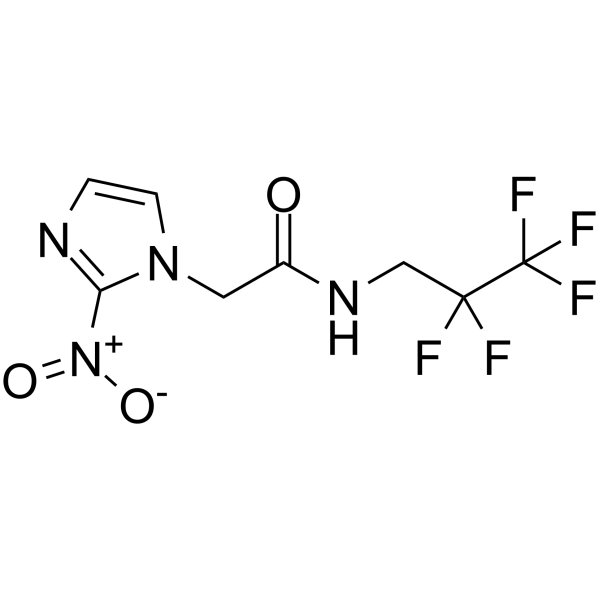
Physicochemical Properties
| Molecular Formula | C8H7N4O3F5 |
| Molecular Weight | 302.15818 |
| Exact Mass | 302.044 |
| CAS # | 152721-37-4 |
| PubChem CID | 389053 |
| Appearance | White to off-white solid powder |
| LogP | 2.468 |
| Hydrogen Bond Donor Count | 1 |
| Hydrogen Bond Acceptor Count | 9 |
| Rotatable Bond Count | 4 |
| Heavy Atom Count | 20 |
| Complexity | 383 |
| Defined Atom Stereocenter Count | 0 |
| SMILES | O=C(NCC(F)(F)C(F)(F)F)CN1C=CN=C1[N+]([O-])=O |
| InChi Key | JGGDSDPOPRWSCX-UHFFFAOYSA-N |
| InChi Code | InChI=1S/C8H7F5N4O3/c9-7(10,8(11,12)13)4-15-5(18)3-16-2-1-14-6(16)17(19)20/h1-2H,3-4H2,(H,15,18) |
| Chemical Name | 2-(2-nitroimidazol-1-yl)-N-(2,2,3,3,3-pentafluoropropyl)acetamide |
| HS Tariff Code | 2934.99.9001 |
| Storage |
Powder-20°C 3 years 4°C 2 years In solvent -80°C 6 months -20°C 1 month |
| Shipping Condition | Room temperature (This product is stable at ambient temperature for a few days during ordinary shipping and time spent in Customs) |
Biological Activity
| ln Vitro | Overexpression of CYPOR in SiHa and HCT116 cell lines resulted in a 2- to 4-fold increase in EF-5 binding, decreased metabolism of tirapazamine and CEN-209, and increased production of γH2AX. In 14 hypoxic tumor cell lines, reduced EF-5 binding and prodrug metabolism are significantly linked [1]. |
| ln Vivo | A potential stratification biomarker for benzotriazine-N-oxide bioreducible prodrugs is EF-5 binding. There is a strong correlation between CEN209-induced DNA damage at the individual tumor level and CYPOR overexpression, which also significantly increased EF-5 binding and decreased CEN-209 in HCT116 xenografts. Additionally, altering tumor hypoxia led to similar changes in bioreductive activation of both drugs, resulting in EF-5 binding. After intravenous injection of EF-5, monoclonal antibodies specifically bind to and identify 9L gliomas; this process is oxygen-dependent. On frozen tissue, binding can be identified by fluorescence microscopy. For light microscopic examination, tissue sections can be counterstained with hematoxylin and eosin. As an alternative, flow cytometry methods can be used to analyze individual tumor cells in order to infer the distribution of hypoxia inside tumors [2]. |
| References |
[1]. Wang J, et al. The 2-nitroimidazole EF5 is a biomarker for oxidoreductases that activate the bioreductive prodrug CEN-209 under hypoxia. Clin Cancer Res. 2012 Mar 15;18(6):1684-95. [2]. Evans SM, et al. Identification of hypoxia in cells and tissues of epigastric 9L rat glioma using EF5 [2-(2-nitro-1H-imidazol-1-yl)-N-(2,2,3,3,3-pentafluoropropyl) acetamide]. Br J Cancer. 1995 Oct;72(4):875-82 |
| Additional Infomation | EF5 is a fluorinated derivative of the 2-nitroimidazole etanidazole. EF5 is effective in accessing oxygen levels in tumor tissue through its adduct formation to intracellular macromolecules in the absence of oxygen. Reduction of this agent is carried out by a diverse group of enzymes in the cytoplasm, microsomes and mitochondria. Tissue hypoxia detection via EF5 has been reported in several cancers, including squamous cell carcinoma of the cervix and the head and neck, and in sarcoma. |
Solubility Data
| Solubility (In Vitro) | DMSO : ~125 mg/mL (~413.69 mM) |
| Solubility (In Vivo) |
Solubility in Formulation 1: ≥ 2.08 mg/mL (6.88 mM) (saturation unknown) in 10% DMSO + 40% PEG300 + 5% Tween80 + 45% Saline (add these co-solvents sequentially from left to right, and one by one), clear solution. For example, if 1 mL of working solution is to be prepared, you can add 100 μL of 20.8 mg/mL clear DMSO stock solution to 400 μL PEG300 and mix evenly; then add 50 μL Tween-80 to the above solution and mix evenly; then add 450 μL normal saline to adjust the volume to 1 mL. Preparation of saline: Dissolve 0.9 g of sodium chloride in 100 mL ddH₂ O to obtain a clear solution. Solubility in Formulation 2: ≥ 2.08 mg/mL (6.88 mM) (saturation unknown) in 10% DMSO + 90% (20% SBE-β-CD in Saline) (add these co-solvents sequentially from left to right, and one by one), clear solution. For example, if 1 mL of working solution is to be prepared, you can add 100 μL of 20.8 mg/mL clear DMSO stock solution to 900 μL of 20% SBE-β-CD physiological saline solution and mix evenly. Preparation of 20% SBE-β-CD in Saline (4°C,1 week): Dissolve 2 g SBE-β-CD in 10 mL saline to obtain a clear solution. Solubility in Formulation 3: ≥ 2.08 mg/mL (6.88 mM) (saturation unknown) in 10% DMSO + 90% Corn Oil (add these co-solvents sequentially from left to right, and one by one), clear solution. For example, if 1 mL of working solution is to be prepared, you can add 100 μL of 20.8 mg/mL clear DMSO stock solution to 900 μL of corn oil and mix evenly. (Please use freshly prepared in vivo formulations for optimal results.) |
| Preparing Stock Solutions | 1 mg | 5 mg | 10 mg | |
| 1 mM | 3.3095 mL | 16.5475 mL | 33.0950 mL | |
| 5 mM | 0.6619 mL | 3.3095 mL | 6.6190 mL | |
| 10 mM | 0.3310 mL | 1.6548 mL | 3.3095 mL |