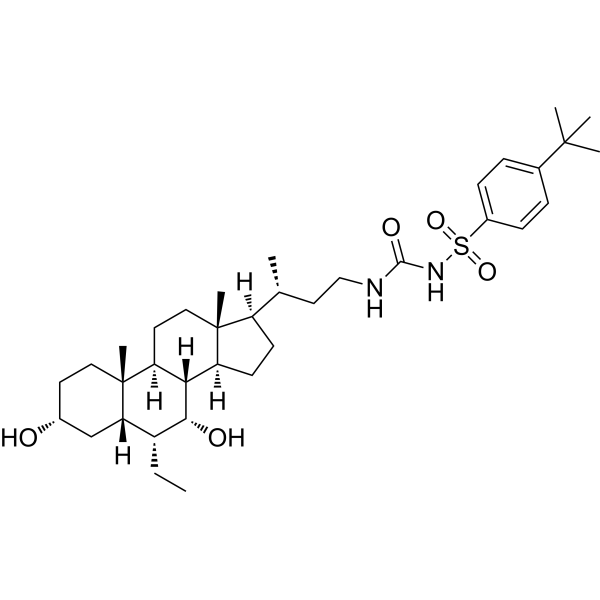
Physicochemical Properties
| Molecular Formula | C36H58N2O5S |
| Molecular Weight | 630.92 |
| CAS # | 1933507-63-1 |
| PubChem CID | 121428882 |
| Appearance | White to off-white solid powder |
| Hydrogen Bond Donor Count | 4 |
| Hydrogen Bond Acceptor Count | 5 |
| Rotatable Bond Count | 8 |
| Heavy Atom Count | 44 |
| Complexity | 1120 |
| Defined Atom Stereocenter Count | 11 |
| SMILES | S(C1C=CC(C(C)(C)C)=CC=1)(NC(NCC[C@@H](C)[C@@]1([H])CC[C@]2([H])[C@]1(C)CC[C@]1([H])[C@@]3(C)CC[C@@H](C[C@]3([H])[C@@H](CC)[C@H]([C@@]12[H])O)O)=O)(=O)=O |
| HS Tariff Code | 2934.99.9001 |
| Storage |
Powder-20°C 3 years 4°C 2 years In solvent -80°C 6 months -20°C 1 month |
| Shipping Condition | Room temperature (This product is stable at ambient temperature for a few days during ordinary shipping and time spent in Customs) |
Biological Activity
| ln Vitro | In liver hepatocytes, EDP-305 (10 μM, 72 h) directly activates FXR, but not in stellate cells [1]. In HepaRG hepatocytes, EDP-305 (0–5 μM, 16 hours) can down-regulate the expression of CYP7A1 and up-regulate the expression of the FXR target gene SHP [2]. |
| ln Vivo | EDP-305 (0-30 mg/kg, oral gavage, once daily for 2 weeks) decreases blood indicators of liver injury and reduces hepatic fibrosis in a dose-dependent manner in BDL rats [1]. EDP-305 (0-30 mg/kg, oral gavage, once daily for 6 weeks) decreases liver fibrosis in CDAHFD mice in a dose-dependent manner [1]. |
| Cell Assay |
Western Blot Analysis[1] Cell Types: Hepatic stellate cell (HSC) line, primary HSC and hepatocytes Tested Concentrations: 10 μM Incubation Duration: 72 hrs (hours) Experimental Results: Induced SHP and FGF19 mRNA expression in human hepatocytes, but not Expression of downstream targets in star lines is SHP or FGF15/19. RT-PCR[2] Cell Types: HepaRG Hepatocyte Tested Concentrations: 0.05, 0.1, 0.5, 1, 5, 10, 50, 100, 500, 1000, 5000 nM Incubation Duration: 16 hrs (hours) Experimental Results: Dose-dependent increase in FXR target genes CYP7A1 expression was downregulated in , SHP and HepaRG hepatocytes. |
| Animal Protocol |
Animal/Disease Models: Male CD rats (receiving BDL, n=24, n=8 per group) [1] Doses: 0, 10 and 30 mg/kg Route of Administration: Daily po (oral gavage), starting from the 4th day after BDL Started on day 17 and continued until day 17-18. Experimental Results: Alanine aminotransferase and aspartate aminotransferase were Dramatically diminished. demonstrated a dose-dependent decrease in CPA. Hydroxyproline levels were diminished in whole liver tissue samples. The messenger RNA (mRNA) relative quantification (RQ) of Col1a1 and actin, α2, smooth muscle, and aorta (Acta2) was diminished. Animal/Disease Models: Male C57BL/6 mice (n = 24, fed CDAHFD consisting of 60% kcal fat and 0.1% methionine) [1] Doses: 0, 10 and 30 mg/kg Route of Administration: Daily po (oral gavage) , starting the diet from week 6 and continuing until week 12. Experimental Results: Serum triglycerides were diminished, hydroxyproline and MR liver signal intensity were Dramatically diminished in a dose-dependent manner. The mRNA expression of lysyl oxidase genes Lox and Loxl1-4 diminished in a dose-depe |
| References |
[1]. Molecular magnetic resonance imaging accurately measures the antifibrotic effect of EDP-305, a novel farnesoid X receptor agonist. Hepatol Commun. 2018 May 21;2(7):821-835. [2]. Characterization of EDP-305, a Highly Potent and Selective Farnesoid X Receptor Agonist, for the Treatment of Non-alcoholic Steatohepatitis. International Journal of Gastroenterology, 2019(1). |
Solubility Data
| Solubility (In Vitro) | DMSO : ≥ 100 mg/mL (~158.50 mM) |
| Solubility (In Vivo) |
Solubility in Formulation 1: 2.5 mg/mL (3.96 mM) in 10% DMSO + 40% PEG300 + 5% Tween80 + 45% Saline (add these co-solvents sequentially from left to right, and one by one), suspension solution; with sonication. For example, if 1 mL of working solution is to be prepared, you can add 100 μL of 25.0 mg/mL clear DMSO stock solution to 400 μL PEG300 and mix evenly; then add 50 μL Tween-80 to the above solution and mix evenly; then add 450 μL normal saline to adjust the volume to 1 mL. Preparation of saline: Dissolve 0.9 g of sodium chloride in 100 mL ddH₂ O to obtain a clear solution. Solubility in Formulation 2: 2.5 mg/mL (3.96 mM) in 10% DMSO + 90% (20% SBE-β-CD in Saline) (add these co-solvents sequentially from left to right, and one by one), suspension solution; with ultrasonication. For example, if 1 mL of working solution is to be prepared, you can add 100 μL of 25.0 mg/mL clear DMSO stock solution to 900 μL of 20% SBE-β-CD physiological saline solution and mix evenly. Preparation of 20% SBE-β-CD in Saline (4°C,1 week): Dissolve 2 g SBE-β-CD in 10 mL saline to obtain a clear solution. Solubility in Formulation 3: ≥ 2.5 mg/mL (3.96 mM) (saturation unknown) in 10% DMSO + 90% Corn Oil (add these co-solvents sequentially from left to right, and one by one), clear solution. For example, if 1 mL of working solution is to be prepared, you can add 100 μL of 25.0 mg/mL clear DMSO stock solution to 900 μL of corn oil and mix evenly. (Please use freshly prepared in vivo formulations for optimal results.) |
| Preparing Stock Solutions | 1 mg | 5 mg | 10 mg | |
| 1 mM | 1.5850 mL | 7.9249 mL | 15.8499 mL | |
| 5 mM | 0.3170 mL | 1.5850 mL | 3.1700 mL | |
| 10 mM | 0.1585 mL | 0.7925 mL | 1.5850 mL |