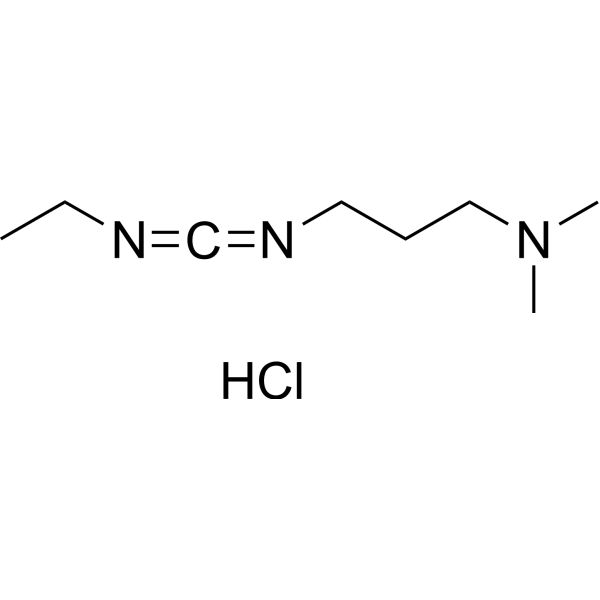
Physicochemical Properties
| Molecular Formula | C8H18CLN3 |
| Molecular Weight | 191.7016 |
| Exact Mass | 191.118 |
| CAS # | 25952-53-8 |
| PubChem CID | 2723939 |
| Appearance | White to off-white solid powder |
| Density | 0.877 g/mL at 20 °C(lit.) |
| Boiling Point | 269.1ºC at 760 mmHg |
| Melting Point | 110-115 °C(lit.) |
| Flash Point | 107.9ºC |
| Vapour Pressure | 0.171mmHg at 25°C |
| Index of Refraction | n20/D 1.461 |
| LogP | 1.933 |
| Hydrogen Bond Donor Count | 1 |
| Hydrogen Bond Acceptor Count | 3 |
| Rotatable Bond Count | 5 |
| Heavy Atom Count | 12 |
| Complexity | 134 |
| Defined Atom Stereocenter Count | 0 |
| InChi Key | FPQQSJJWHUJYPU-UHFFFAOYSA-N |
| InChi Code | InChI=1S/C8H17N3.ClH/c1-4-9-8-10-6-5-7-11(2)3;/h4-7H2,1-3H3;1H |
| HS Tariff Code | 2934.99.9001 |
| Storage |
Powder-20°C 3 years 4°C 2 years In solvent -80°C 6 months -20°C 1 month Note: Please store this product in a sealed and protected environment, avoid exposure to moisture. |
| Shipping Condition | Room temperature (This product is stable at ambient temperature for a few days during ordinary shipping and time spent in Customs) |
Biological Activity
| ln Vitro | 1-(3-Dimethylaminopropyl)-3-ethylcarbodiimide hydrochloride (EDC.HCl) is an extremely helpful chemical for forming amide bonds, or peptide bonds, in aqueous fluids [5]. In order to prepare fatty amines for HPLC and polyaniline-carbon nanotubes for cryogenic biosensors, 1-(3-Dimethylaminopropyl)-3-ethylcarbodiimide hydrochloride (EDC.HCl) is frequently utilized. The experiments include pre-column derivatization, solid-phase microregulation of peptides, preparation and detection of calcium sensors, creation of molecular beacons for DNA research, and simulation of 1-(3-dimethylaminopropyl)-3-ethylcarbodiimide hydrochloride (EDC.HCl) using fluorometric measurement [2]. Acid decarboxylase (GAD) does not significantly limit substrate degradation [3]. |
| References |
[1]. Spectrophotometric determination of 1-(3-dimethylaminopropyl)-3-ethylcarbodiimide hydrochloride by flow injection analysis. Anal Sci. 2008 Apr;24(4):505-8. [2]. Determination of 1-(3-dimethylaminopropyl)-3-ethylcarbodiimide hydrochloride by flow-injection analysis based on a specific condensation reaction between malonic acid and ethylenediamine. Anal Sci. 2009 Mar;25(3):389-93. [3]. AMADH inhibitor optimization and its effects on GABA accumulation in soybean sprouts under NaCl-CaCl 2 treatment. 3 Biotech. 2019 May;9(5):184. |
Solubility Data
| Solubility (In Vitro) |
H2O : ~100 mg/mL (~521.65 mM) DMSO : ~62.5 mg/mL (~326.03 mM) |
| Solubility (In Vivo) |
Solubility in Formulation 1: ≥ 2.5 mg/mL (13.04 mM) (saturation unknown) in 10% DMSO + 40% PEG300 + 5% Tween80 + 45% Saline (add these co-solvents sequentially from left to right, and one by one), clear solution. For example, if 1 mL of working solution is to be prepared, you can add 100 μL of 25.0 mg/mL clear DMSO stock solution to 400 μL PEG300 and mix evenly; then add 50 μL Tween-80 to the above solution and mix evenly; then add 450 μL normal saline to adjust the volume to 1 mL. Preparation of saline: Dissolve 0.9 g of sodium chloride in 100 mL ddH₂ O to obtain a clear solution. Solubility in Formulation 2: ≥ 2.5 mg/mL (13.04 mM) (saturation unknown) in 10% DMSO + 90% (20% SBE-β-CD in Saline) (add these co-solvents sequentially from left to right, and one by one), clear solution. For example, if 1 mL of working solution is to be prepared, you can add 100 μL of 25.0 mg/mL clear DMSO stock solution to 900 μL of 20% SBE-β-CD physiological saline solution and mix evenly. Preparation of 20% SBE-β-CD in Saline (4°C,1 week): Dissolve 2 g SBE-β-CD in 10 mL saline to obtain a clear solution. Solubility in Formulation 3: ≥ 2.5 mg/mL (13.04 mM) (saturation unknown) in 10% DMSO + 90% Corn Oil (add these co-solvents sequentially from left to right, and one by one), clear solution. For example, if 1 mL of working solution is to be prepared, you can add 100 μL of 25.0 mg/mL clear DMSO stock solution to 900 μL of corn oil and mix evenly. (Please use freshly prepared in vivo formulations for optimal results.) |
| Preparing Stock Solutions | 1 mg | 5 mg | 10 mg | |
| 1 mM | 5.2165 mL | 26.0824 mL | 52.1648 mL | |
| 5 mM | 1.0433 mL | 5.2165 mL | 10.4330 mL | |
| 10 mM | 0.5216 mL | 2.6082 mL | 5.2165 mL |