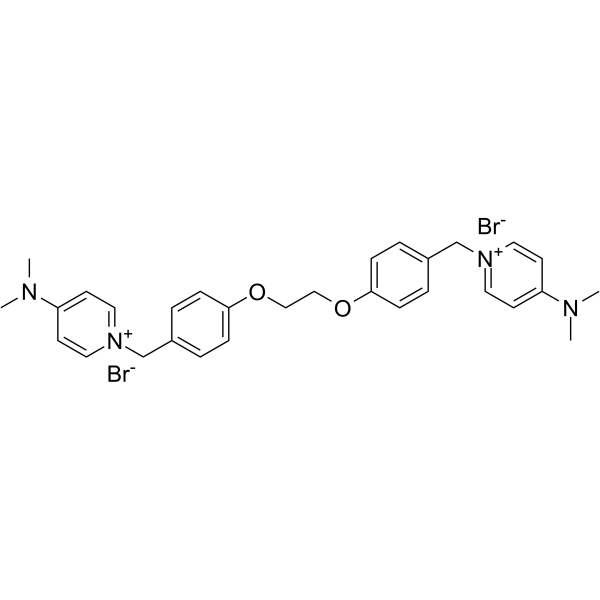
Physicochemical Properties
| Molecular Formula | C₃₀H₃₆BR₂N₄O₂MOLECULARWEIGHT |
| Molecular Weight | 644.44 |
| Exact Mass | 644.118 |
| Elemental Analysis | C, 55.91; H, 5.63; Br, 24.80; N, 8.69; O, 4.97 |
| CAS # | 1839150-63-8 |
| Related CAS # | 1839150-62-7 (cation);1839150-63-8 (bromide); |
| PubChem CID | 90467110 |
| Appearance | White to off-white solid powder |
| Hydrogen Bond Donor Count | 0 |
| Hydrogen Bond Acceptor Count | 6 |
| Rotatable Bond Count | 11 |
| Heavy Atom Count | 38 |
| Complexity | 534 |
| Defined Atom Stereocenter Count | 0 |
| InChi Key | SCXVGPSPZQBBDM-UHFFFAOYSA-L |
| InChi Code | InChI=1S/C30H36N4O2.2BrH/c1-31(2)27-13-17-33(18-14-27)23-25-5-9-29(10-6-25)35-21-22-36-30-11-7-26(8-12-30)24-34-19-15-28(16-20-34)32(3)4;;/h5-20H,21-24H2,1-4H3;2*1H/q+2;;/p-2 |
| Chemical Name | 1-[[4-[2-[4-[[4-(dimethylamino)pyridin-1-ium-1-yl]methyl]phenoxy]ethoxy]phenyl]methyl]-N,N-dimethylpyridin-1-ium-4-amine;dibromide |
| Synonyms | EB3D; EB 3D |
| HS Tariff Code | 2934.99.9001 |
| Storage |
Powder-20°C 3 years 4°C 2 years In solvent -80°C 6 months -20°C 1 month Note: Please store this product in a sealed and protected environment, avoid exposure to moisture. |
| Shipping Condition | Room temperature (This product is stable at ambient temperature for a few days during ordinary shipping and time spent in Customs) |
Biological Activity
| ln Vitro | With GI GI50s 13 values in the nanomolar range, EB-3D has outstanding antiproliferative action against several T leukemia cell lines (0-100 μM; 72 hours) [1]. In leukemia cell lines, EB-3D (1.25-5μM; 24 hours) causes apoptosis [1]. G0/G1 arrest is induced by EB-3D (0.5-1 μM; 24 hours), which results cell apoptosis [1]. After 30 minutes, AMPKα is first activated in EB-3D (0.3 μM; 48 hours), which is followed by enhanced T172 phosphorylation [1]. HepG2 cell proliferation is inhibited by EB-3D (1-40 μM; 48 hours) with a GI50 of 14.55 μM [2]. In leukemic T cells, EB-3D causes deregulation of the AMPK-mTOR pathway and apoptosis [1]. |
| ln Vivo | In the syngeneic orthotopic E0771-C57BL/6 mouse model, EB-3D (1 mg/kg; i.p.; every other day) inhibits the formation of breast tumors [4]. For four weeks, EB-3D (2.5 mg/kg; every other day) reduced the amount of spontaneous lung macro- and micrometastases [4]. |
| Cell Assay |
Cell Proliferation Assay[1] Cell Types: JURKAT, CCRF-CEM, HSB-2, MOLT-16, DNA-41, LOUCY, PEER, ALL-SIL Cell Tested Concentrations: 0.001, 0.01, 0.1, 1, 10, 100 μM Incubation Duration: 72 hrs (hours) Experimental Results: Inhibition of JURKAT, CCRF-CEM, HSB-2, MOLT-16, DNA-41, LOUCY, PEER and ALL-SIL cell growth with GI50 of 136.2, 478.8, 17.7, 0.9, 60.6, 200, respectively are 265 and 132 nM. Apoptosis analysis [1] Cell Types: Jurkat, CCRF-CEM and HSB-2 Cell Tested Concentrations: 1.25, 2.5, 5 μM Incubation Duration: 24 hrs (hours) Experimental Results: Induction of apoptosis in leukemia cell lines. Cell cycle analysis [1] Cell Types: Jurkat, CCRF-CEM and HSB-2 Cell Tested Concentrations: 0.5, 1 μM Incubation Duration: 24 hrs (hours) Experimental Results: Induced cell cycle arrest in G0/G1 phase. Western Blot Analysis [1] Cell Types: Jurkat cells Tested Concentrations: 0.3 μM Incubation Duration: 48 hrs (hours) Experimental Results: The first activation peak of AMPKα occurred after 30 minutes of treatment, followed by an increase in T172 phosphorylation. The same pattern was followed by increased S79 phosph |
| Animal Protocol |
Animal/Disease Models: E0771-C57BL/6 mice [4] Doses: Ip; every other day for 4 weeks: 2.5 mg/kg Experimental Results: The number of spontaneous lung macro and micro metastases was diminished. |
| References |
[1]. EB-3D a novel choline kinase inhibitor induces deregulation of the AMPK-mTOR pathway and apoptosis in leukemia T-cells. Biochem Pharmacol. 2018 Sep;155:213-223. [2]. Choline kinase inhibitors EB-3D and EB-3P interferes with lipid homeostasis in HepG2 cells. Sci Rep. 2019 Mar 25;9(1):5109. [3]. Design, synthesis, crystallization and biological evaluation of new symmetrical biscationic compounds as selective inhibitors of human Choline Kinase α1 (ChoKα1). [4]. Choline Kinase Alpha Inhibition by EB-3D Triggers Cellular Senescence, Reduces Tumor Growth and Metastatic Dissemination in Breast Cancer. Cancers (Basel). 2018;10(10):391. Published 2018 Oct 22. |
Solubility Data
| Solubility (In Vitro) |
DMSO : ~50 mg/mL (~77.59 mM) H2O : ≥ 9.09 mg/mL (~14.11 mM) |
| Solubility (In Vivo) |
Note: Listed below are some common formulations that may be used to formulate products with low water solubility (e.g. < 1 mg/mL), you may test these formulations using a minute amount of products to avoid loss of samples. Injection Formulations (e.g. IP/IV/IM/SC) Injection Formulation 1: DMSO : Tween 80: Saline = 10 : 5 : 85 (i.e. 100 μL DMSO stock solution → 50 μL Tween 80 → 850 μL Saline) *Preparation of saline: Dissolve 0.9 g of sodium chloride in 100 mL ddH ₂ O to obtain a clear solution. Injection Formulation 2: DMSO : PEG300 :Tween 80 : Saline = 10 : 40 : 5 : 45 (i.e. 100 μL DMSO → 400 μLPEG300 → 50 μL Tween 80 → 450 μL Saline) Injection Formulation 3: DMSO : Corn oil = 10 : 90 (i.e. 100 μL DMSO → 900 μL Corn oil) Example: Take the Injection Formulation 3 (DMSO : Corn oil = 10 : 90) as an example, if 1 mL of 2.5 mg/mL working solution is to be prepared, you can take 100 μL 25 mg/mL DMSO stock solution and add to 900 μL corn oil, mix well to obtain a clear or suspension solution (2.5 mg/mL, ready for use in animals). Injection Formulation 4: DMSO : 20% SBE-β-CD in saline = 10 : 90 [i.e. 100 μL DMSO → 900 μL (20% SBE-β-CD in saline)] *Preparation of 20% SBE-β-CD in Saline (4°C,1 week): Dissolve 2 g SBE-β-CD in 10 mL saline to obtain a clear solution. Injection Formulation 5: 2-Hydroxypropyl-β-cyclodextrin : Saline = 50 : 50 (i.e. 500 μL 2-Hydroxypropyl-β-cyclodextrin → 500 μL Saline) Injection Formulation 6: DMSO : PEG300 : castor oil : Saline = 5 : 10 : 20 : 65 (i.e. 50 μL DMSO → 100 μLPEG300 → 200 μL castor oil → 650 μL Saline) Injection Formulation 7: Ethanol : Cremophor : Saline = 10: 10 : 80 (i.e. 100 μL Ethanol → 100 μL Cremophor → 800 μL Saline) Injection Formulation 8: Dissolve in Cremophor/Ethanol (50 : 50), then diluted by Saline Injection Formulation 9: EtOH : Corn oil = 10 : 90 (i.e. 100 μL EtOH → 900 μL Corn oil) Injection Formulation 10: EtOH : PEG300:Tween 80 : Saline = 10 : 40 : 5 : 45 (i.e. 100 μL EtOH → 400 μLPEG300 → 50 μL Tween 80 → 450 μL Saline) Oral Formulations Oral Formulation 1: Suspend in 0.5% CMC Na (carboxymethylcellulose sodium) Oral Formulation 2: Suspend in 0.5% Carboxymethyl cellulose Example: Take the Oral Formulation 1 (Suspend in 0.5% CMC Na) as an example, if 100 mL of 2.5 mg/mL working solution is to be prepared, you can first prepare 0.5% CMC Na solution by measuring 0.5 g CMC Na and dissolve it in 100 mL ddH2O to obtain a clear solution; then add 250 mg of the product to 100 mL 0.5% CMC Na solution, to make the suspension solution (2.5 mg/mL, ready for use in animals). Oral Formulation 3: Dissolved in PEG400 Oral Formulation 4: Suspend in 0.2% Carboxymethyl cellulose Oral Formulation 5: Dissolve in 0.25% Tween 80 and 0.5% Carboxymethyl cellulose Oral Formulation 6: Mixing with food powders Note: Please be aware that the above formulations are for reference only. InvivoChem strongly recommends customers to read literature methods/protocols carefully before determining which formulation you should use for in vivo studies, as different compounds have different solubility properties and have to be formulated differently. (Please use freshly prepared in vivo formulations for optimal results.) |
| Preparing Stock Solutions | 1 mg | 5 mg | 10 mg | |
| 1 mM | 1.5517 mL | 7.7587 mL | 15.5173 mL | |
| 5 mM | 0.3103 mL | 1.5517 mL | 3.1035 mL | |
| 10 mM | 0.1552 mL | 0.7759 mL | 1.5517 mL |