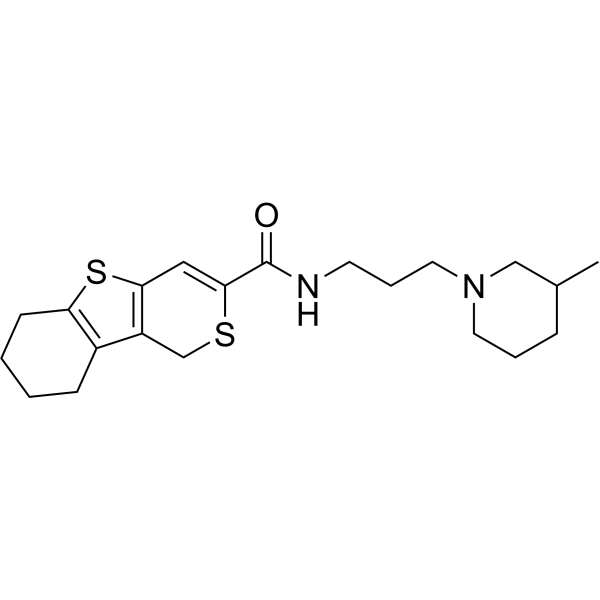
Physicochemical Properties
| Molecular Formula | C21H30N2OS2 |
| Molecular Weight | 390.605702877045 |
| Exact Mass | 390.179 |
| CAS # | 931963-55-2 |
| PubChem CID | 20913345 |
| Appearance | Typically exists as solid at room temperature |
| LogP | 4.6 |
| Hydrogen Bond Donor Count | 1 |
| Hydrogen Bond Acceptor Count | 4 |
| Rotatable Bond Count | 5 |
| Heavy Atom Count | 26 |
| Complexity | 538 |
| Defined Atom Stereocenter Count | 0 |
| SMILES | S1C2C=C(C(NCCCN3CCCC(C)C3)=O)SCC=2C2=C1CCCC2 |
| InChi Key | KTLYLDMTGYBKTC-UHFFFAOYSA-N |
| InChi Code | InChI=1S/C21H30N2OS2/c1-15-6-4-10-23(13-15)11-5-9-22-21(24)20-12-19-17(14-25-20)16-7-2-3-8-18(16)26-19/h12,15H,2-11,13-14H2,1H3,(H,22,24) |
| Chemical Name | N-[3-(3-methylpiperidin-1-yl)propyl]-6,7,8,9-tetrahydro-1H-thiopyrano[4,3-b][1]benzothiole-3-carboxamide |
| Synonyms | E722-2648; CHEMBL5398378; 931963-55-2; N-[3-(3-METHYL-1-PIPERIDINYL)PROPYL]-6,7,8,9-TETRAHYDRO-1H-THIOPYRANO[4,3-B][1]BENZOTHIOPHENE-3-CARBOXAMIDE; N-[3-(3-methylpiperidin-1-yl)propyl]-6,7,8,9-tetrahydro-1H-thiopyrano[4,3-b][1]benzothiole-3-carboxamide; |
| HS Tariff Code | 2934.99.9001 |
| Storage |
Powder-20°C 3 years 4°C 2 years In solvent -80°C 6 months -20°C 1 month |
| Shipping Condition | Room temperature (This product is stable at ambient temperature for a few days during ordinary shipping and time spent in Customs) |
Biological Activity
| Targets | β-catenin/BCL9 complex |
| ln Vitro | Top hits identified by HTS (table S1) that were commercially available were purchased and examined with a 10-dose response AlphaScreen assay, in which compounds were titrated against full-length β-catenin and against an unrelated protein (BRD9) as a counter-screen to further filter out any unspecific compounds (Fig. 1F). This assay validated 16 compounds that specifically and competitively inhibited β-catenin/BCL9, but not BRD9/ligand complexes. The five top-performing compounds include E722-2648 (C-1), L814-1428 (C-2), SYN22094413 (C-3), L859-1770 (C-4), and F838-0143 (C-5) and will be referred to using their shortened names (C-1 to C-5) throughout this manuscript (Fig. 1F). To further confirm specificity and characterize the binding thermodynamics of the top 16 compounds, we used isothermal titration calorimetry (ITC). Dissociation constant (KD) values for the five top-performing compounds ranged between 0.27 and 2.22 μM and were comparable to the BCL9 peptide used as a positive control (2.74 μM) (Fig. 1G and table S2).[1] |
| References |
[1].A novel β-catenin/BCL9 complex inhibitor blocks oncogenic Wnt signaling and disrupts cholesterol homeostasis in colorectal cancer. Sci Adv. 2022 Apr 29;8(17):eabm3108. |
| Additional Infomation | Dysregulated Wnt/β-catenin signaling is implicated in the pathogenesis of many human cancers, including colorectal cancer (CRC), making it an attractive clinical target. With the aim of inhibiting oncogenic Wnt activity, we developed a high-throughput screening AlphaScreen assay to identify selective small-molecule inhibitors of the interaction between β-catenin and its coactivator BCL9. We identified a compound that consistently bound to β-catenin and specifically inhibited in vivo native β-catenin/BCL9 complex formation in CRC cell lines. This compound inhibited Wnt activity, down-regulated expression of the Wnt/β-catenin signature in gene expression studies, disrupted cholesterol homeostasis, and significantly reduced the proliferation of CRC cell lines and tumor growth in a xenograft mouse model of CRC. This study has therefore identified a specific small-molecule inhibitor of oncogenic Wnt signaling, which may have value as a probe for functional studies and has important implications for the development of novel therapies in patients with CRC.[1] |
Solubility Data
| Solubility (In Vitro) | Typically soluble in DMSO (e.g. 10 mM) |
| Solubility (In Vivo) |
Note: Listed below are some common formulations that may be used to formulate products with low water solubility (e.g. < 1 mg/mL), you may test these formulations using a minute amount of products to avoid loss of samples. Injection Formulations (e.g. IP/IV/IM/SC) Injection Formulation 1: DMSO : Tween 80: Saline = 10 : 5 : 85 (i.e. 100 μL DMSO stock solution → 50 μL Tween 80 → 850 μL Saline) *Preparation of saline: Dissolve 0.9 g of sodium chloride in 100 mL ddH ₂ O to obtain a clear solution. Injection Formulation 2: DMSO : PEG300 :Tween 80 : Saline = 10 : 40 : 5 : 45 (i.e. 100 μL DMSO → 400 μLPEG300 → 50 μL Tween 80 → 450 μL Saline) Injection Formulation 3: DMSO : Corn oil = 10 : 90 (i.e. 100 μL DMSO → 900 μL Corn oil) Example: Take the Injection Formulation 3 (DMSO : Corn oil = 10 : 90) as an example, if 1 mL of 2.5 mg/mL working solution is to be prepared, you can take 100 μL 25 mg/mL DMSO stock solution and add to 900 μL corn oil, mix well to obtain a clear or suspension solution (2.5 mg/mL, ready for use in animals). Injection Formulation 4: DMSO : 20% SBE-β-CD in saline = 10 : 90 [i.e. 100 μL DMSO → 900 μL (20% SBE-β-CD in saline)] *Preparation of 20% SBE-β-CD in Saline (4°C,1 week): Dissolve 2 g SBE-β-CD in 10 mL saline to obtain a clear solution. Injection Formulation 5: 2-Hydroxypropyl-β-cyclodextrin : Saline = 50 : 50 (i.e. 500 μL 2-Hydroxypropyl-β-cyclodextrin → 500 μL Saline) Injection Formulation 6: DMSO : PEG300 : castor oil : Saline = 5 : 10 : 20 : 65 (i.e. 50 μL DMSO → 100 μLPEG300 → 200 μL castor oil → 650 μL Saline) Injection Formulation 7: Ethanol : Cremophor : Saline = 10: 10 : 80 (i.e. 100 μL Ethanol → 100 μL Cremophor → 800 μL Saline) Injection Formulation 8: Dissolve in Cremophor/Ethanol (50 : 50), then diluted by Saline Injection Formulation 9: EtOH : Corn oil = 10 : 90 (i.e. 100 μL EtOH → 900 μL Corn oil) Injection Formulation 10: EtOH : PEG300:Tween 80 : Saline = 10 : 40 : 5 : 45 (i.e. 100 μL EtOH → 400 μLPEG300 → 50 μL Tween 80 → 450 μL Saline) Oral Formulations Oral Formulation 1: Suspend in 0.5% CMC Na (carboxymethylcellulose sodium) Oral Formulation 2: Suspend in 0.5% Carboxymethyl cellulose Example: Take the Oral Formulation 1 (Suspend in 0.5% CMC Na) as an example, if 100 mL of 2.5 mg/mL working solution is to be prepared, you can first prepare 0.5% CMC Na solution by measuring 0.5 g CMC Na and dissolve it in 100 mL ddH2O to obtain a clear solution; then add 250 mg of the product to 100 mL 0.5% CMC Na solution, to make the suspension solution (2.5 mg/mL, ready for use in animals). Oral Formulation 3: Dissolved in PEG400 Oral Formulation 4: Suspend in 0.2% Carboxymethyl cellulose Oral Formulation 5: Dissolve in 0.25% Tween 80 and 0.5% Carboxymethyl cellulose Oral Formulation 6: Mixing with food powders Note: Please be aware that the above formulations are for reference only. InvivoChem strongly recommends customers to read literature methods/protocols carefully before determining which formulation you should use for in vivo studies, as different compounds have different solubility properties and have to be formulated differently. (Please use freshly prepared in vivo formulations for optimal results.) |
| Preparing Stock Solutions | 1 mg | 5 mg | 10 mg | |
| 1 mM | 2.5601 mL | 12.8005 mL | 25.6010 mL | |
| 5 mM | 0.5120 mL | 2.5601 mL | 5.1202 mL | |
| 10 mM | 0.2560 mL | 1.2800 mL | 2.5601 mL |