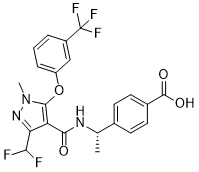
E7046 is a potent and selective antagonist of the type 4 prostaglandin E2 (PGE2) receptor EP4. In order to restore anti-tumor immunity, EP4 antagonisty by E7046 reduces myeloid immunosuppression and works in concert with Treg-reducing IL-2-Diphtheria toxin fusion protein. The pro-tumor myeloid cell differentiation and activation mediated by PGE2 is specifically and potently inhibited by E7046. In vivo, E7046 treatment inhibited the growth of tumors or even rejected those that had already grown; this effect was reliant on both myeloid and CD8+ T cells.
Physicochemical Properties
| Molecular Formula | C22H18F5N3O4 |
| Molecular Weight | 483.395 |
| Exact Mass | 483.121 |
| Elemental Analysis | C, 54.66; H, 3.75; F, 19.65; N, 8.69; O, 13.24 |
| CAS # | 1369489-71-3 |
| Related CAS # | 1369489-71-3 |
| PubChem CID | 56944705 |
| Appearance | White to off-white solid powder |
| Density | 1.4±0.1 g/cm3 |
| Boiling Point | 594.8±50.0 °C at 760 mmHg |
| Flash Point | 313.5±30.1 °C |
| Vapour Pressure | 0.0±1.8 mmHg at 25°C |
| Index of Refraction | 1.564 |
| LogP | 3.81 |
| Hydrogen Bond Donor Count | 2 |
| Hydrogen Bond Acceptor Count | 10 |
| Rotatable Bond Count | 7 |
| Heavy Atom Count | 34 |
| Complexity | 717 |
| Defined Atom Stereocenter Count | 1 |
| SMILES | O=C(O)C1=CC=C([C@@H](NC(C2=C(OC3=CC=CC(C(F)(F)F)=C3)N(C)N=C2C(F)F)=O)C)C=C1 |
| InChi Key | MKLKAQMPKHNQPR-NSHDSACASA-N |
| InChi Code | InChI=1S/C22H18F5N3O4/c1-11(12-6-8-13(9-7-12)21(32)33)28-19(31)16-17(18(23)24)29-30(2)20(16)34-15-5-3-4-14(10-15)22(25,26)27/h3-11,18H,1-2H3,(H,28,31)(H,32,33)/t11-/m0/s1 |
| Chemical Name | 4-[(1S)-1-[[3-(difluoromethyl)-1-methyl-5-[3-(trifluoromethyl)phenoxy]pyrazole-4-carbonyl]amino]ethyl]benzoic acid |
| Synonyms | E7046; E-7046; E 7046 |
| HS Tariff Code | 2934.99.9001 |
| Storage |
Powder-20°C 3 years 4°C 2 years In solvent -80°C 6 months -20°C 1 month |
| Shipping Condition | Room temperature (This product is stable at ambient temperature for a few days during ordinary shipping and time spent in Customs) |
Biological Activity
| Targets | EP4 ( IC50 = 13.5 nM ); EP4 ( Ki = 23.14 nM ) |
| ln Vitro | E7046 exhibits selective and strong inhibitory action on pro-tumor myeloid cell activation and differentiation mediated by PGE2.[1] |
| ln Vivo | E7046 treatment slows the growth of tumors in vivo and can even reject those that have already grown; this effect is reliant on both myeloid and CD8+ T cells. |
| Cell Assay | BALB/c mice's femurs are flushed with sterile CM to extract bone marrow (BM) cells. Following harvesting, freshly isolated (0.5×10⁶) mouse GM-CSF recombinant is added, and the mixture is allowed to differentiate for eight days at 37°C with 20 ng/mL ±PGE2 (10 nM). On day 3 and day 6, new GM-CSF ± PGE2 is added. Cells are examined using flow cytometry following in vitro differentiation. CT26, 4T1 cell supernatants, and/or 1 mM antagonists of EP1 (SC-57089), EP2 (ER-880696), EP3 (L-798106), or EP4 (E7046) are added to the BM cells for specific experiments. In order to evaluate the impact of differentiated bone marrow cells on T cell proliferation, T cells stained with CFSE (1 mM) and stimulated with anti-CD3/CD28 Dynabeads are co-cultured with mouse bone marrow cells for a duration of 72 hours. CFSE dilution is used in flow cytometry to measure T cell proliferation. |
| Animal Protocol | In order to conduct tumor isograft efficacy studies, 6-week-old female BALB/c mice are implanted with 1×10⁵ CT26 or 4T1 cells, 8×10⁵ H22 cells per mouse s.c., or 1×10⁵ EMT6 cells in the mammary fat pad. Single-cell suspensions of 1x10⁶ Pan02 cells per mouse and 2-3 mm3 SAI/N tumor fragments per mouse are injected into C57BL/6 and A/J mice, respectively. One thousand five hundred CT26 cells are injected subcutaneously into 6-week-old female nude mice, who do not have T cells, in order to study the function of T cells in the anti-tumor response. Tumor-bearing mice are randomly allocated to vehicle or treatment groups, and treatment regimens start when tumor sizes reach between 50 and 100 mm3. E7046 is taken orally (p.o.) as a suspension of 100 or 150 mg/kg in 0.5% MC every day for 21 days (QDx21). In the context of combination studies, E7777 is injected intravenously (i.v.) in saline at a dose of 2.5 mg/mouse in two to three injections spaced one week apart (Q7Dx2-3). Body weights and tumor volumes are measured two or three times per week. Mice are assigned to vehicle control, E7046 C E7777, anti-PD1 antibodies, or anti-mouse PD-1 C antimouse CTLA4 antibodies treatment groups in order to compare with current immunotherapies. For a total of 300 mg each, anti-PD-1 and anti-CTLA-4 antibodies (1 mg/mL) are given intraperitoneally (i.p.) in 100 mL, three times, four days apart (Q4Dx3). The control group receives isotype controls intraperitoneally at a dose of 1 mg/mL. Antimouse CD4 or anti-mouse CD8 antibodies, or their isotype controls, are injected intraperitoneally (i.p.) into a 100 mL volume every 4 days at a dose of 2.5 mg/mL, for a total of 4 injections per mouse (1 mg) in order to deplete CD4CT and CD8CT lymphocytes. |
| References |
[1]. Oncoimmunology . 2017 Jun 28;6(8):e1338239. |
| Additional Infomation | Palupiprant is an orally bioavailable antagonist of the prostaglandin E2 (PGE2) receptor type 4 (EP4; EP-4), with potential immunomodulating and antineoplastic activities. Upon oral administration, palupiprant selectively targets, binds to and blocks the activity of immunosuppressive tumor-associated myeloid cells (TAMCs) in the microenvironment. This abolishes TAMC-dependent immunosuppression and reduces tumor cell proliferation. The presence of immunosuppressive myeloid cells in certain tumors is associated with a poor prognosis. |
Solubility Data
| Solubility (In Vitro) | DMSO: ~100 mg/mL (~206.9 mM) |
| Solubility (In Vivo) |
Solubility in Formulation 1: ≥ 2.08 mg/mL (4.30 mM) (saturation unknown) in 10% DMSO + 40% PEG300 + 5% Tween80 + 45% Saline (add these co-solvents sequentially from left to right, and one by one), clear solution. For example, if 1 mL of working solution is to be prepared, you can add 100 μL of 20.8 mg/mL clear DMSO stock solution to 400 μL PEG300 and mix evenly; then add 50 μL Tween-80 to the above solution and mix evenly; then add 450 μL normal saline to adjust the volume to 1 mL. Preparation of saline: Dissolve 0.9 g of sodium chloride in 100 mL ddH₂ O to obtain a clear solution. Solubility in Formulation 2: ≥ 2.08 mg/mL (4.30 mM) (saturation unknown) in 10% DMSO + 90% (20% SBE-β-CD in Saline) (add these co-solvents sequentially from left to right, and one by one), clear solution. For example, if 1 mL of working solution is to be prepared, you can add 100 μL of 20.8 mg/mL clear DMSO stock solution to 900 μL of 20% SBE-β-CD physiological saline solution and mix evenly. Preparation of 20% SBE-β-CD in Saline (4°C,1 week): Dissolve 2 g SBE-β-CD in 10 mL saline to obtain a clear solution. Solubility in Formulation 3: ≥ 2.08 mg/mL (4.30 mM) (saturation unknown) in 10% DMSO + 90% Corn Oil (add these co-solvents sequentially from left to right, and one by one), clear solution. For example, if 1 mL of working solution is to be prepared, you can add 100 μL of 20.8 mg/mL clear DMSO stock solution to 900 μL of corn oil and mix evenly. (Please use freshly prepared in vivo formulations for optimal results.) |
| Preparing Stock Solutions | 1 mg | 5 mg | 10 mg | |
| 1 mM | 2.0687 mL | 10.3434 mL | 20.6868 mL | |
| 5 mM | 0.4137 mL | 2.0687 mL | 4.1374 mL | |
| 10 mM | 0.2069 mL | 1.0343 mL | 2.0687 mL |