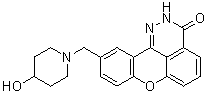
E7016, formerly known as GPI21016, is an inhibitor of the nuclear enzyme poly (ADP-ribose) polymerase (PARP) with potential chemo- and/or radiosensitizing activity. PARP inhibitor E7016 selectively binds to PARP and prevents PARP-mediated DNA repair of single strand DNA breaks via the base-excision repair pathway. This enhances the accumulation of DNA strand breaks and promotes genomic instability and eventually leads to apoptosis. In addition, this agent may enhance the cytotoxicity of DNA-damaging agents and reverse tumor cell resistance to chemotherapy and radiation therapy. PARP catalyzes post-translational ADP-ribosylation of nuclear proteins that signal and recruit other proteins to repair damaged DNA and is activated by single-strand DNA breaks. References: Lai WG, Farah N, Moniz GA, Wong YN. A Baeyer-Villiger oxidation specifically catalyzed by human flavin-containing monooxygenase 5. Drug Metab Dispos. 2011 Jan;39(1):61-70. Epub 2010 Oct 14. PubMed PMID: 20947616.
Physicochemical Properties
| Molecular Formula | C20H19N3O3 |
| Molecular Weight | 349.383 |
| Exact Mass | 349.143 |
| CAS # | 902128-92-1 |
| Related CAS # | 1005412-29-2 (deleted);902128-92-1;E7016 HCl; |
| PubChem CID | 11660296 |
| Appearance | White to off-white solid powder |
| LogP | 3.002 |
| Hydrogen Bond Donor Count | 2 |
| Hydrogen Bond Acceptor Count | 5 |
| Rotatable Bond Count | 2 |
| Heavy Atom Count | 26 |
| Complexity | 587 |
| Defined Atom Stereocenter Count | 0 |
| InChi Key | HAVFFEMDLROBGI-UHFFFAOYSA-N |
| InChi Code | InChI=1S/C20H19N3O3/c24-13-6-8-23(9-7-13)11-12-4-5-16-15(10-12)19-18-14(20(25)22-21-19)2-1-3-17(18)26-16/h1-5,10,13,24H,6-9,11H2,(H,22,25) |
| Chemical Name | 10-((4-Hydroxypiperidin-1-yl)methyl)chromeno[4,3,2-de]phthalazin-3(2H)-one |
| Synonyms | E7016 E-7016 E 7016 GPI21016 GPI 21016 GPI-21016. |
| HS Tariff Code | 2934.99.9001 |
| Storage |
Powder-20°C 3 years 4°C 2 years In solvent -80°C 6 months -20°C 1 month Note: This product requires protection from light (avoid light exposure) during transportation and storage. |
| Shipping Condition | Room temperature (This product is stable at ambient temperature for a few days during ordinary shipping and time spent in Customs) |
Biological Activity
| ln Vitro | By preventing DNA repair, E7016 can increase the radiosensitivity of tumor cells [1]. Increasing the number of cells undergoing mitotic catastrophe instead of increasing the number of cells undergoing apoptosis is how E7016 (3 μM)-mediated radiosensitization is accomplished [1]. By imitating NAD+, E7016 inhibits PARP[2]. |
| ln Vivo | In mice xenograft trials, E7016 possesses anti-tumor efficaciousness [1]. When E7016 (40 mg/kg) was given orally to mice that were carrying U251 xenografts, the combination of radiation and temozolomide was more successful [1]. In comparison to the in vivo combination of temozolomide and radiation, mice treated with E7016/radiotherapy/temozolomide showed a six-day growth delay [1]. |
| Cell Assay |
Apoptosis analysis [1] Cell Types: U251 human glioblastoma cell line Tested Concentrations: 3 μM Incubation Duration: 6 hrs (hours) before irradiation, 24 hrs (hours) and 72 hrs (hours) after irradiation Staining Experimental Results: The number of cells undergoing mitotic catastrophe was obvious in E7016 Increased - treated irradiated cells compared to cells exposed to radiation only 24 hrs (hours) after irradiation. |
| Animal Protocol |
Animal/Disease Models: Four to six week old female nude mice [3] Doses: 40 mg/kg Route of Administration: po (oral gavage) Experimental Results: E7016 enhanced radiation/temozolomide (3 mg/kg orally)-induced delayed tumor growth in U251 xenografts. |
| References |
[1]. In vitro and in vivo radiosensitization of glioblastoma cells by the poly (ADP-ribose) polymerase inhibitor E7016. Clin Cancer Res. 2009 Jan 15;15(2):607-12. [2]. A Baeyer-Villiger oxidation specifically catalyzed by human flavin-containing monooxygenase 5. Drug Metab Dispos. 2011 Jan;39(1):61-70. |
| Additional Infomation | PARP Inhibitor E7016 is an inhibitor of the nuclear enzyme poly(ADP-ribose) polymerase (PARP) with potential chemo- and/or radiosensitizing activity. PARP inhibitor E7016 selectively binds to PARP and prevents PARP mediated DNA repair of single strand DNA breaks via the base-excision repair pathway. This enhances the accumulation of DNA strand breaks and promotes genomic instability and eventually leads to apoptosis. In addition, this agent may enhance the cytotoxicity of DNA-damaging agents and reverse tumor cell resistance to chemotherapy and radiation therapy. PARP catalyzes post-translational ADP-ribosylation of nuclear proteins that signal and recruit other proteins to repair damaged DNA and is activated by single-strand DNA breaks. |
Solubility Data
| Solubility (In Vitro) | DMSO : ~25 mg/mL (~71.56 mM) |
| Solubility (In Vivo) |
Solubility in Formulation 1: ≥ 1.25 mg/mL (3.58 mM) (saturation unknown) in 10% DMSO + 90% (20% SBE-β-CD in Saline) (add these co-solvents sequentially from left to right, and one by one), clear solution. For example, if 1 mL of working solution is to be prepared, you can add 100 μL of 12.5 mg/mL clear DMSO stock solution to 900 μL of 20% SBE-β-CD physiological saline solution and mix evenly. Preparation of 20% SBE-β-CD in Saline (4°C,1 week): Dissolve 2 g SBE-β-CD in 10 mL saline to obtain a clear solution. Solubility in Formulation 2: ≥ 1.25 mg/mL (3.58 mM) (saturation unknown) in 10% DMSO + 90% Corn Oil (add these co-solvents sequentially from left to right, and one by one), clear solution. For example, if 1 mL of working solution is to be prepared, you can add 100 μL of 12.5 mg/mL clear DMSO stock solution to 900 μL of corn oil and mix evenly. (Please use freshly prepared in vivo formulations for optimal results.) |
| Preparing Stock Solutions | 1 mg | 5 mg | 10 mg | |
| 1 mM | 2.8622 mL | 14.3111 mL | 28.6221 mL | |
| 5 mM | 0.5724 mL | 2.8622 mL | 5.7244 mL | |
| 10 mM | 0.2862 mL | 1.4311 mL | 2.8622 mL |