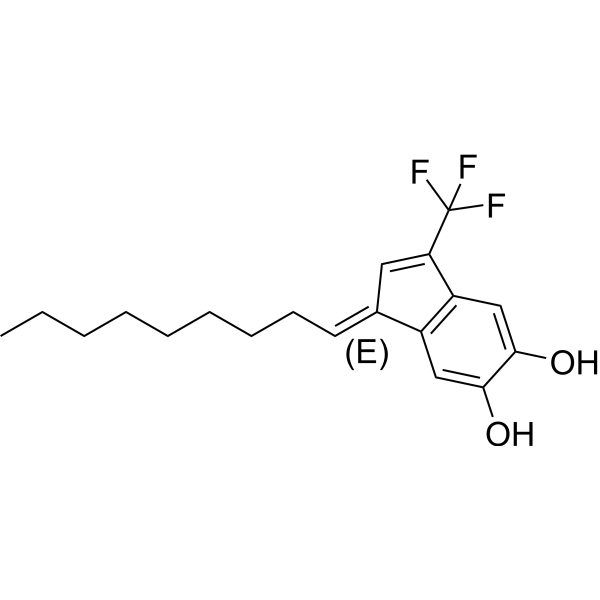
Physicochemical Properties
| Molecular Formula | C19H23F3O2 |
| Molecular Weight | 340.37993645668 |
| Exact Mass | 340.165 |
| CAS # | 2285446-62-8 |
| Related CAS # | (E/Z)-E64FC26;2285446-67-3 |
| PubChem CID | 137796284 |
| Appearance | Light yellow to yellow solid powder |
| LogP | 6.5 |
| Hydrogen Bond Donor Count | 2 |
| Hydrogen Bond Acceptor Count | 5 |
| Rotatable Bond Count | 7 |
| Heavy Atom Count | 24 |
| Complexity | 468 |
| Defined Atom Stereocenter Count | 0 |
| SMILES | FC(C1=C/C(=C\CCCCCCCC)/C2C=C(C(=CC=21)O)O)(F)F |
| InChi Key | OWYMWLCFHDHVAH-UKTHLTGXSA-N |
| InChi Code | InChI=1S/C19H23F3O2/c1-2-3-4-5-6-7-8-9-13-10-16(19(20,21)22)15-12-18(24)17(23)11-14(13)15/h9-12,23-24H,2-8H2,1H3/b13-9+ |
| Chemical Name | (1E)-1-nonylidene-3-(trifluoromethyl)indene-5,6-diol |
| Synonyms | E64-FC26; E64 FC26 |
| HS Tariff Code | 2934.99.9001 |
| Storage |
Powder-20°C 3 years 4°C 2 years In solvent -80°C 6 months -20°C 1 month |
| Shipping Condition | Room temperature (This product is stable at ambient temperature for a few days during ordinary shipping and time spent in Customs) |
Biological Activity
| ln Vitro | E64FC26 has anti-MM action with an EC50 of 0.59 μM (0.01-100 μM; 24 hours) [1]. E64FC26 demonstrated notable cytotoxicity in genetically varied multiple myeloma (MM) cell lines (KMS11, OPM2, MM.1S BzR, MM.1S, SA-13, U266 BzR, ANBL6, KMS12PE, U266, 8226 DxR, 8226 BzR, KMS12BM, H929, 8226 cells) [1]. |
| ln Vivo | In an NSG mouse model, intraperitoneal administration of E64FC26 (2 mg/kg; three days per week for seven days) demonstrated anti-MM effects, extending the median survival by 2 weeks [1]. The two treatments that increased survival the most were bortezomib and E64FC26, which extended median survival by 20 days [1]. In CD-1 mice, the pharmacokinetics of E64FC26 were assessed. The intravenous administration of E64FC26 (2 mg/kg; gray trace) or side-study (5 mg/kg; blue trace) resulted in the measurement of drug concentrations during a 24-hour period. A single mouse dose of 5 mg/kg resulted in systemic exposure that reached a maximum concentration (Cmax) of 400 nM with a terminal half-phase decline of 9.5 hours, indicating sufficient local bioavailability in CD-1 mice. 34% [1]. Scenario mode Vk*MYC E64FC26 is continuously administered during the day (2 mg/kg, intraperitoneal injection, 3 days/week). In all mice, E64FC26 can cause an instant anti-MM reaction and reduce serum M protein by 33 ± 7.9% on average [1]. |
| Cell Assay |
Cell viability assay [1] Cell Types: MM. 1S BzR Cell Tested Concentrations: 0.01, 0.1, 1, 10, 100 µM Incubation Duration: 24 hrs (hours) Experimental Results: demonstrated anti-MM activity with EC50 of 0.59 µM. |
| Animal Protocol |
Animal/Disease Models: NOD-SCID IL2Rγ-/- (NSG) mice (carrying MM.1S cells) [1] Doses: 2 mg/kg Route of Administration: intraperitoneal (ip) injection; three days per week for 7 days Experimental Results: here The model also demonstrated significant anti-MM effects, extending median survival by 2 weeks. |
| References |
[1]. Inhibitors of the protein disulfide isomerase family for the treatment of multiple myeloma. Leukemia. 2019 Apr;33(4):1011-1022. |
Solubility Data
| Solubility (In Vitro) | DMSO : ~100 mg/mL (~293.79 mM) |
| Solubility (In Vivo) |
Solubility in Formulation 1: ≥ 2.5 mg/mL (7.34 mM) (saturation unknown) in 10% DMSO + 90% (20% SBE-β-CD in Saline) (add these co-solvents sequentially from left to right, and one by one), clear solution. For example, if 1 mL of working solution is to be prepared, you can add 100 μL of 25.0 mg/mL clear DMSO stock solution to 900 μL of 20% SBE-β-CD physiological saline solution and mix evenly. Preparation of 20% SBE-β-CD in Saline (4°C,1 week): Dissolve 2 g SBE-β-CD in 10 mL saline to obtain a clear solution. (Please use freshly prepared in vivo formulations for optimal results.) |
| Preparing Stock Solutions | 1 mg | 5 mg | 10 mg | |
| 1 mM | 2.9379 mL | 14.6895 mL | 29.3789 mL | |
| 5 mM | 0.5876 mL | 2.9379 mL | 5.8758 mL | |
| 10 mM | 0.2938 mL | 1.4689 mL | 2.9379 mL |