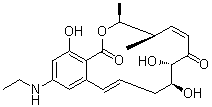
E6201 (E-6201) is a novel, potent, and fungal metabolite analog and inhibitor of MEK-1/MEKK-1 (mitogen-activated protein kinase kinase 1 and mitogen-activated protein kinase kinase kinase 1) with potential antipsoriatic, anti-inflammatory and antineoplastic activities. As a novel anti-inflammatory agent, it has potent inhibitory effects on the production of proinflammatory cytokines from leukocytes and antiproliferative activity on keratinocytes. E6201 specifically binds to and inhibits the activities of MEK-1 and MEKK-1, which may result in the inhibition of tumor cell proliferation. MEK-1 and MEKK-1 are key components in the RAS/RAF/MEK/MAPK signaling pathway, which regulates cell proliferation and is frequently activated in human cancers.
Physicochemical Properties
| Molecular Formula | C21H27NO6 |
| Molecular Weight | 389.44218 |
| Exact Mass | 389.183 |
| CAS # | 603987-35-5 |
| PubChem CID | 10172827 |
| Appearance | Typically exists as solid at room temperature |
| Density | 1.2±0.1 g/cm3 |
| Boiling Point | 680.4±55.0 °C at 760 mmHg |
| Flash Point | 365.3±31.5 °C |
| Vapour Pressure | 0.0±2.2 mmHg at 25°C |
| Index of Refraction | 1.577 |
| LogP | 3.09 |
| Hydrogen Bond Donor Count | 4 |
| Hydrogen Bond Acceptor Count | 7 |
| Rotatable Bond Count | 2 |
| Heavy Atom Count | 28 |
| Complexity | 604 |
| Defined Atom Stereocenter Count | 4 |
| SMILES | CCNC1=CC(=C2C(=C1)C=CC[C@@H]([C@@H](C(=O)C=C[C@@H](C)[C@H](C)OC2=O)O)O)O |
| InChi Key | MWUFVYLAWAXDHQ-HMNLTAHHSA-N |
| InChi Code | InChI=1S/C21H27NO6/c1-4-22-15-10-14-6-5-7-16(23)20(26)17(24)9-8-12(2)13(3)28-21(27)19(14)18(25)11-15/h5-6,8-13,16,20,22-23,25-26H,4,7H2,1-3H3/b6-5+,9-8-/t12-,13+,16+,20+/m1/s1 |
| Chemical Name | (3S,4R,5Z,8S,9S,11E)-14-(ethylamino)-8,9,16-trihydroxy-3,4-dimethyl-3,4,9,10-tetrahydro-1H-benzo[c][1]oxacyclotetradecine-1,7(8H)-dione |
| Synonyms | E6201 ER-806201 LLZ16402E-6201 ER806201 LLZ-16402E 6201 ER 806201 LLZ 16402 |
| HS Tariff Code | 2934.99.9001 |
| Storage |
Powder-20°C 3 years 4°C 2 years In solvent -80°C 6 months -20°C 1 month |
| Shipping Condition | Room temperature (This product is stable at ambient temperature for a few days during ordinary shipping and time spent in Customs) |
Biological Activity
| ln Vitro | The MEKK1 and MEK families are inhibited by E6201, however the MAPK family is not. MEKK1-induced phosphorylation of MEK1, MKK4, and MKK6 is inhibited by E6201, with IC50 values of 31, 522, and 65 nM, in that order. Other MAPK family enzymes like ERK2, JNK, and p38 MAPK are unaffected by E6201 at 10 μM [1]. With an IC50 value of 50±14 nM, E6201 suppresses TNF transcription induced by LPS, but it has no effect on β-actin transcription at 3 μM and only a minor inhibitory effect at 10 μM [1]. E6201 suppresses the non-receptor tyrosine kinase Syk, with an IC50 value of 460 nM, as well as the receptor tyrosine kinases VEGFR2, PDGFR, hepatocyte growth factor receptor, and EGFR, with IC50 values of 350, 860, 1100, and 5400 nM, respectively. At 100 μM, E6201 does not inhibit PKC activity and neither does it inhibit ZAP-70 or IKK [1]. With an IC50 value of 18 nM, E6201 suppresses the production of IL-2 48 hours after T cell mitogen PHA-P stimulation[1]. E6201 inhibits EGF-stimulated proliferation of human keratinocytes with an IC50 value of 160 nM[1]. After stimulating human keratinocytes with IL-1α or TNFα for 24 hours, E6201 inhibits the production of IL-8 with IC50 values of 60 and 30 nM, respectively[1]. E6201 inhibits the production of TNFα, IL-1, IL-6 and IL-8 by human PBMC, with IC50 values of 20, 16, 52 and 53 nM respectively[1]. E6201 (0.08-20.0 μM) significantly inhibits triple-negative breast cancer (TNBC) cell proliferation and anchorage-independent colony formation in a dose-dependent manner [2]. E6201 (1 μM) inhibits the expression of phospho-ERK and induces G1 phase cell cycle arrest and apoptosis in TNBC cells [2]. |
| ln Vivo | Three weekly tail vein injections of E6201 (30 mg/kg) stop the growth of TNBC xenograft tumors. E6201 significantly reduces the expression of Ki-67 and pERK in xenograft tumor tissues [2]. |
| Cell Assay |
Cell viability assay [2] Cell Types: Human TNBC cell lines BT20, HCC70, MDA-MB-231, HCC1806, HCC1937, SUM149 and SUM159 Tested Concentrations: 0.00, 0.08, 0.16, 0.31, 0.63, 1.25, 2.50, 5.00, 10.0, 20.0 μM Incubation Duration: 5 days Experimental Results: Inhibited TNBC cell proliferation and anchorage-independent colony formation in a dose-dependent manner. Western Blot Analysis[3] Cell Types: Human TNBC cell lines BT20, HCC70, MDA-MB-231, HCC1806, HCC1937, SUM149 and SUM159 Tested Concentrations: 1 μM Incubation Duration: 0, 1, 24 hrs (hours) Experimental Results: pERK expression levels show treatment Afterwards, the TNBC cell lines tested experienced rapid (apparent after 1 hour) and sustained (still evident after 24 hrs (hours)) reductions. |
| Animal Protocol |
Animal/Disease Models: Female Nod.Scid γ mice (4 to 6 weeks old) bearing MDA-MB-231-LM2 xenograft tumors [2] Doses: 30 mg/kg Route of Administration: tail vein injection 3 times per week, Results lasting 17 days: E6201-treated mice demonstrated 60% inhibition of tumor growth compared to mice treated with vehicle controls. |
| References |
[1]. E6201 [(3S,4R,5Z,8S,9S,11E)-14-(ethylamino)-8, 9,16-trihydroxy-3,4-dimethyl-3,4,9,19-tetrahydro-1H-2-benzoxacyclotetradecine-1,7(8H)-dione] a novel kinase inhibitor of mitogen-activated protein kinase/extracellular signal-regulated ki. [2]. Anti-tumor and anti-metastasis efficacy of E6201, a MEK1 inhibitor, in preclinical models of triple-negative breast cancer. Breast Cancer Res Treat. 2019 Jun;175(2):339-351. |
| Additional Infomation |
E6201 has been investigated for the treatment of Chronic Plaque Psoriasis. MEK-1/MEKK-1 Inhibitor E6201 is a synthetic, fungal metabolite analogue inhibitor of mitogen-activated protein kinase kinase 1 (MEK-1) and mitogen-activated protein kinase kinase kinase 1 (MEKK-1) with potential antipsoriatic and antineoplastic activities. MEK-1/MEKK-1 inhibitor E6201 specifically binds to and inhibits the activities of MEK-1 and MEKK-1, which may result in the inhibition of tumor cell proliferation. MEK-1 and MEKK-1 are key components in the RAS/RAF/MEK/MAPK signaling pathway, which regulates cell proliferation and is frequently activated in human cancers. |
Solubility Data
| Solubility (In Vitro) | May dissolve in DMSO (in most cases), if not, try other solvents such as H2O, Ethanol, or DMF with a minute amount of products to avoid loss of samples |
| Solubility (In Vivo) |
Note: Listed below are some common formulations that may be used to formulate products with low water solubility (e.g. < 1 mg/mL), you may test these formulations using a minute amount of products to avoid loss of samples. Injection Formulations (e.g. IP/IV/IM/SC) Injection Formulation 1: DMSO : Tween 80: Saline = 10 : 5 : 85 (i.e. 100 μL DMSO stock solution → 50 μL Tween 80 → 850 μL Saline) *Preparation of saline: Dissolve 0.9 g of sodium chloride in 100 mL ddH ₂ O to obtain a clear solution. Injection Formulation 2: DMSO : PEG300 :Tween 80 : Saline = 10 : 40 : 5 : 45 (i.e. 100 μL DMSO → 400 μLPEG300 → 50 μL Tween 80 → 450 μL Saline) Injection Formulation 3: DMSO : Corn oil = 10 : 90 (i.e. 100 μL DMSO → 900 μL Corn oil) Example: Take the Injection Formulation 3 (DMSO : Corn oil = 10 : 90) as an example, if 1 mL of 2.5 mg/mL working solution is to be prepared, you can take 100 μL 25 mg/mL DMSO stock solution and add to 900 μL corn oil, mix well to obtain a clear or suspension solution (2.5 mg/mL, ready for use in animals). Injection Formulation 4: DMSO : 20% SBE-β-CD in saline = 10 : 90 [i.e. 100 μL DMSO → 900 μL (20% SBE-β-CD in saline)] *Preparation of 20% SBE-β-CD in Saline (4°C,1 week): Dissolve 2 g SBE-β-CD in 10 mL saline to obtain a clear solution. Injection Formulation 5: 2-Hydroxypropyl-β-cyclodextrin : Saline = 50 : 50 (i.e. 500 μL 2-Hydroxypropyl-β-cyclodextrin → 500 μL Saline) Injection Formulation 6: DMSO : PEG300 : castor oil : Saline = 5 : 10 : 20 : 65 (i.e. 50 μL DMSO → 100 μLPEG300 → 200 μL castor oil → 650 μL Saline) Injection Formulation 7: Ethanol : Cremophor : Saline = 10: 10 : 80 (i.e. 100 μL Ethanol → 100 μL Cremophor → 800 μL Saline) Injection Formulation 8: Dissolve in Cremophor/Ethanol (50 : 50), then diluted by Saline Injection Formulation 9: EtOH : Corn oil = 10 : 90 (i.e. 100 μL EtOH → 900 μL Corn oil) Injection Formulation 10: EtOH : PEG300:Tween 80 : Saline = 10 : 40 : 5 : 45 (i.e. 100 μL EtOH → 400 μLPEG300 → 50 μL Tween 80 → 450 μL Saline) Oral Formulations Oral Formulation 1: Suspend in 0.5% CMC Na (carboxymethylcellulose sodium) Oral Formulation 2: Suspend in 0.5% Carboxymethyl cellulose Example: Take the Oral Formulation 1 (Suspend in 0.5% CMC Na) as an example, if 100 mL of 2.5 mg/mL working solution is to be prepared, you can first prepare 0.5% CMC Na solution by measuring 0.5 g CMC Na and dissolve it in 100 mL ddH2O to obtain a clear solution; then add 250 mg of the product to 100 mL 0.5% CMC Na solution, to make the suspension solution (2.5 mg/mL, ready for use in animals). Oral Formulation 3: Dissolved in PEG400 Oral Formulation 4: Suspend in 0.2% Carboxymethyl cellulose Oral Formulation 5: Dissolve in 0.25% Tween 80 and 0.5% Carboxymethyl cellulose Oral Formulation 6: Mixing with food powders Note: Please be aware that the above formulations are for reference only. InvivoChem strongly recommends customers to read literature methods/protocols carefully before determining which formulation you should use for in vivo studies, as different compounds have different solubility properties and have to be formulated differently. (Please use freshly prepared in vivo formulations for optimal results.) |
| Preparing Stock Solutions | 1 mg | 5 mg | 10 mg | |
| 1 mM | 2.5678 mL | 12.8389 mL | 25.6779 mL | |
| 5 mM | 0.5136 mL | 2.5678 mL | 5.1356 mL | |
| 10 mM | 0.2568 mL | 1.2839 mL | 2.5678 mL |