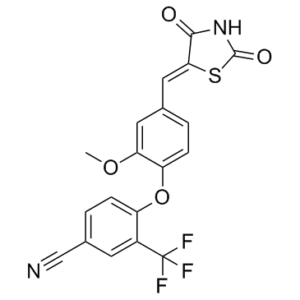
E3 ligase Ligand 5 is an E3 ligase ligand that interacts with an E3 ubiquitin ligase during the production of PROTACs (proteolysis targeting chimeras). It is specifically an antagonist of estrogen-related receptor α (ERRα), with IC50 values for ERRα and ERRγ of 0.04 and 2.8 μM, respectively. A two-headed molecule called PROTAC can eliminate particular undesirable proteins. A PROTAC functions by inducing selective intracellular proteolysis, as opposed to conventional enzyme inhibition. Two covalently bonded protein-binding molecules make up PROTACs: one molecule attaches to a target protein that is intended to be degraded, and the other is able to interact with an E3 ubiquitin ligase. The target protein is ubiquitinated upon the recruitment of the E3 ligase, which subsequently leads to the proteasome's degradation of the target protein. There are currently many efforts underway to retool previously unproductive inhibitor molecules as PROTACs for next-generation drugs, since PROTACs need only to bind their targets with high selectivity (rather than inhibit the target protein's enzymatic activity).
Physicochemical Properties
| Molecular Formula | C₁₉H₁₁F₃N₂O₄S | |
| Molecular Weight | 420.36 | |
| Exact Mass | 420.039 | |
| Elemental Analysis | 54.29; H, 2.64; F, 13.56; N, 6.66; O, 15.22; S, 7.63 | |
| CAS # | 1264754-13-3 | |
| Related CAS # |
|
|
| PubChem CID | 46916268 | |
| Appearance | Light yellow to green yellow solid powder | |
| Density | 1.5±0.1 g/cm3 | |
| Index of Refraction | 1.628 | |
| LogP | 3.35 | |
| Hydrogen Bond Donor Count | 1 | |
| Hydrogen Bond Acceptor Count | 9 | |
| Rotatable Bond Count | 4 | |
| Heavy Atom Count | 29 | |
| Complexity | 733 | |
| Defined Atom Stereocenter Count | 0 | |
| SMILES | C(#N)C1=CC=C(OC2=CC=C(/C=C3\SC(=O)NC\3=O)C=C2OC)C(C(F)(F)F)=C1 |
|
| InChi Key | OBBIOCQFTMNSJI-PXNMLYILSA-N | |
| InChi Code | InChI=1S/C19H11F3N2O4S/c1-27-15-7-10(8-16-17(25)24-18(26)29-16)2-5-14(15)28-13-4-3-11(9-23)6-12(13)19(20,21)22/h2-8H,1H3,(H,24,25,26)/b16-8- | |
| Chemical Name | 4-[4-[(Z)-(2,4-dioxo-1,3-thiazolidin-5-ylidene)methyl]-2-methoxyphenoxy]-3-(trifluoromethyl)benzonitrile | |
| Synonyms | E3 ligase Ligand 5; E3L 4133; E3L4133; E3L-4133 | |
| HS Tariff Code | 2934.99.9001 | |
| Storage |
Powder-20°C 3 years 4°C 2 years In solvent -80°C 6 months -20°C 1 month |
|
| Shipping Condition | Room temperature (This product is stable at ambient temperature for a few days during ordinary shipping and time spent in Customs) |
Biological Activity
| Targets | ERRα (IC50 = 0.04 μM); ERRγ (IC50 = 2.8 μM) |
| References | US20160058872A1.. |
Solubility Data
| Solubility (In Vitro) |
|
|||
| Solubility (In Vivo) |
Solubility in Formulation 1: ≥ 2.5 mg/mL (5.95 mM) (saturation unknown) in 10% DMSO + 40% PEG300 +5% Tween-80 + 45% Saline (add these co-solvents sequentially from left to right, and one by one), clear solution. For example, if 1 mL of working solution is to be prepared, you can add 100 μL of 25.0 mg/mL clear DMSO stock solution to 400 μL PEG300 and mix evenly; then add 50 μL Tween-80 + to the above solution and mix evenly; then add 450 μL normal saline to adjust the volume to 1 mL. Preparation of saline: Dissolve 0.9 g of sodium chloride in 100 mL ddH₂ O to obtain a clear solution. (Please use freshly prepared in vivo formulations for optimal results.) |
| Preparing Stock Solutions | 1 mg | 5 mg | 10 mg | |
| 1 mM | 2.3789 mL | 11.8946 mL | 23.7891 mL | |
| 5 mM | 0.4758 mL | 2.3789 mL | 4.7578 mL | |
| 10 mM | 0.2379 mL | 1.1895 mL | 2.3789 mL |