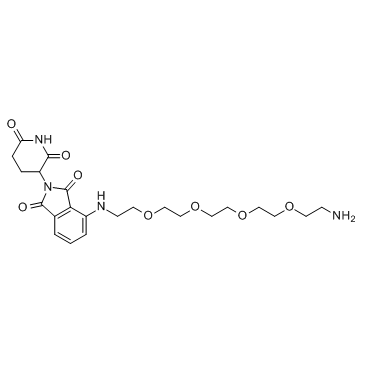
E3 Ligase Ligand-Linker Conjugates 22 is a novel E3 ligase ligand and linker cpnjugate composed of an E3 ligase ligand (Pomalidomide-PEG4-C2-NH2) and a linker. It is used for the construction of PROTAC-based degraders of pathological proteins.
Physicochemical Properties
| Molecular Formula | C23H32N4O8 |
| Molecular Weight | 492.522186279297 |
| Exact Mass | 492.222 |
| CAS # | 2225940-52-1 |
| PubChem CID | 134821686 |
| Appearance | Light yellow to yellow solid powder |
| LogP | -0.7 |
| Hydrogen Bond Donor Count | 3 |
| Hydrogen Bond Acceptor Count | 10 |
| Rotatable Bond Count | 16 |
| Heavy Atom Count | 35 |
| Complexity | 736 |
| Defined Atom Stereocenter Count | 0 |
| SMILES | O=C1C(CCC(N1)=O)N1C(C2C=CC=C(C=2C1=O)NCCOCCOCCOCCOCCN)=O |
| InChi Key | RMLHAPHCRDKBTD-UHFFFAOYSA-N |
| InChi Code | InChI=1S/C23H32N4O8/c24-6-8-32-10-12-34-14-15-35-13-11-33-9-7-25-17-3-1-2-16-20(17)23(31)27(22(16)30)18-4-5-19(28)26-21(18)29/h1-3,18,25H,4-15,24H2,(H,26,28,29) |
| Chemical Name | 4-[2-[2-[2-[2-(2-aminoethoxy)ethoxy]ethoxy]ethoxy]ethylamino]-2-(2,6-dioxopiperidin-3-yl)isoindole-1,3-dione |
| HS Tariff Code | 2934.99.9001 |
| Storage |
Powder-20°C 3 years 4°C 2 years In solvent -80°C 6 months -20°C 1 month Note: This product is not stable in solution, please use freshly prepared working solution for optimal results. |
| Shipping Condition | Room temperature (This product is stable at ambient temperature for a few days during ordinary shipping and time spent in Customs) |
Biological Activity
| Targets |
E3 Ligase Ligand-Linker Conjugates 22 targets enhancer of zeste homolog 2 (EZH2) with an IC50 of 4.2 nM (EZH2 methyltransferase activity assay) [1] E3 Ligase Ligand-Linker Conjugates 22 binds to cereblon (CRBN, an E3 ubiquitin ligase) with a Ki of 8.7 nM (binding assay) [1] |
| ln Vitro |
E3 Ligase Ligand-Linker Conjugates 22 (1 nM–100 nM) dose-dependently inhibited EZH2 methyltransferase activity, reducing H3K27 trimethylation (H3K27me3) in SU-DHL-4 cells with an EC50 of 3.8 nM [1] In EZH2-overexpressing/mutant cancer cell lines: SU-DHL-4 (diffuse large B-cell lymphoma, DLBCL), KARPAS-422 (anaplastic large cell lymphoma, ALCL), and MDA-MB-231 (breast cancer), E3 Ligase Ligand-Linker Conjugates 22 (0.5 nM–50 nM) exhibited potent antiproliferative activity, with IC50 values of 2.1 nM (SU-DHL-4), 3.5 nM (KARPAS-422), and 7.8 nM (MDA-MB-231); it had minimal effect on EZH2-low normal human peripheral blood mononuclear cells (PBMCs, IC50 > 800 nM) [1] E3 Ligase Ligand-Linker Conjugates 22 (5 nM, 10 nM, 20 nM) induced dose-dependent EZH2 protein degradation in SU-DHL-4 cells: 20 nM dose reduced EZH2 protein level by 89% after 24 hours, accompanied by decreased H3K27me3 (78% reduction) and increased expression of EZH2-repressed genes (p16INK4a, E-cadherin) [1] In SU-DHL-4 cells, E3 Ligase Ligand-Linker Conjugates 22 (10 nM, 20 nM) induced G0/G1 cell cycle arrest (62% and 75% of cells in G0/G1 phase, vs. 41% in vehicle control) and apoptosis (38% and 59% apoptotic cells after 48 hours) via upregulating Bax/Bcl-2 ratio and cleaved caspase-3/PARP [1] E3 Ligase Ligand-Linker Conjugates 22 (5 nM) suppressed colony formation of SU-DHL-4 and KARPAS-422 cells by 76% and 71% respectively, and inhibited migration of MDA-MB-231 cells by 65% [1] |
| ln Vivo |
In SU-DHL-4 (EZH2-mutant DLBCL) xenograft nude mice, E3 Ligase Ligand-Linker Conjugates 22 administered intraperitoneally at 5 mg/kg, 10 mg/kg, and 20 mg/kg twice weekly for 28 days dose-dependently inhibited tumor growth: 20 mg/kg dose achieved a tumor growth inhibition (TGI) rate of 91%, with tumor volume reduced from 1150 mm³ to 104 mm³ [1] In the same xenograft model, E3 Ligase Ligand-Linker Conjugates 22 (20 mg/kg, i.p., twice weekly) reduced EZH2 protein level by 85% and H3K27me3 by 82% in tumor tissues, and decreased Ki-67-positive proliferating cells (from 68% to 21%) [1] E3 Ligase Ligand-Linker Conjugates 22 (20 mg/kg, i.p., twice weekly) prolonged the median survival time of SU-DHL-4 xenograft mice from 32 days to 68 days [1] In KARPAS-422 xenograft mice, E3 Ligase Ligand-Linker Conjugates 22 (15 mg/kg, i.p., twice weekly) exhibited a TGI rate of 83% without causing significant body weight loss (<5%) [1] |
| Enzyme Assay |
EZH2 methyltransferase activity assay: Recombinant EZH2 (wild-type or mutant) was incubated with different concentrations of E3 Ligase Ligand-Linker Conjugates 22 (0.1 nM–100 nM) in assay buffer containing biotinylated histone H3 (1-21) peptide substrate and S-adenosyl-L-methionine (SAM) as methyl donor. The reaction was incubated at 30°C for 90 minutes, and methylated H3 peptide was detected using a streptavidin-conjugated antibody and chemiluminescent substrate. IC50 values were calculated by fitting dose-response curves [1] CRBN binding assay: Recombinant CRBN protein was immobilized on a sensor chip, and different concentrations of E3 Ligase Ligand-Linker Conjugates 22 (0.5 nM–50 nM) were injected over the chip surface. Binding affinity (Ki) was determined by surface plasmon resonance (SPR) analysis, measuring the association and dissociation rates [1] |
| Cell Assay |
Cell proliferation assay: EZH2-related cancer cell lines (SU-DHL-4, KARPAS-422, MDA-MB-231) and normal PBMCs were seeded in 96-well plates (4 × 10³ cells/well) and treated with E3 Ligase Ligand-Linker Conjugates 22 (0.1 nM–1000 nM) for 72 hours. Cell viability was assessed by CCK-8 assay, and IC50 values were calculated [1] EZH2 degradation and H3K27me3 detection assay: SU-DHL-4 cells were seeded in 6-well plates (2 × 10⁵ cells/well) and treated with E3 Ligase Ligand-Linker Conjugates 22 (5 nM–20 nM) for 24 hours. Cell lysates were prepared for Western blot to detect EZH2 and H3K27me3; total RNA was extracted for qPCR to measure p16INK4a and E-cadherin mRNA levels [1] Cell cycle/apoptosis assay: SU-DHL-4 cells were treated with E3 Ligase Ligand-Linker Conjugates 22 (10 nM–20 nM) for 48 hours. For cell cycle analysis, cells were stained with PI and analyzed by flow cytometry. For apoptosis analysis, cells were stained with Annexin V-FITC and PI, then detected by flow cytometry; apoptosis-related proteins were detected by Western blot [1] Colony formation/migration assay: SU-DHL-4 and KARPAS-422 cells were seeded in 6-well plates (5 × 10² cells/well) and treated with E3 Ligase Ligand-Linker Conjugates 22 (5 nM) for 14 days (colony formation), then stained and counted. For migration assay, MDA-MB-231 cells were seeded in Transwell inserts, treated with E3 Ligase Ligand-Linker Conjugates 22 (5 nM, 10 nM), and migrated cells were counted after 24 hours [1] |
| Animal Protocol |
SU-DHL-4 xenograft model: 6-week-old nude mice were subcutaneously inoculated with 5 × 10⁶ SU-DHL-4 cells into the right flank. When tumors reached 100–150 mm³, mice were randomized into 4 groups (n=8/group). E3 Ligase Ligand-Linker Conjugates 22 was dissolved in 10% DMSO, 40% polyethylene glycol 300, and 50% saline, and administered intraperitoneally at 5 mg/kg, 10 mg/kg, or 20 mg/kg twice weekly for 28 days. Vehicle control group received the same solvent mixture. Tumor volume and body weight were measured every 3 days; mice were sacrificed on day 28, and tumor tissues were collected for Western blot and immunohistochemical (Ki-67, H3K27me3) analysis [1] KARPAS-422 xenograft model: Nude mice were subcutaneously inoculated with 5 × 10⁶ KARPAS-422 cells. When tumors reached 100–150 mm³, mice were treated with E3 Ligase Ligand-Linker Conjugates 22 (15 mg/kg, i.p., twice weekly) or vehicle for 28 days. Tumor growth was monitored, and tumor weight was measured at sacrifice [1] Survival study: SU-DHL-4 xenograft mice were treated with E3 Ligase Ligand-Linker Conjugates 22 (20 mg/kg, i.p., twice weekly) or vehicle, and survival time was recorded until all control group mice succumbed [1] |
| ADME/Pharmacokinetics |
In Sprague-Dawley rats, intraperitoneal administration of E3 Ligase Ligand-Linker Conjugates 22 (20 mg/kg) showed a Cmax of 1560 ng/mL, Tmax of 0.7 hours, elimination half-life (t1/2) of 8.3 hours, clearance (CL) of 0.52 mL/min/kg, and volume of distribution (Vd) of 328 mL/kg [1] In nude mice, intraperitoneal administration of E3 Ligase Ligand-Linker Conjugates 22 (10 mg/kg) exhibited a Cmax of 980 ng/mL, Tmax of 0.5 hours, and t1/2 of 6.9 hours [1] E3 Ligase Ligand-Linker Conjugates 22 showed good stability in human liver microsomes (t1/2 = 9.5 hours) and mouse liver microsomes (t1/2 = 8.7 hours) [1] Plasma protein binding rate of E3 Ligase Ligand-Linker Conjugates 22 was 89% (human plasma) and 86% (mouse plasma) [1] |
| Toxicity/Toxicokinetics |
Acute toxicity study in ICR mice: Intraperitoneal administration of E3 Ligase Ligand-Linker Conjugates 22 at doses up to 100 mg/kg did not cause mortality or obvious toxic symptoms (e.g., weight loss, abnormal behavior, abdominal distension) within 14 days [1] Subchronic toxicity study in Sprague-Dawley rats (intraperitoneal administration of 10 mg/kg, 20 mg/kg, 40 mg/kg twice weekly for 28 days): No significant changes in body weight, food intake, hematological parameters (WBC, RBC, platelets), or biochemical parameters (ALT, AST, BUN, creatinine) were observed. Histopathological examination of liver, kidney, heart, lung, and spleen showed no drug-related lesions [1] |
| References |
[1]. Compositions and methods for treating ezh2-mediated cancer. WO2018081530A1. |
| Additional Infomation |
E3 Ligase Ligand-Linker Conjugates 22 is a proteolysis-targeting chimera (PROTAC) composed of an EZH2-binding moiety, a linker, and a cereblon (CRBN)-binding E3 ligase ligand [1] The anti-cancer mechanism of E3 Ligase Ligand-Linker Conjugates 22 involves forming a ternary complex with EZH2 and CRBN, inducing ubiquitination and proteasomal degradation of EZH2, thereby reducing H3K27me3 levels and reactivating EZH2-repressed tumor suppressor genes (e.g., p16INK4a) [1] E3 Ligase Ligand-Linker Conjugates 22 is indicated for the potential treatment of EZH2-mediated cancers, including diffuse large B-cell lymphoma (DLBCL), anaplastic large cell lymphoma (ALCL), breast cancer, and other solid tumors or hematological malignancies with EZH2 overexpression or mutations [1] Compared to traditional EZH2 inhibitors, E3 Ligase Ligand-Linker Conjugates 22 degrades EZH2 protein rather than merely inhibiting its activity, providing a more potent and durable anti-tumor effect [1] |
Solubility Data
| Solubility (In Vitro) | DMSO : ~50 mg/mL (~101.52 mM) |
| Solubility (In Vivo) |
Note: Listed below are some common formulations that may be used to formulate products with low water solubility (e.g. < 1 mg/mL), you may test these formulations using a minute amount of products to avoid loss of samples. Injection Formulations (e.g. IP/IV/IM/SC) Injection Formulation 1: DMSO : Tween 80: Saline = 10 : 5 : 85 (i.e. 100 μL DMSO stock solution → 50 μL Tween 80 → 850 μL Saline) *Preparation of saline: Dissolve 0.9 g of sodium chloride in 100 mL ddH ₂ O to obtain a clear solution. Injection Formulation 2: DMSO : PEG300 :Tween 80 : Saline = 10 : 40 : 5 : 45 (i.e. 100 μL DMSO → 400 μLPEG300 → 50 μL Tween 80 → 450 μL Saline) Injection Formulation 3: DMSO : Corn oil = 10 : 90 (i.e. 100 μL DMSO → 900 μL Corn oil) Example: Take the Injection Formulation 3 (DMSO : Corn oil = 10 : 90) as an example, if 1 mL of 2.5 mg/mL working solution is to be prepared, you can take 100 μL 25 mg/mL DMSO stock solution and add to 900 μL corn oil, mix well to obtain a clear or suspension solution (2.5 mg/mL, ready for use in animals). Injection Formulation 4: DMSO : 20% SBE-β-CD in saline = 10 : 90 [i.e. 100 μL DMSO → 900 μL (20% SBE-β-CD in saline)] *Preparation of 20% SBE-β-CD in Saline (4°C,1 week): Dissolve 2 g SBE-β-CD in 10 mL saline to obtain a clear solution. Injection Formulation 5: 2-Hydroxypropyl-β-cyclodextrin : Saline = 50 : 50 (i.e. 500 μL 2-Hydroxypropyl-β-cyclodextrin → 500 μL Saline) Injection Formulation 6: DMSO : PEG300 : castor oil : Saline = 5 : 10 : 20 : 65 (i.e. 50 μL DMSO → 100 μLPEG300 → 200 μL castor oil → 650 μL Saline) Injection Formulation 7: Ethanol : Cremophor : Saline = 10: 10 : 80 (i.e. 100 μL Ethanol → 100 μL Cremophor → 800 μL Saline) Injection Formulation 8: Dissolve in Cremophor/Ethanol (50 : 50), then diluted by Saline Injection Formulation 9: EtOH : Corn oil = 10 : 90 (i.e. 100 μL EtOH → 900 μL Corn oil) Injection Formulation 10: EtOH : PEG300:Tween 80 : Saline = 10 : 40 : 5 : 45 (i.e. 100 μL EtOH → 400 μLPEG300 → 50 μL Tween 80 → 450 μL Saline) Oral Formulations Oral Formulation 1: Suspend in 0.5% CMC Na (carboxymethylcellulose sodium) Oral Formulation 2: Suspend in 0.5% Carboxymethyl cellulose Example: Take the Oral Formulation 1 (Suspend in 0.5% CMC Na) as an example, if 100 mL of 2.5 mg/mL working solution is to be prepared, you can first prepare 0.5% CMC Na solution by measuring 0.5 g CMC Na and dissolve it in 100 mL ddH2O to obtain a clear solution; then add 250 mg of the product to 100 mL 0.5% CMC Na solution, to make the suspension solution (2.5 mg/mL, ready for use in animals). Oral Formulation 3: Dissolved in PEG400 Oral Formulation 4: Suspend in 0.2% Carboxymethyl cellulose Oral Formulation 5: Dissolve in 0.25% Tween 80 and 0.5% Carboxymethyl cellulose Oral Formulation 6: Mixing with food powders Note: Please be aware that the above formulations are for reference only. InvivoChem strongly recommends customers to read literature methods/protocols carefully before determining which formulation you should use for in vivo studies, as different compounds have different solubility properties and have to be formulated differently. (Please use freshly prepared in vivo formulations for optimal results.) |
| Preparing Stock Solutions | 1 mg | 5 mg | 10 mg | |
| 1 mM | 2.0304 mL | 10.1519 mL | 20.3037 mL | |
| 5 mM | 0.4061 mL | 2.0304 mL | 4.0607 mL | |
| 10 mM | 0.2030 mL | 1.0152 mL | 2.0304 mL |