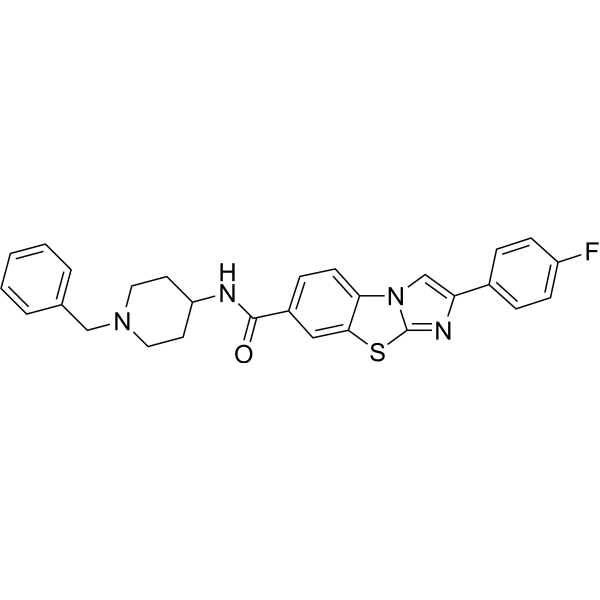
Physicochemical Properties
| Molecular Formula | C28H25FN4OS |
| Molecular Weight | 484.587708234787 |
| Exact Mass | 484.173 |
| CAS # | 891894-69-2 |
| PubChem CID | 22523776 |
| Appearance | White to off-white solid powder |
| LogP | 6.4 |
| Hydrogen Bond Donor Count | 1 |
| Hydrogen Bond Acceptor Count | 5 |
| Rotatable Bond Count | 5 |
| Heavy Atom Count | 35 |
| Complexity | 720 |
| Defined Atom Stereocenter Count | 0 |
| InChi Key | SNVVZJBHCSPRGY-UHFFFAOYSA-N |
| InChi Code | InChI=1S/C28H25FN4OS/c29-22-9-6-20(7-10-22)24-18-33-25-11-8-21(16-26(25)35-28(33)31-24)27(34)30-23-12-14-32(15-13-23)17-19-4-2-1-3-5-19/h1-11,16,18,23H,12-15,17H2,(H,30,34) |
| Chemical Name | N-(1-benzylpiperidin-4-yl)-2-(4-fluorophenyl)imidazo[2,1-b][1,3]benzothiazole-6-carboxamide |
| HS Tariff Code | 2934.99.9001 |
| Storage |
Powder-20°C 3 years 4°C 2 years In solvent -80°C 6 months -20°C 1 month |
| Shipping Condition | Room temperature (This product is stable at ambient temperature for a few days during ordinary shipping and time spent in Customs) |
Biological Activity
| Targets | Activates transcription factor 4, ATF4[1] |
| ln Vitro | In HT1080 cells, E235 (1 µM; 2, 4, 8, 16 or 24 h) time-dependently reduces the levels of XBP-1 mRNA [1]. E235 exhibits antiproliferative action on HT1080, RPMI-8226, B16F10, 4T1, HT1080 shNT, and HT1080 shATF4 cells at concentrations of 0.1–10 µM over 4 or 5 days [1]. In AG1522 cells, E235 (0, 1, 5, and 10 µM; 4 h) boosted p53 expression in a dose-dependent way. In AG1522 cells, E235 (1 µM; 2 h) enhances p-Chk2 expression [1]. In AG1522 and HT1080 cells, E235 (0, 1, 5, and 10 µM; 2 h) enhances p-p53 expression [1]. HT1080 cells express more γ-H2AX when exposed to E235 (0, 0.5, 1, 5, and 10 µM; 0.5 h) in a dose-dependent manner [1]. |
| Cell Assay |
Western Blot Analysis[1] Cell Types: HT1080, B16F10 and AG1522 cells. Tested Concentrations: 0, 1, 5 and 10 µM. Incubation Duration: 4 h. Experimental Results: Increased the expression of ATF4 with dose-dependent manner. Western Blot Analysis[1] Cell Types: HT1080 cells. Tested Concentrations: 0, 0.5, 1, 5 or 10 µM. Incubation Duration: 2, 4 or 8 h. Experimental Results: Increased the expression of p-elF2α with time and dose dependent manner. Cell Proliferation Assay [1] Cell Types: HT1080 or RPMI-8226 cells. Tested Concentrations: 1 µM. Incubation Duration: 0, 8, 16 and 24 h. Experimental Results: demonstrated anti-proliferative activity. Cell Viability Assay[1] Cell Types: AG1522 cells. Tested Concentrations: 0, 0.1, 0.5, 1 and 10 µM. Incubation Duration: 4 d. Experimental Results: Inhibited cell viability with dose-dependent manner. Cell Cycle Analysis[1] Cell Types: HT1080 cells and B16F10 cells. Tested Concentrations: 1 µM. Incubation Duration: 8, 16 and 24 h. Experimental Results: Caused cell arrest during G2/M phase. |
| References |
[1]. Identification and characterization of a potent activator of p53-independent cellular senescence via a small-molecule screen for modifiers of the integrated stress response. Mol Pharmacol. 2013 Mar;83(3):594-604. |
Solubility Data
| Solubility (In Vitro) |
DMSO: 10 mg/mL (20.64 mM) H2O: < 0.1 mg/mL |
| Solubility (In Vivo) |
Solubility in Formulation 1: 1 mg/mL (2.06 mM) in 10% DMSO + 90% Corn Oil (add these co-solvents sequentially from left to right, and one by one), suspension solution; with sonication. For example, if 1 mL of working solution is to be prepared, you can add 100 μL of 10.0 mg/mL clear DMSO stock solution to 900 μL of corn oil and mix evenly. (Please use freshly prepared in vivo formulations for optimal results.) |
| Preparing Stock Solutions | 1 mg | 5 mg | 10 mg | |
| 1 mM | 2.0636 mL | 10.3180 mL | 20.6360 mL | |
| 5 mM | 0.4127 mL | 2.0636 mL | 4.1272 mL | |
| 10 mM | 0.2064 mL | 1.0318 mL | 2.0636 mL |