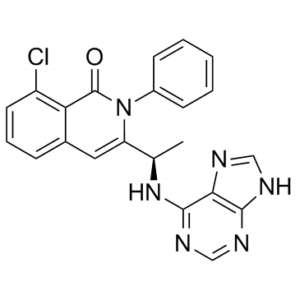
Duvelisib R enantiomer is the R-isomer of Duvelisib (formerly known as IPI-145 and INK1197, trade name: Copiktra) which is an isoquinolinone derivative and a novel potent, oral and selective small-molecule phosphoinositide-3 kinases (PI3K) inhibitor that selectively and potently inhibits two PI3K isoforms, PI3K-δ and PI3K-γ, with half maximal inhibition concentration IC50 of 2.5 nM and 27 nM respectively. FDA approved duvelisib in September 2018 to treat small lymphocytic lymphoma, follicular lymphoma, and chronic lymphocytic leukemia that has relapsed or is resistant to treatment. Despite having a preference for PI3K-δ and PI3K-γ, IPI-145 also inhibits PI3K-α and PI3K-β to a lesser extent, with IC50 values of 1602 nM and 85 nM, respectively. Phosphoinositide-3-kinase (PI3K) is an enzyme group, known to regulate key survival pathways in acute myeloid leukaemia (AML). It produces phosphatidylinositol-3,4,5-triphosphate, which offers a membrane docking site for protein kinaseB activation. There are four isoforms of the p110 catalytic subunit of PI3K:,, and. In contrast to the highly variable frequency of PI3Kγ expression, the PI3Kδ isoform is consistently expressed in AML cells. The roles of these individual catalytic enzymes have not been fully elucidated in AML, so the function of these two p110 subunits in human AML blast survival was investigated using the PI3K p110δ and p110γ targeted inhibitor IPI-145 (duvelisib) and specific p110δ and p110γ shRNA.
Physicochemical Properties
| Molecular Formula | C22H17CLN6O | |
| Molecular Weight | 416.86 | |
| Exact Mass | 416.115 | |
| CAS # | 1261590-48-0 | |
| Related CAS # | Duvelisib;1201438-56-3 | |
| PubChem CID | 68353646 | |
| Appearance | White to gray solid | |
| Density | 1.5±0.1 g/cm3 | |
| Boiling Point | 757.8±60.0 °C at 760 mmHg | |
| Flash Point | 412.1±32.9 °C | |
| Vapour Pressure | 0.0±2.6 mmHg at 25°C | |
| Index of Refraction | 1.757 | |
| LogP | 4.6 | |
| Hydrogen Bond Donor Count | 2 | |
| Hydrogen Bond Acceptor Count | 5 | |
| Rotatable Bond Count | 4 | |
| Heavy Atom Count | 30 | |
| Complexity | 668 | |
| Defined Atom Stereocenter Count | 1 | |
| SMILES | ClC1=C([H])C([H])=C([H])C2=C1C(N(C1C([H])=C([H])C([H])=C([H])C=1[H])C(=C2[H])C([H])(C([H])([H])[H])N([H])C1C2=C(N=C([H])N=1)N=C([H])N2[H])=O |
|
| InChi Key | SJVQHLPISAIATJ-CYBMUJFWSA-N | |
| InChi Code | InChI=1S/C22H17ClN6O/c1-13(28-21-19-20(25-11-24-19)26-12-27-21)17-10-14-6-5-9-16(23)18(14)22(30)29(17)15-7-3-2-4-8-15/h2-13H,1H3,(H2,24,25,26,27,28)/t13-/m1/s1 | |
| Chemical Name | 8-chloro-2-phenyl-3-[(1R)-1-(7H-purin-6-ylamino)ethyl]isoquinolin-1-one | |
| Synonyms |
|
|
| HS Tariff Code | 2934.99.9001 | |
| Storage |
Powder-20°C 3 years 4°C 2 years In solvent -80°C 6 months -20°C 1 month |
|
| Shipping Condition | Room temperature (This product is stable at ambient temperature for a few days during ordinary shipping and time spent in Customs) |
Biological Activity
| Targets | PI3K | ||
| ln Vitro |
|
||
| ln Vivo |
|
||
| Cell Assay | IPI-145 suppresses murine/human B-cell proliferation with EC50 of 0.5 nM/0.5 nM and also inhibits human T-cell proliferation with EC50 of 9.5 nM. | ||
| Animal Protocol |
|
||
| References |
[1]. Certain chemical entities, compositions and methods. WO 2011008302 A1. |
Solubility Data
| Solubility (In Vitro) |
|
|||
| Solubility (In Vivo) |
Solubility in Formulation 1: ≥ 2.5 mg/mL (6.00 mM) (saturation unknown) in 10% DMSO + 90% (20% SBE-β-CD in Saline) (add these co-solvents sequentially from left to right, and one by one), clear solution. For example, if 1 mL of working solution is to be prepared, you can add 100 μL of 25.0 mg/mL clear DMSO stock solution to 900 μL of 20% SBE-β-CD physiological saline solution and mix evenly. Preparation of 20% SBE-β-CD in Saline (4°C,1 week): Dissolve 2 g SBE-β-CD in 10 mL saline to obtain a clear solution. Solubility in Formulation 2: ≥ 2.5 mg/mL (6.00 mM) (saturation unknown) in 10% DMSO + 90% Corn Oil (add these co-solvents sequentially from left to right, and one by one), clear solution. For example, if 1 mL of working solution is to be prepared, you can add 100 μL of 25.0 mg/mL clear DMSO stock solution to 900 μL of corn oil and mix evenly. Solubility in Formulation 3: ≥ 2.38 mg/mL (5.71 mM) (saturation unknown) in 10% DMSO + 40% PEG300 + 5% Tween80 + 45% Saline (add these co-solvents sequentially from left to right, and one by one), clear solution. For example, if 1 mL of working solution is to be prepared, you can add 100 μL of 23.8 mg/mL clear DMSO stock solution to 400 μL PEG300 and mix evenly; then add 50 μL Tween-80 to the above solution and mix evenly; then add 450 μL normal saline to adjust the volume to 1 mL. Preparation of saline: Dissolve 0.9 g of sodium chloride in 100 mL ddH₂ O to obtain a clear solution. Solubility in Formulation 4: 30% PEG400+0.5% Tween80+5% Propylene glycol : 30mg/mL (Please use freshly prepared in vivo formulations for optimal results.) |
| Preparing Stock Solutions | 1 mg | 5 mg | 10 mg | |
| 1 mM | 2.3989 mL | 11.9944 mL | 23.9889 mL | |
| 5 mM | 0.4798 mL | 2.3989 mL | 4.7978 mL | |
| 10 mM | 0.2399 mL | 1.1994 mL | 2.3989 mL |