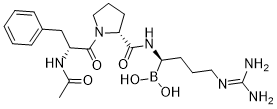
Dup-714 is a potent and orally bioavailable thrombin inhibitor with the potential for treatment of thromboembolic disorders.
Physicochemical Properties
| Molecular Formula | C21H33BN6O5 |
| Molecular Weight | 460.33492 |
| Exact Mass | 460.261 |
| Elemental Analysis | C, 54.79; H, 7.23; B, 2.35; N, 18.26; O, 17.38 |
| CAS # | 130982-43-3 |
| Related CAS # | 131062-98-1 (HCl);130982-43-3; |
| PubChem CID | 122296 |
| SequenceShortening | FP |
| Appearance | Typically exists as solid at room temperature |
| Density | 1.34g/cm3 |
| Index of Refraction | 1.619 |
| LogP | 1.714 |
| Hydrogen Bond Donor Count | 6 |
| Hydrogen Bond Acceptor Count | 6 |
| Rotatable Bond Count | 11 |
| Heavy Atom Count | 33 |
| Complexity | 697 |
| Defined Atom Stereocenter Count | 3 |
| SMILES | N/C(=N/CCC[C@H](NC([C@@H]1CCCN1C([C@@H](CC1C=CC=CC=1)NC(=O)C)=O)=O)B(O)O)/N |
| InChi Key | FXFYPTZERULUBS-SQNIBIBYSA-N |
| InChi Code | InChI=1S/C21H33BN6O5/c1-14(29)26-16(13-15-7-3-2-4-8-15)20(31)28-12-6-9-17(28)19(30)27-18(22(32)33)10-5-11-25-21(23)24/h2-4,7-8,16-18,32-33H,5-6,9-13H2,1H3,(H,26,29)(H,27,30)(H4,23,24,25)/t16-,17+,18+/m1/s1 |
| Chemical Name | [(1R)-1-[[(2S)-1-[(2R)-2-acetamido-3-phenylpropanoyl]pyrrolidine-2-carbonyl]amino]-4-(diaminomethylideneamino)butyl]boronic acid |
| Synonyms | Dup-714; Dup 714; acetylphenylalanyl-prolyl-boroarginine; Dup 714; 130982-43-3; Ac-Phe-pro-boroarg-OH; AC-(D)PHE-PRO-BOROARG-OH; [(1R)-1-[[(2S)-1-[(2R)-2-acetamido-3-phenylpropanoyl]pyrrolidine-2-carbonyl]amino]-4-(diaminomethylideneamino)butyl]boronic acid; Dup714. |
| HS Tariff Code | 2934.99.9001 |
| Storage |
Powder-20°C 3 years 4°C 2 years In solvent -80°C 6 months -20°C 1 month |
| Shipping Condition | Room temperature (This product is stable at ambient temperature for a few days during ordinary shipping and time spent in Customs) |
Biological Activity
| Targets | Thrombin |
| ln Vitro | Since thrombin plays an important role in platelet-mediated arterial thrombosis, we have examined the antiplatelet activity of a synthetic thrombin inhibitor, DuP 714 (Ac-(D)Phe-Pro-boroArg), in comparison with that of the naturally occurring inhibitor hirudin. Hirudin was slightly more potent than DuP 714 in inhibiting thrombin-induced aggregation in washed human platelets (IC50s of 72 nM and 150 nM, respectively) and in inhibiting the secretion of plasminogen activator inhibitor-I from human platelets (IC50s of 300 nM and 900 nM, respectively). In contrast, DuP 714 was more potent than hirudin in inhibiting thrombin-induced [125I]fibrinogen binding to gel purified platelets, and in inhibiting thrombin-induced intracellular calcium mobilization in washed platelets. These results indicate that the tripeptide DuP 714 has comparable antiplatelet activity to the 65 amino acid hirudin. We conclude that DuP 714 may have clinical utility in the prevention of platelet-dependent, arterial thrombotic processes. [1] |
| ln Vivo | A competition enzyme-linked immunosorbent assay (ELISA) has been developed for the quantitative detection in plasma of DuP 714, a boroarginine tripeptide (Ac-(D)-Phe-Pro-boroArg) with potent antithrombin activity. The assay has been used to calculate the half-life after i.v. administration of DuP 714, as well as the percent bioavailability after oral administration of the agent. Following i.v. administration, in dogs, the clearance of compound from the circulation could best be fit to a biexponential decay with an initial half-life of approximately 9 min, and a slower elimination phase with a half-life of 40 min. There was a significant correlation between pharmacokinetic and pharmacodynamic characteristics (r = 0.9570, P < 0.01) as measured with the ELISA and the clotting assay, aPTT, following i.v. infusion in conscious dogs. A plasma concentration of 311 ng/ml doubled the aPTT. After oral administration of 1 mg/kg DuP 714, peak concentration ranged from 384 to 584 ng/ml. Oral bioavailability, determined by comparing the areas under concentration vs time curves after oral and i.v. administration, was 53 +/- 8% (n = 4). In summary, this assay offers a rapid, sensitive and specific method of examining the peptide's pharmacokinetic characteristics. [2] |
| References |
[1]. Effect of thrombin inhibitors on platelet functions: comparative analysis of DuP 714 and hirudin. Blood Coagul Fibrinolysis. 1992;3(5):513-517. [2]. Analysis of the thrombin inhibitor DuP 714 by an enzyme-linked immunosorbent assay. Blood Coagul Fibrinolysis. 1994;5(4):517-521. |
| Additional Infomation | Ac-(D)Phe-Pro-boroArg-OH is a C-terminal boronic acid petide that is N-acetyl-D-phenylalanyl-L-prolyl-L-arginine in which the C-termnal carboxy group has been replaced by a borono (-B(OH)2) group. A thrombin (Factor IIa) inhibitor, thereby acting as an anticoagulant. It has a role as an EC 3.4.21.5 (thrombin) inhibitor and an anticoagulant. It is a C-terminal boronic acid peptide, a member of acetamides and a member of guanidines. It is a conjugate base of an Ac-(D)Phe-Pro-boroArg-OH(1+). |
Solubility Data
| Solubility (In Vitro) | May dissolve in DMSO (in most cases), if not, try other solvents such as H2O, Ethanol, or DMF with a minute amount of products to avoid loss of samples |
| Solubility (In Vivo) |
Note: Listed below are some common formulations that may be used to formulate products with low water solubility (e.g. < 1 mg/mL), you may test these formulations using a minute amount of products to avoid loss of samples. Injection Formulations (e.g. IP/IV/IM/SC) Injection Formulation 1: DMSO : Tween 80: Saline = 10 : 5 : 85 (i.e. 100 μL DMSO stock solution → 50 μL Tween 80 → 850 μL Saline) *Preparation of saline: Dissolve 0.9 g of sodium chloride in 100 mL ddH ₂ O to obtain a clear solution. Injection Formulation 2: DMSO : PEG300 :Tween 80 : Saline = 10 : 40 : 5 : 45 (i.e. 100 μL DMSO → 400 μLPEG300 → 50 μL Tween 80 → 450 μL Saline) Injection Formulation 3: DMSO : Corn oil = 10 : 90 (i.e. 100 μL DMSO → 900 μL Corn oil) Example: Take the Injection Formulation 3 (DMSO : Corn oil = 10 : 90) as an example, if 1 mL of 2.5 mg/mL working solution is to be prepared, you can take 100 μL 25 mg/mL DMSO stock solution and add to 900 μL corn oil, mix well to obtain a clear or suspension solution (2.5 mg/mL, ready for use in animals). Injection Formulation 4: DMSO : 20% SBE-β-CD in saline = 10 : 90 [i.e. 100 μL DMSO → 900 μL (20% SBE-β-CD in saline)] *Preparation of 20% SBE-β-CD in Saline (4°C,1 week): Dissolve 2 g SBE-β-CD in 10 mL saline to obtain a clear solution. Injection Formulation 5: 2-Hydroxypropyl-β-cyclodextrin : Saline = 50 : 50 (i.e. 500 μL 2-Hydroxypropyl-β-cyclodextrin → 500 μL Saline) Injection Formulation 6: DMSO : PEG300 : castor oil : Saline = 5 : 10 : 20 : 65 (i.e. 50 μL DMSO → 100 μLPEG300 → 200 μL castor oil → 650 μL Saline) Injection Formulation 7: Ethanol : Cremophor : Saline = 10: 10 : 80 (i.e. 100 μL Ethanol → 100 μL Cremophor → 800 μL Saline) Injection Formulation 8: Dissolve in Cremophor/Ethanol (50 : 50), then diluted by Saline Injection Formulation 9: EtOH : Corn oil = 10 : 90 (i.e. 100 μL EtOH → 900 μL Corn oil) Injection Formulation 10: EtOH : PEG300:Tween 80 : Saline = 10 : 40 : 5 : 45 (i.e. 100 μL EtOH → 400 μLPEG300 → 50 μL Tween 80 → 450 μL Saline) Oral Formulations Oral Formulation 1: Suspend in 0.5% CMC Na (carboxymethylcellulose sodium) Oral Formulation 2: Suspend in 0.5% Carboxymethyl cellulose Example: Take the Oral Formulation 1 (Suspend in 0.5% CMC Na) as an example, if 100 mL of 2.5 mg/mL working solution is to be prepared, you can first prepare 0.5% CMC Na solution by measuring 0.5 g CMC Na and dissolve it in 100 mL ddH2O to obtain a clear solution; then add 250 mg of the product to 100 mL 0.5% CMC Na solution, to make the suspension solution (2.5 mg/mL, ready for use in animals). Oral Formulation 3: Dissolved in PEG400 Oral Formulation 4: Suspend in 0.2% Carboxymethyl cellulose Oral Formulation 5: Dissolve in 0.25% Tween 80 and 0.5% Carboxymethyl cellulose Oral Formulation 6: Mixing with food powders Note: Please be aware that the above formulations are for reference only. InvivoChem strongly recommends customers to read literature methods/protocols carefully before determining which formulation you should use for in vivo studies, as different compounds have different solubility properties and have to be formulated differently. (Please use freshly prepared in vivo formulations for optimal results.) |
| Preparing Stock Solutions | 1 mg | 5 mg | 10 mg | |
| 1 mM | 2.1724 mL | 10.8618 mL | 21.7235 mL | |
| 5 mM | 0.4345 mL | 2.1724 mL | 4.3447 mL | |
| 10 mM | 0.2172 mL | 1.0862 mL | 2.1724 mL |