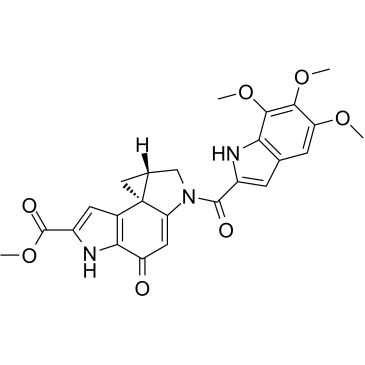
Physicochemical Properties
| Molecular Formula | C25H23N3O7 |
| Molecular Weight | 477.46600 |
| Exact Mass | 477.154 |
| CAS # | 130288-24-3 |
| PubChem CID | 115369 |
| Appearance | Off-white to light yellow solid powder |
| Density | 1.53±0.1 g/cm3 |
| Vapour Pressure | 8.82E-25mmHg at 25°C |
| LogP | 2.74 |
| Hydrogen Bond Donor Count | 2 |
| Hydrogen Bond Acceptor Count | 7 |
| Rotatable Bond Count | 6 |
| Heavy Atom Count | 35 |
| Complexity | 971 |
| Defined Atom Stereocenter Count | 2 |
| SMILES | COC1=C(C(=C2C(=C1)C=C(N2)C(=O)N3C[C@H]4C[C@@]45C3=CC(=O)C6=C5C=C(N6)C(=O)OC)OC)OC |
| InChi Key | VQNATVDKACXKTF-XELLLNAOSA-N |
| InChi Code | InChI=1S/C25H23N3O7/c1-32-17-6-11-5-14(26-19(11)22(34-3)21(17)33-2)23(30)28-10-12-9-25(12)13-7-15(24(31)35-4)27-20(13)16(29)8-18(25)28/h5-8,12,26-27H,9-10H2,1-4H3/t12-,25-/m1/s1 |
| Chemical Name | methyl (1R,12S)-7-oxo-10-(5,6,7-trimethoxy-1H-indole-2-carbonyl)-5,10-diazatetracyclo[7.4.0.01,12.02,6]trideca-2(6),3,8-triene-4-carboxylate |
| HS Tariff Code | 2934.99.9001 |
| Storage |
Powder-20°C 3 years 4°C 2 years In solvent -80°C 6 months -20°C 1 month Note: Please store this product in a sealed and protected environment (e.g. under nitrogen), avoid exposure to moisture. |
| Shipping Condition | Room temperature (This product is stable at ambient temperature for a few days during ordinary shipping and time spent in Customs) |
Biological Activity
| ln Vitro | Duocarmycin SA (DSA) (0.1-1 nM; 72 hours) decreases U-138 cell pathway survival in a dose-dependent manner and activates insets and endpoints [2]. Duocarmycin SA (0.1-1 nM; 72 hours) flow chart. |
| ln Vivo | In CDF1 mice implanted with mouse liver cancer P388, duocarmycin SA (0.143 mg/kg, intraperitoneal injection, single dose) shown anti-tumor efficacy, considerably prolonging carotene in mice by 30% [3]. Mice lacking CDF1 were given a transplant of murine lymphocytic leukemia P388 [3]. |
| Cell Assay |
Cell viability assay [1] Cell Types: U-138 Cell Tested Concentrations: 0.1, 0.5, 1 nM Incubation Duration: 72 hrs (hours) Experimental Results: Produced a significant concentration-dependent decrease in cell viability, and tumor cells were more sensitive to proton radiation [2]. 65% cell viability was observed at 0.1 nM, cell viability stabilized at at least 25% at 0.5 nM, and no increase in cytotoxicity was observed at higher doses. The IC50 of Duocarmycin SA against U-138 MG cells is 0.4 nM. Exhibits strong cytotoxicity with an IC50 of 0.0018 nM (1.8 pM). Apoptosis analysis [1] Cell Types: U-138 Cell Tested Concentrations: 0.001, 0.1 nM Incubation Duration: 3 or 14 days Experimental Results: Improved radiosensitivity of U-138 GBM cells by activating apoptosis and necrosis pathways. Survival rates were Dramatically diminished at different proton radiation doses (1-8 Gy). |
| Animal Protocol |
Animal/Disease Models: Murine lymphocytic leukemia P388 transplanted in CDF1 mice [3] Doses: 0.143 mg/kg Route of Administration: intraperitoneal (ip) injection (i.p.), single dose Experimental Results:demonstrated a significant 30% increase in life span. |
| References |
[1]. Synthesis and evaluation of a thio analogue of duocarmycin SA. Bioorg Med Chem Lett. 2009 Dec 15;19(24):6962-5. [2]. Boyle KE, et.al. Duocarmycin SA, a potent antitumor antibiotic, sensitizes glioblastoma cells to proton radiation. Bioorg Med Chem Lett. 2018 Sep 1;28(16):2688-2692. [3]. Ichimura M,et.al. Duocarmycin SA, a new antitumor antibiotic from Streptomyces sp. J Antibiot (Tokyo). 1990 Aug;43(8):1037-8. |
| Additional Infomation |
Duocarmycin SA is an indolecarboxamide. Duocarmycin sa has been reported in Streptomyces with data available. |
Solubility Data
| Solubility (In Vitro) | DMSO : ~50 mg/mL (~104.72 mM) |
| Solubility (In Vivo) |
Solubility in Formulation 1: ≥ 5 mg/mL (10.47 mM) (saturation unknown) in 10% DMSO + 40% PEG300 + 5% Tween80 + 45% Saline (add these co-solvents sequentially from left to right, and one by one), clear solution. For example, if 1 mL of working solution is to be prepared, you can add 100 μL of 50.0 mg/mL clear DMSO stock solution to 400 μL PEG300 and mix evenly; then add 50 μL Tween-80 to the above solution and mix evenly; then add 450 μL normal saline to adjust the volume to 1 mL. Preparation of saline: Dissolve 0.9 g of sodium chloride in 100 mL ddH₂ O to obtain a clear solution. Solubility in Formulation 2: ≥ 5 mg/mL (10.47 mM) (saturation unknown) in 10% DMSO + 90% Corn Oil (add these co-solvents sequentially from left to right, and one by one), clear solution. For example, if 1 mL of working solution is to be prepared, you can add 100 μL of 50.0 mg/mL clear DMSO stock solution to 900 μL of corn oil and mix evenly. (Please use freshly prepared in vivo formulations for optimal results.) |
| Preparing Stock Solutions | 1 mg | 5 mg | 10 mg | |
| 1 mM | 2.0944 mL | 10.4719 mL | 20.9437 mL | |
| 5 mM | 0.4189 mL | 2.0944 mL | 4.1887 mL | |
| 10 mM | 0.2094 mL | 1.0472 mL | 2.0944 mL |