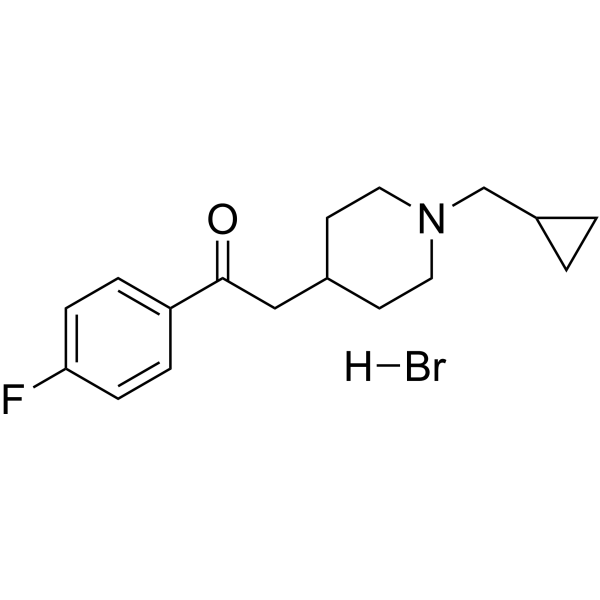
Physicochemical Properties
| Molecular Formula | C17H23BRFNO |
| Molecular Weight | 356.27 |
| Exact Mass | 355.095 |
| CAS # | 135135-87-4 |
| PubChem CID | 121967 |
| Appearance | Off-white to light yellow solid powder |
| Boiling Point | 384.5ºC at 760mmHg |
| Flash Point | 186.4ºC |
| Vapour Pressure | 4.07E-06mmHg at 25°C |
| LogP | 4.416 |
| Hydrogen Bond Donor Count | 1 |
| Hydrogen Bond Acceptor Count | 3 |
| Rotatable Bond Count | 5 |
| Heavy Atom Count | 21 |
| Complexity | 326 |
| Defined Atom Stereocenter Count | 0 |
| InChi Key | QLZIAKMYJFJBKA-UHFFFAOYSA-N |
| InChi Code | InChI=1S/C17H22FNO.BrH/c18-16-5-3-15(4-6-16)17(20)11-13-7-9-19(10-8-13)12-14-1-2-14;/h3-6,13-14H,1-2,7-12H2;1H |
| Chemical Name | 2-[1-(cyclopropylmethyl)piperidin-4-yl]-1-(4-fluorophenyl)ethanone;hydrobromide |
| HS Tariff Code | 2934.99.9001 |
| Storage |
Powder-20°C 3 years 4°C 2 years In solvent -80°C 6 months -20°C 1 month Note: Please store this product in a sealed and protected environment (e.g. under nitrogen), avoid exposure to moisture. |
| Shipping Condition | Room temperature (This product is stable at ambient temperature for a few days during ordinary shipping and time spent in Customs) |
Biological Activity
| Targets | Sigma receptor; 5-HT2 receptor; D2 receptor[1][2][3] |
| ln Vivo | DuP 734 is comparatively significantly weaker as an apomorphine antagonist (ED50=12 mg/kg, po) and potently inhibits mescaline-induced scratching (ED50=0.35 mg/kg, po) and aggressive activity (ED50=1.9 mg/kg, po) [1]. In vivo, the binding of [3H]DuP 734 and [3H](+)-SKF 10,047 to brain sigma receptors is potently antagonistic when DuP 734 is administered, with ID50 values of 0.02 and 0.07 mg/kg (0.07 and 0.25μmol/ kg), respectively[2]. DuP 734 is disposed of in mice, rats, beagle dogs, and cynomolgus monkeys by substantial steady-state volume of distribution (3.6 to 6.8 L/kg) and high total body systemic plasma clearance (46 to 87 mL/min/kg) after intravenous administration. There was a 50–83 minute range in the terminal elimination half-life. In rats and mice, the gastrointestinal absorption of an aqueous solution occurs very quickly; peak DuP 734 plasma concentrations are reached in 5 and 20 minutes after treatment, respectively. In 45 and 130 minutes, respectively, dogs and monkeys reach their maximal plasma concentrations. At dosages of 3.1 to 30.1 mg/kg, the absolute bioavailability in mice varies from 29 to 46%. When dosages of DuP 734 are increased from 12.5 to 50 mg/kg and 1 to 3 mg/kg in rats and dogs, respectively, the bioavailability improves from 4 to 10% and from 14 to 72%. In monkeys, the bioavailability of 9.3 mg/kg DuP 734 is 30.5%. In every animal species examined, the dose-dependent pharmacokinetics of DuP 734 are seen within constrained dose ranges[3]. |
| References |
[1]. DuP 734 [1-(cyclopropylmethyl)-4-(2'(4''-fluorophenyl)-2'- Oxoethyl)piperidine HBr] a Potential Antipsychotic Agent: Preclinical Behavioral Effects. J Pharmacol Exp Ther. 1992 Dec;263(3):1159-66. [2]. [3H]1-(cyclopropylmethyl)-4-(2-(4-fluorophenyl)-2-oxoethyl) Piperidine HBr (DuP 734). A Selective Ligand for Sigma Receptors in Mouse Brain in Vivo. J Pharmacol Exp Ther. 1993 Sep;266(3):1541-8. [3]. Dose and Species Dependent Pharmacokinetics of a Novel Sigma Receptor Antagonist, DuP 734. Res Commun Mol Pathol Pharmacol. 1995 Apr;88(1):3-20. |
Solubility Data
| Solubility (In Vitro) |
DMSO: 250 mg/mL (701.71 mM) H2O: ≥ 100 mg/mL (280.69 mM) |
| Solubility (In Vivo) |
Solubility in Formulation 1: ≥ 2.08 mg/mL (5.84 mM) (saturation unknown) in 10% DMSO + 40% PEG300 + 5% Tween80 + 45% Saline (add these co-solvents sequentially from left to right, and one by one), clear solution. For example, if 1 mL of working solution is to be prepared, you can add 100 μL of 20.8 mg/mL clear DMSO stock solution to 400 μL PEG300 and mix evenly; then add 50 μL Tween-80 to the above solution and mix evenly; then add 450 μL normal saline to adjust the volume to 1 mL. Preparation of saline: Dissolve 0.9 g of sodium chloride in 100 mL ddH₂ O to obtain a clear solution. Solubility in Formulation 2: ≥ 2.08 mg/mL (5.84 mM) (saturation unknown) in 10% DMSO + 90% (20% SBE-β-CD in Saline) (add these co-solvents sequentially from left to right, and one by one), clear solution. For example, if 1 mL of working solution is to be prepared, you can add 100 μL of 20.8 mg/mL clear DMSO stock solution to 900 μL of 20% SBE-β-CD physiological saline solution and mix evenly. Preparation of 20% SBE-β-CD in Saline (4°C,1 week): Dissolve 2 g SBE-β-CD in 10 mL saline to obtain a clear solution. Solubility in Formulation 3: ≥ 2.08 mg/mL (5.84 mM) (saturation unknown) in 10% DMSO + 90% Corn Oil (add these co-solvents sequentially from left to right, and one by one), clear solution. For example, if 1 mL of working solution is to be prepared, you can add 100 μL of 20.8 mg/mL clear DMSO stock solution to 900 μL of corn oil and mix evenly. (Please use freshly prepared in vivo formulations for optimal results.) |
| Preparing Stock Solutions | 1 mg | 5 mg | 10 mg | |
| 1 mM | 2.8069 mL | 14.0343 mL | 28.0686 mL | |
| 5 mM | 0.5614 mL | 2.8069 mL | 5.6137 mL | |
| 10 mM | 0.2807 mL | 1.4034 mL | 2.8069 mL |