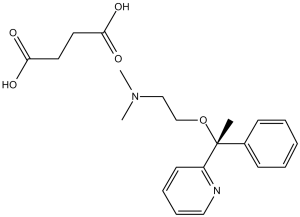
Doxylamine succinate (Decapryn; Unisom; Evigoa D), the succinate salt of Doxylamine, is an antihistamine drug that can be used as monotherapy (short-term sedative) or in combination with other drugs to relieve night-time allergy and cold. It competitively inhibits histamine at H1 receptors with substantial sedative and anticholinergic effects. The effects of doxylamine (as the succinate salt) on microsomal enzyme activity and serum thyroid hormone levels are examined in B6C3F1 mice following dietary exposure for 7 or 15 days (0, 40, 375, 750, or 1500 ppm in diet, expressed as free base doxylamine).
Physicochemical Properties
| Molecular Formula | C21H28N2O5 | |
| Molecular Weight | 388.46 | |
| Exact Mass | 388.199 | |
| Elemental Analysis | C, 64.93; H, 7.27; N, 7.21; O, 20.59 | |
| CAS # | 562-10-7 | |
| Related CAS # | Doxylamine; 469-21-6; Doxylamine-d5 succinate; 1216840-94-6 | |
| PubChem CID | 11224 | |
| Appearance | White to off-white solid powder | |
| Density | 1.043g/cm3 | |
| Boiling Point | 364.9ºC at 760 mmHg | |
| Melting Point | 103 - 108ºC | |
| Flash Point | 174.5ºC | |
| LogP | 2.859 | |
| Hydrogen Bond Donor Count | 2 | |
| Hydrogen Bond Acceptor Count | 7 | |
| Rotatable Bond Count | 9 | |
| Heavy Atom Count | 28 | |
| Complexity | 369 | |
| Defined Atom Stereocenter Count | 0 | |
| SMILES | O(C([H])([H])C([H])([H])N(C([H])([H])[H])C([H])([H])[H])C(C([H])([H])[H])(C1=C([H])C([H])=C([H])C([H])=N1)C1C([H])=C([H])C([H])=C([H])C=1[H].O([H])C(C([H])([H])C([H])([H])C(=O)O[H])=O |
|
| InChi Key | KBAUFVUYFNWQFM-UHFFFAOYSA-N | |
| InChi Code | InChI=1S/C17H22N2O.C4H6O4/c1-17(20-14-13-19(2)3,15-9-5-4-6-10-15)16-11-7-8-12-18-16;5-3(6)1-2-4(7)8/h4-12H,13-14H2,1-3H3;1-2H2,(H,5,6)(H,7,8) | |
| Chemical Name | butanedioic acid;N,N-dimethyl-2-(1-phenyl-1-pyridin-2-ylethoxy)ethanamine | |
| Synonyms |
|
|
| HS Tariff Code | 2934.99.9001 | |
| Storage |
Powder-20°C 3 years 4°C 2 years In solvent -80°C 6 months -20°C 1 month Note: Please store this product in a sealed and protected environment, avoid exposure to moisture. |
|
| Shipping Condition | Room temperature (This product is stable at ambient temperature for a few days during ordinary shipping and time spent in Customs) |
Biological Activity
| Targets | Histamine H1 receptor | ||
| ln Vitro |
|
||
| ln Vivo |
|
||
| Animal Protocol |
|
||
| References |
[1]. Toxicol Appl Pharmacol . 1996 Dec;141(2):584-94. |
||
| Additional Infomation |
Doxylamine succinate appears as white or creamy white powder. pH (1% aqueous solution) between 4.9 and 5.1. (NTP, 1992) Doxylamine succinate is an organic molecular entity. Doxylamine Succinate is a pyridine derivate histamine H1 antagonist with pronounced sedative properties. Doxylamine succinate competitively blocks the histamine H1 receptor and limits the typical allergic and anaphylactic responses, including bronchoconstriction, vasodilation, increased capillary permeability, and spasmodic contraction of gastrointestinal smooth muscle, caused by actions of histamine on bronchial and gastrointestinal smooth muscles, and on capillaries. This drug also prevents histamine-induced pain and itching of the skin and mucous membranes. See also: Doxylamine (has active moiety); Doxylamine succinate; pyridoxine hydrochloride (component of); Chlorobutanol; Doxylamine Succinate (component of) ... View More ... |
Solubility Data
| Solubility (In Vitro) |
|
|||
| Solubility (In Vivo) |
Solubility in Formulation 1: ≥ 2.5 mg/mL (6.44 mM) (saturation unknown) in 10% DMSO + 40% PEG300 + 5% Tween80 + 45% Saline (add these co-solvents sequentially from left to right, and one by one), clear solution. For example, if 1 mL of working solution is to be prepared, you can add 100 μL of 25.0 mg/mL clear DMSO stock solution to 400 μL PEG300 and mix evenly; then add 50 μL Tween-80 to the above solution and mix evenly; then add 450 μL normal saline to adjust the volume to 1 mL. Preparation of saline: Dissolve 0.9 g of sodium chloride in 100 mL ddH₂ O to obtain a clear solution. Solubility in Formulation 2: ≥ 2.5 mg/mL (6.44 mM) (saturation unknown) in 10% DMSO + 90% (20% SBE-β-CD in Saline) (add these co-solvents sequentially from left to right, and one by one), clear solution. For example, if 1 mL of working solution is to be prepared, you can add 100 μL of 25.0 mg/mL clear DMSO stock solution to 900 μL of 20% SBE-β-CD physiological saline solution and mix evenly. Preparation of 20% SBE-β-CD in Saline (4°C,1 week): Dissolve 2 g SBE-β-CD in 10 mL saline to obtain a clear solution. Solubility in Formulation 3: ≥ 2.5 mg/mL (6.44 mM) (saturation unknown) in 10% DMSO + 90% Corn Oil (add these co-solvents sequentially from left to right, and one by one), clear solution. For example, if 1 mL of working solution is to be prepared, you can add 100 μL of 25.0 mg/mL clear DMSO stock solution to 900 μL of corn oil and mix evenly. Solubility in Formulation 4: 100 mg/mL (257.43 mM) in PBS (add these co-solvents sequentially from left to right, and one by one), clear solution; with ultrasonication. (Please use freshly prepared in vivo formulations for optimal results.) |
| Preparing Stock Solutions | 1 mg | 5 mg | 10 mg | |
| 1 mM | 2.5743 mL | 12.8713 mL | 25.7427 mL | |
| 5 mM | 0.5149 mL | 2.5743 mL | 5.1485 mL | |
| 10 mM | 0.2574 mL | 1.2871 mL | 2.5743 mL |