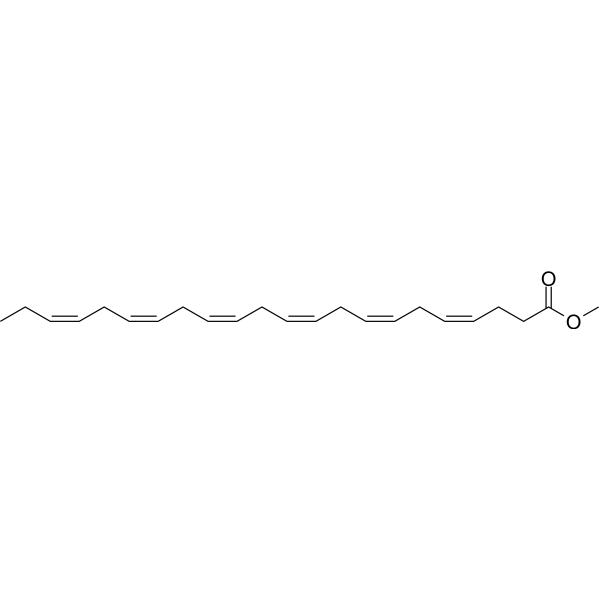
Physicochemical Properties
| Molecular Formula | C23H34O2 |
| Molecular Weight | 342.51486 |
| Exact Mass | 342.255 |
| CAS # | 2566-90-7 |
| Related CAS # | Docosahexaenoic acid-d5 methyl ester;2687960-96-7;Docosahexaenoic acid-13C22 methyl ester |
| PubChem CID | 6421262 |
| Appearance | Colorless to light yellow liquid(Density:0.921 g/cm3) |
| Density | 0.9±0.1 g/cm3 |
| Boiling Point | 429.9±24.0 °C at 760 mmHg |
| Flash Point | 103.9±21.2 °C |
| Vapour Pressure | 0.0±1.0 mmHg at 25°C |
| Index of Refraction | 1.505 |
| LogP | 7.24 |
| Hydrogen Bond Donor Count | 0 |
| Hydrogen Bond Acceptor Count | 2 |
| Rotatable Bond Count | 15 |
| Heavy Atom Count | 25 |
| Complexity | 476 |
| Defined Atom Stereocenter Count | 0 |
| SMILES | CC/C=C\C/C=C\C/C=C\C/C=C\C/C=C\C/C=C\CCC(OC)=O |
| InChi Key | VCDLWFYODNTQOT-JDPCYWKWSA-N |
| InChi Code | InChI=1S/C23H34O2/c1-3-4-5-6-7-8-9-10-11-12-13-14-15-16-17-18-19-20-21-22-23(24)25-2/h4-5,7-8,10-11,13-14,16-17,19-20H,3,6,9,12,15,18,21-22H2,1-2H3/b5-4-,8-7-,11-10-,14-13-,17-16-,20-19- |
| Chemical Name | methyl (4Z,7Z,10Z,13Z,16Z,19Z)-docosa-4,7,10,13,16,19-hexaenoate |
| HS Tariff Code | 2934.99.9001 |
| Storage |
Powder-20°C 3 years 4°C 2 years In solvent -80°C 6 months -20°C 1 month |
| Shipping Condition | Room temperature (This product is stable at ambient temperature for a few days during ordinary shipping and time spent in Customs) |
Biological Activity
| ln Vitro |
The incidence of sharp waves (SPW) appears to be reduced relative to baseline after injection of docosahexaenoic acid methyl ester (DHA-Me) [1]. When bovine serum albumin (BSA) was subjected to a mixed functional oxidation system of Fe2+ and ascorbic acid (AsA) in the absence of docosahexaenoic acid methyl ester (DHA), no new protein bands were formed. However, when BSA was treated with DHA for 24 hours, large molecular weight protein bands were found. Incubation of BSA with 1.0 mM DHA resulted in a large rise in protein carbonyl content, while addition of oxygen radical scavengers results in a considerable decrease in protein carbonyl content [2]. Docosahexaenoic Acid methyl ester (DHA methyl ester) selectively reduced the frequency and amplitude of excitatory sharp waves (SPWs) in acutely isolated rat hippocampal slices at a concentration of 10 μM, without affecting baseline synaptic transmission or field excitatory postsynaptic potentials (fEPSPs) [1] It exhibited a similar SPW-suppressing effect to docosahexaenoic acid (DHA), but with comparable potency in the hippocampal CA3-CA1 pathway [1] Under oxidative conditions, DHA methyl ester underwent peroxidation to form reactive products that covalently bound to proteins (e.g., bovine serum albumin, BSA), generating high-molecular-weight (HMW) protein adducts (molecular weight > 250 kDa) [2] The formation of HMW protein adducts was dependent on oxidative stress; the addition of antioxidants inhibited adduct formation, confirming peroxidation as a prerequisite [2] |
| Cell Assay |
#### From Literature [1] (Hippocampal Slice Electrophysiology) - Adult rats were euthanized, and the hippocampus was rapidly dissected and cut into 400-μm-thick slices in ice-cold artificial cerebrospinal fluid (aCSF) [1] - Slices were incubated in oxygenated (95% O₂/5% CO₂) aCSF at 32°C for 1 hour to recover [1] - DHA methyl ester was dissolved in ethanol (final ethanol concentration < 0.1%) and added to the incubation medium at 10 μM; control slices received the same volume of ethanol [1] - Extracellular field potentials were recorded from the CA1 stratum radiatum using glass microelectrodes filled with aCSF; sharp waves and fEPSPs were induced by electrical stimulation of the CA3 Schaffer collaterals [1] - Recordings were performed for 30 minutes before and after drug application; data were analyzed for SPW frequency, amplitude, and fEPSP slope [1] #### From Literature [2] (Protein Adduct Formation Assay) - DHA methyl ester was dissolved in organic solvent to prepare a stock solution, then diluted in phosphate-buffered saline (PBS) to a final concentration of 100 μM [2] - Oxidative peroxidation was induced by incubating the peptide solution with a lipid peroxidation initiator at 37°C for 24 hours [2] - Bovine serum albumin (BSA) was added to the peroxidized DHA methyl ester solution (molar ratio 1:10) and incubated at 37°C for 4 hours [2] - Protein samples were separated by SDS-PAGE on a polyacrylamide gel, stained with Coomassie Brilliant Blue, and visualized to detect high-molecular-weight protein adducts [2] - For antioxidant control experiments: antioxidants were added to the reaction mixture before peroxidation induction, and adduct formation was compared to the non-antioxidant group [2] |
| References |
[1]. Taha AY, et al. Selective reduction of excitatory hippocampal sharp waves by docosahexaenoic acid and its methyl ester analog ex-vivo. Brain Res. 2013 Nov 6;1537:9-17. [2]. Liu W, et al. Formation of high-molecular-weight protein adducts by methyl docosahexaenoate peroxidation products. Biochim Biophys Acta. 2007 Feb;1774(2):258-66 |
| Additional Infomation |
Docosahexaenoic acid methyl ester is a fatty acid methyl ester. Docosahexaenoic Acid methyl ester (DHA methyl ester) is a methyl ester derivative of docosahexaenoic acid (DHA), an omega-3 polyunsaturated fatty acid [1][2] Its ability to selectively suppress hippocampal sharp waves ex vivo suggests potential modulatory effects on hippocampal excitatory circuitry, which may be relevant to neurophysiological processes [1] Peroxidation-derived protein adduct formation indicates that its biological effects may be influenced by oxidative microenvironments, with potential implications for oxidative stress-related pathways [2] |
Solubility Data
| Solubility (In Vitro) | Ethanol : ~100 mg/mL (~291.96 mM) |
| Solubility (In Vivo) |
Solubility in Formulation 1: ≥ 2.5 mg/mL (7.30 mM) (saturation unknown) in 10% DMSO + 40% PEG300 + 5% Tween80 + 45% Saline (add these co-solvents sequentially from left to right, and one by one), clear solution. For example, if 1 mL of working solution is to be prepared, you can add 100 μL of 25.0 mg/mL clear DMSO stock solution to 400 μL PEG300 and mix evenly; then add 50 μL Tween-80 to the above solution and mix evenly; then add 450 μL normal saline to adjust the volume to 1 mL. Preparation of saline: Dissolve 0.9 g of sodium chloride in 100 mL ddH₂ O to obtain a clear solution. Solubility in Formulation 2: ≥ 2.5 mg/mL (7.30 mM) (saturation unknown) in 10% DMSO + 90% Corn Oil (add these co-solvents sequentially from left to right, and one by one), clear solution. For example, if 1 mL of working solution is to be prepared, you can add 100 μL of 25.0 mg/mL clear DMSO stock solution to 900 μL of corn oil and mix evenly. (Please use freshly prepared in vivo formulations for optimal results.) |
| Preparing Stock Solutions | 1 mg | 5 mg | 10 mg | |
| 1 mM | 2.9196 mL | 14.5981 mL | 29.1962 mL | |
| 5 mM | 0.5839 mL | 2.9196 mL | 5.8392 mL | |
| 10 mM | 0.2920 mL | 1.4598 mL | 2.9196 mL |