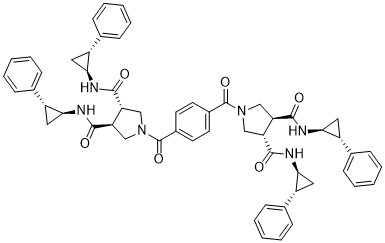
Diprovocim is a novel and potent agonist of Toll-like receptor (TLR1/TLR2) with anticancer and immunomodulatory effects. It induces dose-dependent TNF production with an EC50 of 110 pM in human THP-1 cells and 1.3 nM in primary mouse peritoneal macrophages. Inducing TNF production in bone marrow-derived dendritic cells (BMDC) with EC50 of 6.7 nM, also inducing IL-6 production by mouse BMDC; inducing phosphorylation of IKKα, IKKβ, p38, JNK, and ERK, as well as degradation of IκBα in THP-1 cells and mouse peritoneal macrophages, activating conventional TLR1/TLR2 signaling, including MAPK and canonical NF-κB signaling; synergizes with anti-PD-L1 to eliminate melanoma in mice.
Physicochemical Properties
| Molecular Formula | C56H56N6O6 |
| Molecular Weight | 909.0805 |
| Exact Mass | 908.426 |
| CAS # | 2170867-89-5 |
| PubChem CID | 137553173 |
| Appearance | White to off-white solid powder |
| LogP | 5.3 |
| Hydrogen Bond Donor Count | 4 |
| Hydrogen Bond Acceptor Count | 6 |
| Rotatable Bond Count | 14 |
| Heavy Atom Count | 68 |
| Complexity | 1620 |
| Defined Atom Stereocenter Count | 12 |
| SMILES | O=C([C@@]1([H])C([H])([H])N(C(C2C([H])=C([H])C(=C([H])C=2[H])C(N2C([H])([H])[C@]([H])(C(N([H])[C@]3([H])C([H])([H])[C@@]3([H])C3C([H])=C([H])C([H])=C([H])C=3[H])=O)[C@@]([H])(C(N([H])[C@]3([H])C([H])([H])[C@@]3([H])C3C([H])=C([H])C([H])=C([H])C=3[H])=O)C2([H])[H])=O)=O)C([H])([H])[C@]1([H])C(N([H])[C@]1([H])C([H])([H])[C@@]1([H])C1C([H])=C([H])C([H])=C([H])C=1[H])=O)N([H])[C@]1([H])C([H])([H])[C@@]1([H])C1C([H])=C([H])C([H])=C([H])C=1[H] |
| InChi Key | ABZBNXFGYUSVCJ-UYMKNZQYSA-N |
| InChi Code | InChI=1S/C56H56N6O6/c63-51(57-47-25-39(47)33-13-5-1-6-14-33)43-29-61(30-44(43)52(64)58-48-26-40(48)34-15-7-2-8-16-34)55(67)37-21-23-38(24-22-37)56(68)62-31-45(53(65)59-49-27-41(49)35-17-9-3-10-18-35)46(32-62)54(66)60-50-28-42(50)36-19-11-4-12-20-36/h1-24,39-50H,25-32H2,(H,57,63)(H,58,64)(H,59,65)(H,60,66)/t39-,40-,41-,42-,43-,44-,45-,46-,47+,48+,49+,50+/m1/s1 |
| Chemical Name | (3S,4S)-1-[4-[(3S,4S)-3,4-bis[[(1S,2R)-2-phenylcyclopropyl]carbamoyl]pyrrolidine-1-carbonyl]benzoyl]-3-N,4-N-bis[(1S,2R)-2-phenylcyclopropyl]pyrrolidine-3,4-dicarboxamide |
| HS Tariff Code | 2934.99.9001 |
| Storage |
Powder-20°C 3 years 4°C 2 years In solvent -80°C 6 months -20°C 1 month |
| Shipping Condition | Room temperature (This product is stable at ambient temperature for a few days during ordinary shipping and time spent in Customs) |
Biological Activity
| ln Vitro | Diprovocim (0.01-10000 nM; 4 hours) induces THP-1 cells (EC50=110 pM), human peripheral blood mononuclear cells (PBMC) (EC50=875 pM), and simulated peritoneal macrophages (EC50=1.3 nM). Diprovocim (5 nM in THP-1 cells, 500 nM in mouse peritoneal macrophages; 15-120 minutes) induces phosphorylation of IKKα, IKKβ, p38, JNK, and ERK [2]. ] and dendritic cells derived from bone marrow (BMDC) (EC50=6.7 nM) generate TNF in a dose-dependent manner. Apart from TNF, Diprovocim also causes BMDC to produce IL-6 [2]. |
| ln Vivo | Similar levels of serum OVA waveform IgG were generated 14 days later by diprovocim (10 mg/kg), which functions as an adjuvant when combined with egg albumen (OVA; 100 μg) and injected excisionally [2]. Tumor growth rate can be markedly increased by /kg) combined with ovalbumin (OVA; 100 μg) and injected prior to B16-OVA cell vaccination [2]. |
| Cell Assay |
Western Blot Analysis[2] Cell Types: THP-1 cells and mouse peritoneal macrophages Tested Concentrations: 5 nM in THP-1, 500 nM in mouse peritoneal macrophages Incubation Duration: 15, 30, 60, 120 minutes Experimental Results: Induces phosphorylation of IKKα, IKKβ, p38, JNK and ERK, and degradation of IκBα. |
| Animal Protocol |
Animal/Disease Models: WT or Tlr2−/− C57BL/ 6J mice [2] Doses: 10 mg/kg Route of Administration: intramuscularinjection Experimental Results: Induced similar levels of serum OVA-specific IgG compared with intramuscularinjection of 100 μg OVA This level was Dramatically elevated compared to the levels induced by OVA-loaded immunity mixed with the drug. |
| References |
[1]. Diprovocims: A New and Exceptionally Potent Class of Toll-like Receptor Agonists. J Am Chem Soc. 2018 Oct 31;140(43):14440-14454. [2]. Adjuvant effect of the novel TLR1/TLR2 agonist Diprovocim synergizes with anti-PD-L1 to eliminate melanoma in mice. Proc Natl Acad Sci U S A. 2018 Sep 11;115(37):E8698-E8706. |
Solubility Data
| Solubility (In Vitro) |
DMSO : ~33.33 mg/mL (~36.66 mM) H2O : < 0.1 mg/mL |
| Solubility (In Vivo) |
Solubility in Formulation 1: 2.5 mg/mL (2.75 mM) in 10% DMSO + 90% Corn Oil (add these co-solvents sequentially from left to right, and one by one), suspension solution; with sonication. For example, if 1 mL of working solution is to be prepared, you can add 100 μL of 25.0 mg/mL clear DMSO stock solution to 900 μL of corn oil and mix evenly. (Please use freshly prepared in vivo formulations for optimal results.) |
| Preparing Stock Solutions | 1 mg | 5 mg | 10 mg | |
| 1 mM | 1.1000 mL | 5.5001 mL | 11.0001 mL | |
| 5 mM | 0.2200 mL | 1.1000 mL | 2.2000 mL | |
| 10 mM | 0.1100 mL | 0.5500 mL | 1.1000 mL |