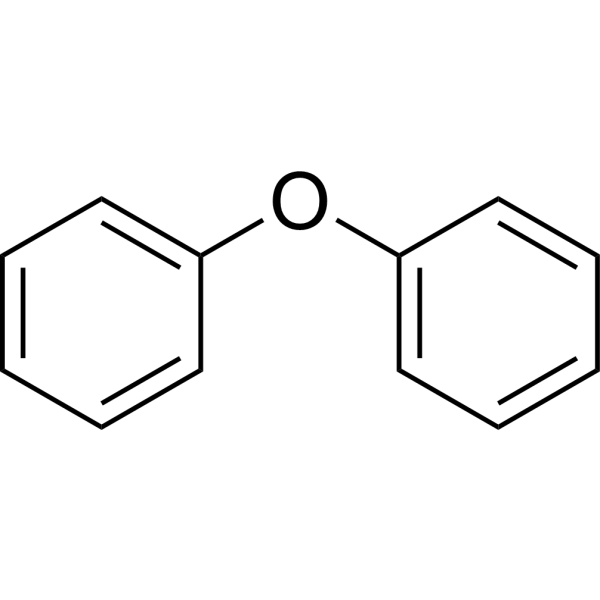
Physicochemical Properties
| Molecular Formula | C12H10O |
| Molecular Weight | 170.21 |
| Exact Mass | 170.073 |
| CAS # | 101-84-8 |
| Related CAS # | Diphenyl ether-d10;93952-05-7 |
| PubChem CID | 7583 |
| Appearance |
Colorless crystals or liquid Colorless, crystalline solid or liquid (above 82 degrees F) |
| Density | 1.073 |
| Boiling Point | 259 ºC |
| Melting Point | 26-30 ºC |
| Flash Point | 115 ºC |
| Vapour Pressure | 0.0±0.5 mmHg at 25°C |
| Index of Refraction | 1.5795-1.5815 |
| LogP | 4.21 |
| Hydrogen Bond Donor Count | 0 |
| Hydrogen Bond Acceptor Count | 1 |
| Rotatable Bond Count | 2 |
| Heavy Atom Count | 13 |
| Complexity | 116 |
| Defined Atom Stereocenter Count | 0 |
| SMILES | O(C1C([H])=C([H])C([H])=C([H])C=1[H])C1C([H])=C([H])C([H])=C([H])C=1[H] |
| InChi Key | USIUVYZYUHIAEV-UHFFFAOYSA-N |
| InChi Code | InChI=1S/C12H10O/c1-3-7-11(8-4-1)13-12-9-5-2-6-10-12/h1-10H |
| Chemical Name | phenoxybenzene |
| HS Tariff Code | 2934.99.9001 |
| Storage |
Powder-20°C 3 years 4°C 2 years In solvent -80°C 6 months -20°C 1 month |
| Shipping Condition | Room temperature (This product is stable at ambient temperature for a few days during ordinary shipping and time spent in Customs) |
Biological Activity
| ln Vitro | utilized in chemical synthesis as well as a heat-transfer medium |
| ADME/Pharmacokinetics |
Absorption, Distribution and Excretion The absorption of diphenyl ether after oral uptake is up to 90% in rats and rabbits and is independent of the administered dose. The data on dermal absorption are somewhat conflicting. After semi-occlusive application of 10-1,000 mg/kg to the clipped skin of rats, almost 20% of the dose was absorbed as measured by the amount excreted in urine. However, in a diffusion experiment only 0.3% (rat skin) or 0.2% (human skin) of diphenyl ether penetrated the skin in vitro. The higher absorption in the in vivo experiment may have been caused by the vehicle (diethyl phthalate) and some oral uptake after removal of the occlusion plaster. After intraperitoneal injection in rats, diphenyl ether was distributed into all organs and tissues within 1 hour with maximum concentrations in liver, lung, kidney and spleen. ... Phenyl ether, when injected into the rabbit, was excreted in the urine as p-hydroxyphenyl phenyl ether and none was excreted as the unchanged ether. /Route not specified/ Metabolism / Metabolites ... In the rabbit no cleavage of the ether linkage /of phenyl ether/ occurs. The major metabolite was the p-hydroxylated ether, which is excreted both unconjugated (15%) and conjugated with glucuronic acid (63%) and sulfuric acid (12%). Another metabolite was also isolated from the rabbit urine and fairly well identified as di(p-hydroxyphenyl) ether. Subcellular fractions of trout liver homogenate metab diphenyl ether mainly to 4 hydroxy derivates with traces of other compounds including 3 hydroxy derivates and possibly 4,4'-dihydroxy derivates. The bacterium Sphingomonas sp strain SS3, which utilizes diphenyl ether as source of carbon and energy, was enriched from soil samples of an industrial waste deposit. During diphenyl ether degradation in batch culture experiments, phenol and catechol were produced as intermediates which were then channeled into the 3-oxoadipate pathway. The initial step in the degradation follows the recently discovered mechanism of 1,2-dioxygenation, which yields unstable phenolic hemiacetals from diphenyl ether structures. Screening of selected fungi proved Cunninghamella echinulata most suitable for research on hydroxylation of biphenyl oxide. The process depended on cultivation conditions and yielded up to 76% 4-hydroxybiphenyl oxide and about 6% 4,4'-dihydroxybiphenyl oxide. |
| Additional Infomation |
Diphenyl oxide appears as colorless liquid with a mild pleasant odor. May float or sink in water. Freezing point is 81 °F. (USCG, 1999) Diphenyl ether is an aromatic ether in which the oxygen is attached to two phenyl substituents. It has been found in muscat grapes and vanilla. It has a role as a plant metabolite. Diphenyl ether has been reported in Vitis vinifera and Mangifera indica with data available. |
Solubility Data
| Solubility (In Vitro) | May dissolve in DMSO (in most cases), if not, try other solvents such as H2O, Ethanol, or DMF with a minute amount of products to avoid loss of samples |
| Solubility (In Vivo) |
Note: Listed below are some common formulations that may be used to formulate products with low water solubility (e.g. < 1 mg/mL), you may test these formulations using a minute amount of products to avoid loss of samples. Injection Formulations (e.g. IP/IV/IM/SC) Injection Formulation 1: DMSO : Tween 80: Saline = 10 : 5 : 85 (i.e. 100 μL DMSO stock solution → 50 μL Tween 80 → 850 μL Saline) *Preparation of saline: Dissolve 0.9 g of sodium chloride in 100 mL ddH ₂ O to obtain a clear solution. Injection Formulation 2: DMSO : PEG300 :Tween 80 : Saline = 10 : 40 : 5 : 45 (i.e. 100 μL DMSO → 400 μLPEG300 → 50 μL Tween 80 → 450 μL Saline) Injection Formulation 3: DMSO : Corn oil = 10 : 90 (i.e. 100 μL DMSO → 900 μL Corn oil) Example: Take the Injection Formulation 3 (DMSO : Corn oil = 10 : 90) as an example, if 1 mL of 2.5 mg/mL working solution is to be prepared, you can take 100 μL 25 mg/mL DMSO stock solution and add to 900 μL corn oil, mix well to obtain a clear or suspension solution (2.5 mg/mL, ready for use in animals). Injection Formulation 4: DMSO : 20% SBE-β-CD in saline = 10 : 90 [i.e. 100 μL DMSO → 900 μL (20% SBE-β-CD in saline)] *Preparation of 20% SBE-β-CD in Saline (4°C,1 week): Dissolve 2 g SBE-β-CD in 10 mL saline to obtain a clear solution. Injection Formulation 5: 2-Hydroxypropyl-β-cyclodextrin : Saline = 50 : 50 (i.e. 500 μL 2-Hydroxypropyl-β-cyclodextrin → 500 μL Saline) Injection Formulation 6: DMSO : PEG300 : castor oil : Saline = 5 : 10 : 20 : 65 (i.e. 50 μL DMSO → 100 μLPEG300 → 200 μL castor oil → 650 μL Saline) Injection Formulation 7: Ethanol : Cremophor : Saline = 10: 10 : 80 (i.e. 100 μL Ethanol → 100 μL Cremophor → 800 μL Saline) Injection Formulation 8: Dissolve in Cremophor/Ethanol (50 : 50), then diluted by Saline Injection Formulation 9: EtOH : Corn oil = 10 : 90 (i.e. 100 μL EtOH → 900 μL Corn oil) Injection Formulation 10: EtOH : PEG300:Tween 80 : Saline = 10 : 40 : 5 : 45 (i.e. 100 μL EtOH → 400 μLPEG300 → 50 μL Tween 80 → 450 μL Saline) Oral Formulations Oral Formulation 1: Suspend in 0.5% CMC Na (carboxymethylcellulose sodium) Oral Formulation 2: Suspend in 0.5% Carboxymethyl cellulose Example: Take the Oral Formulation 1 (Suspend in 0.5% CMC Na) as an example, if 100 mL of 2.5 mg/mL working solution is to be prepared, you can first prepare 0.5% CMC Na solution by measuring 0.5 g CMC Na and dissolve it in 100 mL ddH2O to obtain a clear solution; then add 250 mg of the product to 100 mL 0.5% CMC Na solution, to make the suspension solution (2.5 mg/mL, ready for use in animals). Oral Formulation 3: Dissolved in PEG400 Oral Formulation 4: Suspend in 0.2% Carboxymethyl cellulose Oral Formulation 5: Dissolve in 0.25% Tween 80 and 0.5% Carboxymethyl cellulose Oral Formulation 6: Mixing with food powders Note: Please be aware that the above formulations are for reference only. InvivoChem strongly recommends customers to read literature methods/protocols carefully before determining which formulation you should use for in vivo studies, as different compounds have different solubility properties and have to be formulated differently. (Please use freshly prepared in vivo formulations for optimal results.) |
| Preparing Stock Solutions | 1 mg | 5 mg | 10 mg | |
| 1 mM | 5.8751 mL | 29.3755 mL | 58.7510 mL | |
| 5 mM | 1.1750 mL | 5.8751 mL | 11.7502 mL | |
| 10 mM | 0.5875 mL | 2.9375 mL | 5.8751 mL |