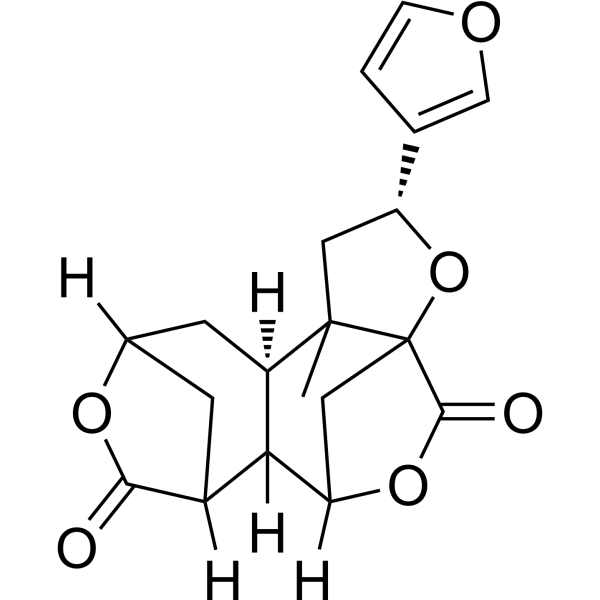
Physicochemical Properties
| Molecular Formula | C19H20O6 |
| Molecular Weight | 344.3585 |
| Exact Mass | 344.125 |
| CAS # | 20086-06-0 |
| PubChem CID | 15559043 |
| Appearance | White to off-white solid powder |
| Density | 1.4±0.1 g/cm3 |
| Boiling Point | 574.8±50.0 °C at 760 mmHg |
| Melting Point | 285 °C |
| Flash Point | 301.4±30.1 °C |
| Vapour Pressure | 0.0±1.6 mmHg at 25°C |
| Index of Refraction | 1.613 |
| LogP | -0.41 |
| Hydrogen Bond Donor Count | 0 |
| Hydrogen Bond Acceptor Count | 6 |
| Rotatable Bond Count | 1 |
| Heavy Atom Count | 25 |
| Complexity | 662 |
| Defined Atom Stereocenter Count | 0 |
| InChi Key | QEANLIISUSNNDX-UHFFFAOYSA-N |
| InChi Code | InChI=1S/C19H20O6/c1-18-6-13(9-2-3-22-8-9)25-19(18)7-14(24-17(19)21)15-11-4-10(5-12(15)18)23-16(11)20/h2-3,8,10-15H,4-7H2,1H3 |
| Chemical Name | 3-(furan-3-yl)-5-methyl-2,9,14-trioxapentacyclo[11.2.1.18,11.01,5.06,12]heptadecane-10,15-dione |
| HS Tariff Code | 2934.99.9001 |
| Storage |
Powder-20°C 3 years 4°C 2 years In solvent -80°C 6 months -20°C 1 month |
| Shipping Condition | Room temperature (This product is stable at ambient temperature for a few days during ordinary shipping and time spent in Customs) |
Biological Activity
| ln Vivo |
Diosbulbin B exhibited antitumor activity in H22 hepatocellular carcinoma-bearing mice: Intraperitoneal administration of Diosbulbin B (20 mg/kg, once daily for 10 consecutive days) significantly reduced tumor weight compared to the control group. However, it induced liver injury, as evidenced by increased serum alanine transaminase (ALT) and aspartate transaminase (AST) levels, and histological changes (hepatocyte swelling and inflammatory infiltration) in liver tissues. [1] Combination with ferulic acid enhanced the antitumor effect and attenuated liver injury of Diosbulbin B in vivo: Co-administration of Diosbulbin B (20 mg/kg, i.p., once daily for 10 days) and ferulic acid (50 mg/kg, p.o., once daily for 10 days) further reduced tumor weight (tumor inhibition rate increased by ~25% compared to Diosbulbin B alone) and significantly decreased serum ALT/AST levels, with improved liver tissue morphology (reduced hepatocyte damage and inflammation). [1] Diosbulbin B induced dose-dependent liver injury in ICR mice: Oral gavage of Diosbulbin B (50, 100, 200 mg/kg, once daily for 7 consecutive days) caused dose-dependent elevation of serum ALT, AST, and alkaline phosphatase (ALP) levels. Histopathological examination showed hepatocyte edema, vacuolar degeneration, and focal necrosis in liver tissues, with more severe damage at higher doses. [2] The liver injury mechanism of Diosbulbin B involved oxidative stress and apoptosis: In liver tissues of mice treated with Diosbulbin B (50-200 mg/kg, p.o. for 7 days), malondialdehyde (MDA) content increased dose-dependently, while superoxide dismutase (SOD) activity and glutathione (GSH) content decreased significantly. Additionally, caspase-3 activity was dose-dependently upregulated, indicating induction of hepatocyte apoptosis. [2] |
| Enzyme Assay |
Assay for oxidative stress-related enzymes and metabolites in liver tissue: After sacrifice, mouse liver tissues were homogenized in ice-cold buffer and centrifuged to obtain supernatant. The supernatant was used to determine SOD activity, GSH content, and MDA level using respective detection kits. The reaction was performed according to the kit protocols, and the absorbance was measured at specific wavelengths to calculate the corresponding enzyme activity or metabolite concentration. [2] Caspase-3 activity assay in liver tissue: Liver tissue homogenates were prepared as described above, and caspase-3 activity was measured using a colorimetric assay kit. The homogenate was incubated with the caspase-3 substrate at 37°C for a specified time, and the absorbance was detected at the wavelength corresponding to the released chromophore to quantify caspase-3 activity. [2] |
| Cell Assay |
In vitro hepatocyte injury assay: Primary mouse hepatocytes or hepatoma cell lines were seeded in culture plates and incubated overnight. Diosbulbin B was added at concentrations of 10, 20, 40 μM, and cells were incubated for 24-48 hours. Cell viability was detected by MTT assay; oxidative stress indicators (intracellular ROS, MDA, SOD, GSH) were measured using specific probes or kits; and apoptosis was analyzed by Annexin V-FITC/PI staining and flow cytometry. [2] |
| Animal Protocol |
Antitumor and liver injury prevention study in H22 tumor-bearing mice [1]: Female Kunming mice were subcutaneously injected with H22 hepatocellular carcinoma cells to establish the xenograft model. When tumors reached ~100 mm³, mice were randomly divided into 4 groups: control group (normal saline), Diosbulbin B group (20 mg/kg, intraperitoneal injection), ferulic acid group (50 mg/kg, oral gavage), and combination group (Diosbulbin B 20 mg/kg i.p. + ferulic acid 50 mg/kg p.o.). All treatments were administered once daily for 10 consecutive days. Tumor volume was measured every 2 days, and mice were sacrificed on day 11. Serum was collected to detect ALT and AST levels; tumor tissues were weighed to calculate inhibition rate; liver tissues were fixed for histological examination. [1] Liver injury induction study in ICR mice [2]: Male ICR mice were randomly divided into 4 groups: control group (0.5% carboxymethylcellulose sodium), Diosbulbin B low-dose group (50 mg/kg), middle-dose group (100 mg/kg), and high-dose group (200 mg/kg). Diosbulbin B was dissolved in 0.5% carboxymethylcellulose sodium and administered via oral gavage once daily for 7 consecutive days. Mice were sacrificed 24 hours after the last administration. Serum was collected to measure ALT, AST, and ALP levels; liver tissues were weighed to calculate liver index; a portion of liver tissue was homogenized to detect SOD, GSH, MDA, and caspase-3 activity; the remaining liver tissue was fixed in 4% paraformaldehyde for HE staining and histological analysis. [2] |
| Toxicity/Toxicokinetics |
Diosbulbin B induced significant hepatotoxicity in mice, characterized by dose-dependent elevation of serum transaminases (ALT, AST) and ALP. At doses of 50-200 mg/kg (oral, 7 days), ALT levels increased by 1.8-4.2 folds, AST by 1.5-3.8 folds, and ALP by 1.3-2.9 folds compared to the control group [2]. Liver histological abnormalities included hepatocyte edema, vacuolar degeneration, focal necrosis, and inflammatory cell infiltration, with severity increasing with dose [2]. Oxidative stress was a key mechanism of hepatotoxicity: Diosbulbin B (50-200 mg/kg) dose-dependently increased hepatic MDA content (a marker of lipid peroxidation) by 1.6-3.5 folds, and decreased SOD activity by 20%-65% and GSH content by 25%-70% [2]. Induction of hepatocyte apoptosis: Caspase-3 activity in liver tissue was increased by 1.7-4.0 folds in a dose-dependent manner after Diosbulbin B treatment (50-200 mg/kg) [2]. Co-administration with ferulic acid (50 mg/kg, oral) significantly attenuated Diosbulbin B-induced hepatotoxicity, reducing serum ALT/AST levels by ~40%-50% and improving liver tissue morphology without compromising its antitumor activity [1]. |
| References |
[1]. Ferulic acid prevents liver injury and increases the anti-tumor effect of diosbulbin B in vivo. J Zhejiang Univ Sci B. 2014 Jun;15(6):540-7. [2]. Diosbulbin B-induced liver injury in mice and its mechanism. Hum Exp Toxicol. 2014 Jul;33(7):729-36. |
| Additional Infomation |
Diosbulbin B is a furanoditerpenoid compound isolated from the tubers of Dioscorea bulbifera L. (a traditional Chinese medicinal plant), which has been reported to possess antitumor activity [1][2]. The antitumor mechanism of Diosbulbin B in vivo may involve inhibiting tumor cell proliferation and inducing tumor cell apoptosis, while its hepatotoxicity is mediated through oxidative stress (overproduction of reactive oxygen species, lipid peroxidation) and activation of the caspase-dependent apoptotic pathway in hepatocytes [1][2]. Ferulic acid attenuates Diosbulbin B-induced hepatotoxicity possibly by enhancing antioxidant capacity (increasing SOD activity and GSH content, reducing MDA accumulation) and inhibiting hepatocyte apoptosis [1]. |
Solubility Data
| Solubility (In Vitro) | DMSO : ~16 mg/mL (~46.46 mM) |
| Solubility (In Vivo) |
Solubility in Formulation 1: ≥ 1.33 mg/mL (3.86 mM) (saturation unknown) in 10% DMSO + 40% PEG300 + 5% Tween80 + 45% Saline (add these co-solvents sequentially from left to right, and one by one), clear solution. For example, if 1 mL of working solution is to be prepared, you can add 100 μL of 13.3 mg/mL clear DMSO stock solution to 400 μL PEG300 and mix evenly; then add 50 μL Tween-80 to the above solution and mix evenly; then add 450 μL normal saline to adjust the volume to 1 mL. Preparation of saline: Dissolve 0.9 g of sodium chloride in 100 mL ddH₂ O to obtain a clear solution. Solubility in Formulation 2: ≥ 1.33 mg/mL (3.86 mM) (saturation unknown) in 10% DMSO + 90% (20% SBE-β-CD in Saline) (add these co-solvents sequentially from left to right, and one by one), clear solution. For example, if 1 mL of working solution is to be prepared, you can add 100 μL of 13.3 mg/mL clear DMSO stock solution to 900 μL of 20% SBE-β-CD physiological saline solution and mix evenly. Preparation of 20% SBE-β-CD in Saline (4°C,1 week): Dissolve 2 g SBE-β-CD in 10 mL saline to obtain a clear solution. Solubility in Formulation 3: ≥ 1.33 mg/mL (3.86 mM) (saturation unknown) in 10% DMSO + 90% Corn Oil (add these co-solvents sequentially from left to right, and one by one), clear solution. For example, if 1 mL of working solution is to be prepared, you can add 100 μL of 13.3 mg/mL clear DMSO stock solution to 900 μL of corn oil and mix evenly. (Please use freshly prepared in vivo formulations for optimal results.) |
| Preparing Stock Solutions | 1 mg | 5 mg | 10 mg | |
| 1 mM | 2.9039 mL | 14.5197 mL | 29.0394 mL | |
| 5 mM | 0.5808 mL | 2.9039 mL | 5.8079 mL | |
| 10 mM | 0.2904 mL | 1.4520 mL | 2.9039 mL |