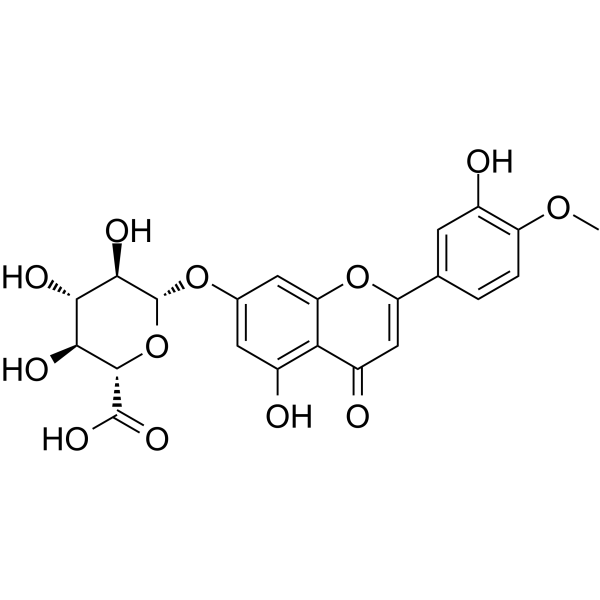
Physicochemical Properties
| Molecular Formula | C22H20O12 |
| Molecular Weight | 476.3870 |
| Exact Mass | 476.095 |
| CAS # | 35110-20-4 |
| PubChem CID | 54462250 |
| Appearance | Off-white to light yellow solid powder |
| Density | 1.695±0.06 g/cm3(Predicted) |
| Boiling Point | 853.6±65.0 °C(Predicted) |
| LogP | 0.15 |
| Hydrogen Bond Donor Count | 6 |
| Hydrogen Bond Acceptor Count | 12 |
| Rotatable Bond Count | 5 |
| Heavy Atom Count | 34 |
| Complexity | 801 |
| Defined Atom Stereocenter Count | 5 |
| SMILES | COC1=C(C=C(C=C1)C2=CC(=O)C3=C(C=C(C=C3O2)O[C@H]4[C@@H]([C@H]([C@@H]([C@H](O4)C(=O)O)O)O)O)O)O |
| InChi Key | XCKMDTYMOHXUHG-SXFAUFNYSA-N |
| InChi Code | InChI=1S/C22H20O12/c1-31-13-3-2-8(4-10(13)23)14-7-12(25)16-11(24)5-9(6-15(16)33-14)32-22-19(28)17(26)18(27)20(34-22)21(29)30/h2-7,17-20,22-24,26-28H,1H3,(H,29,30)/t17-,18-,19+,20-,22+/m0/s1 |
| Chemical Name | (2S,3S,4S,5R,6S)-3,4,5-trihydroxy-6-[5-hydroxy-2-(3-hydroxy-4-methoxyphenyl)-4-oxochromen-7-yl]oxyoxane-2-carboxylic acid |
| HS Tariff Code | 2934.99.9001 |
| Storage |
Powder-20°C 3 years 4°C 2 years In solvent -80°C 6 months -20°C 1 month Note: This product requires protection from light (avoid light exposure) during transportation and storage. |
| Shipping Condition | Room temperature (This product is stable at ambient temperature for a few days during ordinary shipping and time spent in Customs) |
Biological Activity
| ln Vitro |
1. DPPH radical scavenging activity: DiosMetin 7-O-β-D-Glucuronide exhibited concentration-dependent DPPH (2,2-diphenyl-1-picrylhydrazyl) radical scavenging activity. The IC50 value for DPPH radical scavenging was 28.6 ± 1.5 μM. At concentrations of 10 μM, 25 μM, 50 μM, and 100 μM, the scavenging rates were 18.2 ± 2.1%, 45.7 ± 3.3%, 72.3 ± 4.2%, and 91.5 ± 2.8%, respectively [1] 2. ABTS radical scavenging activity: The compound showed potent ABTS (2,2'-azino-bis(3-ethylbenzothiazoline-6-sulfonic acid)) radical scavenging activity. Its IC50 value was 19.8 ± 1.2 μM, which was lower than that of the positive control (ascorbic acid, IC50: 25.3 ± 1.8 μM) at the same experimental conditions. At 50 μM, DiosMetin 7-O-β-D-Glucuronide scavenged 85.6 ± 3.5% of ABTS radicals [1] 3. Ferric reducing antioxidant power (FRAP) activity: DiosMetin 7-O-β-D-Glucuronide had concentration-dependent ferric reducing capacity. The FRAP value was expressed as μmol Fe²⁺ equivalents per mg of the compound. At 25 μM, the FRAP value was 125.3 ± 5.7 μmol Fe²⁺/mg; at 50 μM, it increased to 248.6 ± 7.2 μmol Fe²⁺/mg, indicating strong electron-donating ability [1] |
| Enzyme Assay |
1. DPPH radical scavenging assay: A 0.1 mM DPPH solution was prepared in ethanol. Different concentrations of DiosMetin 7-O-β-D-Glucuronide (5–100 μM, dissolved in 50% ethanol) were mixed with the DPPH solution at a volume ratio of 1:1. The mixture was vortexed and incubated in the dark at room temperature for 30 minutes. The absorbance was measured at 517 nm using a spectrophotometer. The DPPH radical scavenging rate was calculated using the formula: Scavenging rate (%) = [1 - (Absorbance of sample - Absorbance of sample blank) / (Absorbance of DPPH blank - Absorbance of solvent blank)] × 100. The IC50 value was obtained by plotting scavenging rate against compound concentration and fitting with a dose-response curve [1] 2. ABTS radical scavenging assay: ABTS radical cation was generated by mixing 7 mM ABTS solution with 2.45 mM potassium persulfate at a volume ratio of 1:1, followed by incubation in the dark at room temperature for 16 hours. The ABTS radical solution was diluted with ethanol to an absorbance of 0.70 ± 0.02 at 734 nm. DiosMetin 7-O-β-D-Glucuronide solutions (5–100 μM) were mixed with the diluted ABTS radical solution (1:10, v/v) and incubated in the dark for 10 minutes. Absorbance at 734 nm was measured, and the scavenging rate was calculated similarly to the DPPH assay. IC50 was determined from the concentration-scavenging rate curve [1] 3. FRAP assay: The FRAP reagent was prepared by mixing 300 mM acetate buffer (pH 3.6), 10 mM 2,4,6-tripyridyl-s-triazine (TPTZ) solution (in 40 mM HCl), and 20 mM FeCl₃ solution at a volume ratio of 10:1:1. The reagent was pre-warmed at 37°C for 10 minutes. DiosMetin 7-O-β-D-Glucuronide solutions (10–100 μM) were mixed with the pre-warmed FRAP reagent (1:10, v/v) and incubated at 37°C for 30 minutes. The absorbance was measured at 593 nm. A standard curve was generated using FeSO₄·7H₂O (0–1000 μM), and FRAP values were calculated as μmol Fe²⁺ equivalents per mg of the compound [1] |
| References |
[1]. Antioxidant constituents in the fruits of Luffa cylindrica (L.) Roem. J Agric Food Chem. 2006 Jun 14;54(12):4186-90. |
| Additional Infomation |
Diosmetin 7-glucuronide has been reported in Meehania fargesii, Pedalium murex, and other organisms with data available. - DiosMetin 7-O-β-D-Glucuronide is a flavonoid glycoside isolated from the fruits of Luffa cylindrica (L.) Roem. (sponge gourd). Its chemical structure consists of a diosmetin aglycone (5,7-dihydroxy-3',4'-dimethoxyflavone) covalently linked to a β-D-glucuronic acid moiety at the 7-hydroxyl position [1] - Compared to its aglycone (diosmetin), DiosMetin 7-O-β-D-Glucuronide showed slightly lower antioxidant activity (e.g., diosmetin had a DPPH IC50 of 15.2 ± 1.1 μM vs. 28.6 ± 1.5 μM for the glycoside). This difference was attributed to the presence of the glucuronic acid group, which may introduce steric hindrance and reduce the accessibility of the flavonoid’s phenol groups to free radicals [1] - The study identified DiosMetin 7-O-β-D-Glucuronide as one of the key antioxidant constituents in Luffa cylindrica fruits, contributing to the fruit’s overall antioxidant capacity. It was isolated and purified using a combination of column chromatography (silica gel, Sephadex LH-20) and preparative high-performance liquid chromatography (HPLC) [1] |
Solubility Data
| Solubility (In Vitro) | DMSO : ~100 mg/mL (~209.91 mM) |
| Solubility (In Vivo) |
Solubility in Formulation 1: ≥ 2.5 mg/mL (5.25 mM) (saturation unknown) in 10% DMSO + 40% PEG300 + 5% Tween80 + 45% Saline (add these co-solvents sequentially from left to right, and one by one), clear solution. For example, if 1 mL of working solution is to be prepared, you can add 100 μL of 25.0 mg/mL clear DMSO stock solution to 400 μL PEG300 and mix evenly; then add 50 μL Tween-80 to the above solution and mix evenly; then add 450 μL normal saline to adjust the volume to 1 mL. Preparation of saline: Dissolve 0.9 g of sodium chloride in 100 mL ddH₂ O to obtain a clear solution. Solubility in Formulation 2: ≥ 2.5 mg/mL (5.25 mM) (saturation unknown) in 10% DMSO + 90% (20% SBE-β-CD in Saline) (add these co-solvents sequentially from left to right, and one by one), clear solution. For example, if 1 mL of working solution is to be prepared, you can add 100 μL of 25.0 mg/mL clear DMSO stock solution to 900 μL of 20% SBE-β-CD physiological saline solution and mix evenly. Preparation of 20% SBE-β-CD in Saline (4°C,1 week): Dissolve 2 g SBE-β-CD in 10 mL saline to obtain a clear solution. (Please use freshly prepared in vivo formulations for optimal results.) |
| Preparing Stock Solutions | 1 mg | 5 mg | 10 mg | |
| 1 mM | 2.0991 mL | 10.4956 mL | 20.9912 mL | |
| 5 mM | 0.4198 mL | 2.0991 mL | 4.1982 mL | |
| 10 mM | 0.2099 mL | 1.0496 mL | 2.0991 mL |