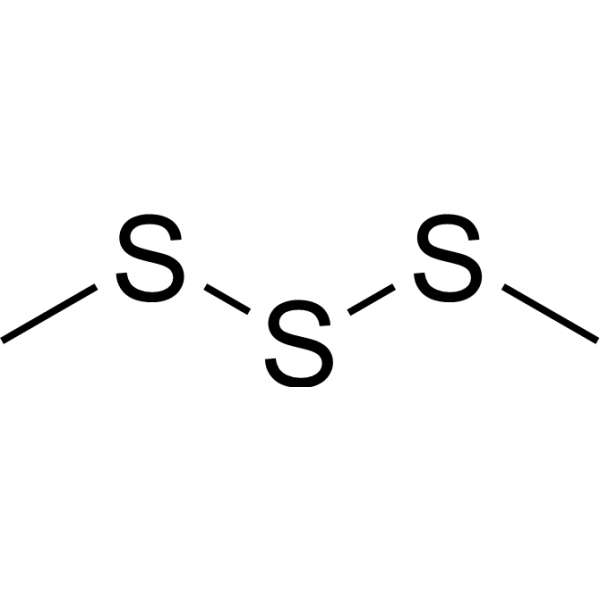
Physicochemical Properties
| Molecular Formula | C2H6S3 |
| Molecular Weight | 126.26404 |
| Exact Mass | 125.963 |
| CAS # | 3658-80-8 |
| PubChem CID | 19310 |
| Appearance | Colorless to light yellow liquid |
| Density | 1.2±0.1 g/cm3 |
| Boiling Point | 183.1±23.0 °C at 760 mmHg |
| Melting Point | −68 °C(lit.) |
| Flash Point | 69.1±19.7 °C |
| Vapour Pressure | 1.1±0.3 mmHg at 25°C |
| Index of Refraction | 1.598 |
| LogP | 2.93 |
| Hydrogen Bond Donor Count | 0 |
| Hydrogen Bond Acceptor Count | 3 |
| Rotatable Bond Count | 2 |
| Heavy Atom Count | 5 |
| Complexity | 12.4 |
| Defined Atom Stereocenter Count | 0 |
| SMILES | CSSSC |
| InChi Key | YWHLKYXPLRWGSE-UHFFFAOYSA-N |
| InChi Code | InChI=1S/C2H6S3/c1-3-5-4-2/h1-2H3 |
| Chemical Name | (methyltrisulfanyl)methane |
| HS Tariff Code | 2934.99.9001 |
| Storage |
Powder-20°C 3 years 4°C 2 years In solvent -80°C 6 months -20°C 1 month |
| Shipping Condition | Room temperature (This product is stable at ambient temperature for a few days during ordinary shipping and time spent in Customs) |
Biological Activity
| Targets |
- Cyanide (CN⁻) toxicity-related pathways: Dimethyl trisulfide acts as a cyanide countermeasure by targeting cyanide-induced inhibition of mitochondrial cytochrome c oxidase (complex IV) [1] |
| ln Vitro |
1. Cyanide toxicity protection in cell models: - Dimethyl trisulfide (0.1-1 mM) protected rat primary hepatocytes from cyanide-induced cytotoxicity; pre-treatment with 0.5 mM Dimethyl trisulfide reduced cyanide (1 mM)-induced cell death by 62% after 4 hours of incubation [1] - In human embryonic kidney (HEK293) cells, 0.3 mM Dimethyl trisulfide restored mitochondrial membrane potential (ΔΨm) by 58% in cells treated with 0.8 mM cyanide, as measured by JC-1 fluorescence staining [1] 2. Cytochrome c oxidase activity restoration: - Dimethyl trisulfide (0.2-1 mM) partially reversed cyanide (0.5 mM)-induced inhibition of cytochrome c oxidase activity in isolated rat liver mitochondria; 0.6 mM Dimethyl trisulfide restored enzyme activity to 73% of the control level [1] |
| ln Vivo |
1. Acute cyanide poisoning rescue in mice: - Intraperitoneal (i.p.) administration: Mice (CD-1 strain, male, 20-25 g) were given a lethal dose of potassium cyanide (KCN, 10 mg/kg, i.p.); immediately after KCN administration, Dimethyl trisulfide (10-50 mg/kg, i.p.) was injected [1] - Survival rate: 30 mg/kg Dimethyl trisulfide increased survival rate from 0% (KCN alone) to 75% at 24 hours; 50 mg/kg further elevated survival to 90% [1] - Survival time extension: In mice given a lethal KCN dose (12 mg/kg), 40 mg/kg Dimethyl trisulfide (i.p.) extended mean survival time from 4.2 minutes (KCN alone) to 28.5 minutes [1] 2. Intravenous (i.v.) efficacy in rabbits: - Rabbits (New Zealand White, 2.5-3 kg) were administered KCN (2 mg/kg, i.v.) to induce severe cyanosis and hypotension; Dimethyl trisulfide (15 mg/kg, i.v.) was given 1 minute post-KCN [1] - Dimethyl trisulfide reversed cyanosis within 3 minutes, restored mean arterial blood pressure from 45 mmHg (post-KCN) to 82 mmHg within 10 minutes, and resulted in 100% survival at 48 hours (vs. 0% survival in KCN alone group) [1] |
| Enzyme Assay |
1. Cytochrome c oxidase activity assay in isolated mitochondria: - Rat liver mitochondria were isolated via differential centrifugation (600×g for 10 min, then 10,000×g for 15 min) and resuspended in respiration buffer [1] - Reaction system contained mitochondria (0.5 mg protein/ml), cytochrome c (10 μM), and either cyanide (0.5 mM) alone or cyanide + Dimethyl trisulfide (0.2-1 mM) [1] - Enzyme activity was measured by monitoring the oxidation of reduced cytochrome c at 550 nm for 5 minutes; activity was calculated as nmol cytochrome c oxidized per minute per mg protein [1] 2. Mitochondrial membrane potential (ΔΨm) assay: - HEK293 cells were loaded with JC-1 dye (5 μM) for 20 minutes at 37°C, then treated with cyanide (0.8 mM) ± Dimethyl trisulfide (0.1-0.5 mM) for 1 hour [1] - Fluorescence intensity was measured using a microplate reader (excitation 485 nm, emission 535 nm for monomeric JC-1; excitation 525 nm, emission 590 nm for J-aggregates); ΔΨm was expressed as the ratio of J-aggregates to monomer fluorescence [1] |
| Cell Assay |
1. Rat primary hepatocyte cytotoxicity assay: - Rat primary hepatocytes were isolated via collagenase perfusion and seeded in 96-well plates (1×10⁴ cells/well) in Williams’ E medium supplemented with 10% FBS [1] - Cells were pre-treated with Dimethyl trisulfide (0.1-1 mM) for 30 minutes, then exposed to cyanide (1 mM) for 4 hours [1] - Cell viability was measured by MTT assay: MTT solution (5 mg/ml) was added (20 μl/well) for 3 hours, formazan was dissolved in DMSO, and absorbance was read at 570 nm; viability was calculated relative to untreated controls [1] 2. HEK293 cell mitochondrial function assay: - HEK293 cells were cultured in DMEM with 10% FBS, seeded in 24-well plates (5×10⁵ cells/well), and treated with cyanide (0.8 mM) ± Dimethyl trisulfide (0.1-0.5 mM) for 1 hour [1] - After treatment, cells were harvested, washed with PBS, and analyzed for ΔΨm via JC-1 staining (as described in Enzyme Assay) and for ATP levels using a luciferin-luciferase assay kit; 0.3 mM Dimethyl trisulfide restored ATP levels to 65% of control (vs. 22% in cyanide alone group) [1] |
| Animal Protocol |
1. Mouse acute cyanide poisoning rescue experiment: - Animals: Male CD-1 mice (20-25 g), housed under standard conditions (12 h light/dark cycle, ad libitum food/water) [1] - Drug preparation: Dimethyl trisulfide was dissolved in a mixture of ethanol and saline (1:9, v/v) to prepare stock solutions (10-50 mg/ml); KCN was dissolved in saline (10 mg/ml) [1] - Treatment protocol: Mice were divided into 5 groups (n=8/group): control (saline), KCN alone (10 mg/kg, i.p.), KCN + Dimethyl trisulfide (10 mg/kg, i.p.), KCN + Dimethyl trisulfide (30 mg/kg, i.p.), KCN + Dimethyl trisulfide (50 mg/kg, i.p.) [1] - Observation: Survival was recorded every 15 minutes for the first 2 hours, then at 6, 12, and 24 hours; behavioral signs (convulsions, ataxia) were noted [1] 2. Rabbit cyanide-induced hypotension reversal experiment: - Animals: Female New Zealand White rabbits (2.5-3 kg), anesthetized with ketamine (50 mg/kg, i.m.) and xylazine (5 mg/kg, i.m.) [1] - Drug preparation: Dimethyl trisulfide was dissolved in propylene glycol and saline (1:4, v/v) to a concentration of 15 mg/ml; KCN was dissolved in saline (2 mg/ml) [1] - Treatment protocol: Rabbits were instrumented with a carotid artery catheter to monitor mean arterial blood pressure (MAP); KCN (2 mg/kg, i.v.) was administered, followed by Dimethyl trisulfide (15 mg/kg, i.v.) 1 minute later [1] - Measurement: MAP was recorded every minute for 30 minutes; cyanosis (skin/mucous membrane color) was scored on a 0-3 scale (0 = no cyanosis, 3 = severe cyanosis) [1] |
| Toxicity/Toxicokinetics |
1. Acute toxicity of Dimethyl trisulfide alone: - In mice, the acute i.p. LD₅₀ of Dimethyl trisulfide was determined to be 185 mg/kg; no mortality was observed at doses ≤100 mg/kg (i.p.) [1] - At 150 mg/kg (i.p.), mice showed transient ataxia and reduced activity for 1-2 hours, but fully recovered within 6 hours [1] 2. Organ toxicity assessment: - Mice treated with Dimethyl trisulfide (50 mg/kg, i.p., daily for 7 days) showed no significant changes in serum alanine transaminase (ALT), aspartate transaminase (AST), blood urea nitrogen (BUN), or creatinine levels compared to controls, indicating no acute liver or kidney toxicity [1] - Histopathological examination of liver, kidney, and brain tissues from treated mice revealed no abnormal lesions [1] |
| References |
[1]. Dimethyl trisulfide: A novel cyanide countermeasure. Toxicol Ind Health. 2016 Dec;32(12):2009-2016. |
| Additional Infomation |
Dimethyl trisulfide is an organic trisulfide. Dimethyl trisulfide has been reported in Humulus lupulus, Gymnodinium nagasakiense, and other organisms with data available. dimethyltrisulfide is a metabolite found in or produced by Saccharomyces cerevisiae. 1. Chemical and therapeutic background: - Dimethyl trisulfide is an organosulfur compound naturally present in garlic and other Allium species; it was identified as a novel cyanide countermeasure due to its ability to mitigate cyanide-induced mitochondrial dysfunction [1] 2. Mechanism of cyanide detoxification: - Dimethyl trisulfide is proposed to act via two pathways: (1) donating sulfur to cyanide to form less toxic thiocyanate (via rhodanese or mercaptopyruvate sulfurtransferase), and (2) directly stabilizing mitochondrial cytochrome c oxidase to prevent cyanide binding [1] 3. Comparison to existing countermeasures: - Dimethyl trisulfide showed faster onset of action (≤3 minutes) in reversing cyanosis and hypotension compared to sodium thiosulfate (a standard cyanide antidote, onset 10-15 minutes) in rabbit models [1] |
Solubility Data
| Solubility (In Vitro) |
DMSO : ~100 mg/mL (~792.02 mM) H2O : ~1 mg/mL (~7.92 mM) |
| Solubility (In Vivo) |
Solubility in Formulation 1: ≥ 2.5 mg/mL (19.80 mM) (saturation unknown) in 10% DMSO + 40% PEG300 + 5% Tween80 + 45% Saline (add these co-solvents sequentially from left to right, and one by one), clear solution. For example, if 1 mL of working solution is to be prepared, you can add 100 μL of 25.0 mg/mL clear DMSO stock solution to 400 μL PEG300 and mix evenly; then add 50 μL Tween-80 to the above solution and mix evenly; then add 450 μL normal saline to adjust the volume to 1 mL. Preparation of saline: Dissolve 0.9 g of sodium chloride in 100 mL ddH₂ O to obtain a clear solution. Solubility in Formulation 2: ≥ 2.5 mg/mL (19.80 mM) (saturation unknown) in 10% DMSO + 90% (20% SBE-β-CD in Saline) (add these co-solvents sequentially from left to right, and one by one), clear solution. For example, if 1 mL of working solution is to be prepared, you can add 100 μL of 25.0 mg/mL clear DMSO stock solution to 900 μL of 20% SBE-β-CD physiological saline solution and mix evenly. Preparation of 20% SBE-β-CD in Saline (4°C,1 week): Dissolve 2 g SBE-β-CD in 10 mL saline to obtain a clear solution. Solubility in Formulation 3: ≥ 2.5 mg/mL (19.80 mM) (saturation unknown) in 10% DMSO + 90% Corn Oil (add these co-solvents sequentially from left to right, and one by one), clear solution. For example, if 1 mL of working solution is to be prepared, you can add 100 μL of 25.0 mg/mL clear DMSO stock solution to 900 μL of corn oil and mix evenly. Solubility in Formulation 4: 100 mg/mL (792.02 mM) in PBS (add these co-solvents sequentially from left to right, and one by one), clear solution; with ultrasonication. (Please use freshly prepared in vivo formulations for optimal results.) |
| Preparing Stock Solutions | 1 mg | 5 mg | 10 mg | |
| 1 mM | 7.9202 mL | 39.6008 mL | 79.2016 mL | |
| 5 mM | 1.5840 mL | 7.9202 mL | 15.8403 mL | |
| 10 mM | 0.7920 mL | 3.9601 mL | 7.9202 mL |