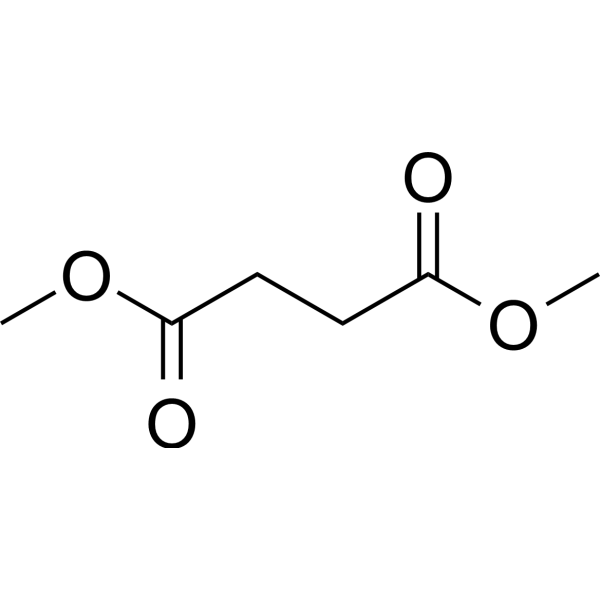
Physicochemical Properties
| Molecular Formula | C6H10O4 |
| Molecular Weight | 146.14 |
| Exact Mass | 146.057 |
| CAS # | 106-65-0 |
| PubChem CID | 7820 |
| Appearance | COLORLESS LIQ @ ROOM TEMP; SOLIDIFIES WHEN COLD |
| Density | 1.1±0.1 g/cm3 |
| Boiling Point | 195.3±0.0 °C at 760 mmHg |
| Melting Point | 16-19 °C(lit.) |
| Flash Point | 85.0±0.0 °C |
| Vapour Pressure | 0.4±0.3 mmHg at 25°C |
| Index of Refraction | 1.411 |
| LogP | 0.2 |
| Hydrogen Bond Donor Count | 0 |
| Hydrogen Bond Acceptor Count | 4 |
| Rotatable Bond Count | 5 |
| Heavy Atom Count | 10 |
| Complexity | 114 |
| Defined Atom Stereocenter Count | 0 |
| InChi Key | MUXOBHXGJLMRAB-UHFFFAOYSA-N |
| InChi Code | InChI=1S/C6H10O4/c1-9-5(7)3-4-6(8)10-2/h3-4H2,1-2H3 |
| Chemical Name | dimethyl butanedioate |
| Synonyms | Dimethyl succinate; Dimethyl succinate |
| HS Tariff Code | 2934.99.9001 |
| Storage |
Powder-20°C 3 years 4°C 2 years In solvent -80°C 6 months -20°C 1 month Note: Please store this product in a sealed and protected environment, avoid exposure to moisture. |
| Shipping Condition | Room temperature (This product is stable at ambient temperature for a few days during ordinary shipping and time spent in Customs) |
Biological Activity
| References |
[1]. Biochemical reagents[M]//Methods of Enzymatic Analysis. Academic Press, 1965: 967-1037. |
| Additional Infomation |
Dimethyl succinate is a colorless liquid. (USCG, 1999) Dimethyl succinate is a fatty acid methyl ester. Dimethyl succinate has been reported in Astragalus mongholicus and Astragalus membranaceus with data available. Mechanism of Action Dibasic esters are a solvent mixture of dimethyl adipate; dimethyl glutarate, and dimethyl succinate used in the paint and coating industry. Subchronic inhalation toxicity studies have demonstrated that dibasic ester induce a mild degeneration of the olfactory, but not the respiratory, epithelium of the rat nasal cavity. Carboxylesterase-mediated hydrolysis of the individual dibasic esters is more efficient in olfactory than in respiratory mucosal homogenates. In the present study, an in vitro system of cultured rat nasal explants was utilized to determine if dibasic ester toxicity is dependent on a metabolic activation by nonspecific carboxylesterase. Explants from both the olfactory and the respiratory regions of the female rat nasal cavity were incubated for 2 hr in Williams' medium E containing 10-100 mM dimethyl adipate, dimethyl glutarate, or dimethyl succinate, dibasic ester caused a dose-related increase in nasal explant acid phosphatase release, a biochemical index of cytotoxicity. HPLC analysis demonstrated parallel increases in the carboxylesterase-mediated formation of monomethyl ester metabolites. Diacid metabolite production in the nasal explant system was not entirely concentration-dependent. Metabolite concentrations and acid phosphatase release were generally greater in olfactory than respiratory tissues. dibasic ester-induced cytotoxicity and acid metabolite production were markedly attenuated in nasal tissue excised from rats which were pretreated with bis(p-nitrophenyl)phosphate, a carboxylesterase inhibitor. This study presents a viable in vitro method for assessing organic ester cytotoxicity in the rat nasal cavity. It was shown that dibasic ester are weak nasal toxicants under the conditions of this system. It was further demonstrated that dibasic ester toxicity is dependent on a carboxylesterase-mediated activation. A similar mechanism was proposed for the nasal toxicity induced by other organic esters following inhalation exposure. Inhalation exposure of rats to dibasic esters revealed lesions of the nasal olfactory epithelium similar to those observed with other ester solvents. Female rats are more sensitive to these effects than are male rats. It has been proposed that carboxylesterase conversion of inhaled esters within nasal tissues to organic acids may be a critical biochemical step in converting these chemicals to toxic substances. These experiments measured the kinetic parameters Vmax, Km, Ksi, and V/K for the hydrolysis of the dibasic esters in the target nasal tissue, olfactory mucosa, and nontarget tissue, respiratory mucosa. It was determined that under the conditions of these experiments, diacid metabolites are not formed. Esterase activity was inhibited by pretreatment with bis p-nitrophenyl phosphate. Vmax values for the three dibasic esters were 5- to 13-fold greater in olfactory mucosa than respiratory mucosa for male or female rats. V/K values were 4- to 11-fold greater in olfactory mucosa than respiratory mucosa for male or female rats. V/K was similar between male and female olfactory mucosa when dimethyl glutarate was used as the substrate. With dimethyl succinate or dimethyl adipate as the substrate, V/K for female olfactory tissue was 0.5- or 2-fold that of males, respectively. Differences in V/K were mainly due to decreases in KM associated with increasing carbon chain length. Substrate inhibition was observed at dibasic ester concentrations greater than approximately 25 mM, which are unlikely to be achieved in vivo. These results lend further support to the hypothesis that organic acid accumulation in the target tissue, olfactory mucosa, plays a significant role in the pathogenesis of dibasic ester-induced nasal lesions. The mechanism nay be applicable to a wide range of inhaled esters. |
Solubility Data
| Solubility (In Vitro) |
DMSO : ≥ 300 mg/mL (2052.83 mM) H2O : ≥ 100 mg/mL (684.28 mM) |
| Solubility (In Vivo) |
Solubility in Formulation 1: ≥ 100 mg/mL (684.28 mM)(Saturation unknown) in Saline (add these co-solvents sequentially from left to right, and one by one), clear solution. For example, if 1 mL of working solution, *Preparation of saline: Dissolve 0.9 g of sodium chloride in 100 mL ddH₂ O to obtain a clear solution. (Please use freshly prepared in vivo formulations for optimal results.) |
| Preparing Stock Solutions | 1 mg | 5 mg | 10 mg | |
| 1 mM | 6.8428 mL | 34.2138 mL | 68.4275 mL | |
| 5 mM | 1.3686 mL | 6.8428 mL | 13.6855 mL | |
| 10 mM | 0.6843 mL | 3.4214 mL | 6.8428 mL |