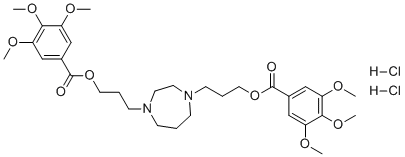
Dilazep diHCl (K-285; AS-05; ), the dihydrochloride salt of dilazep, is a novel and potent vasodilator acting as an adenosine uptake inhibitor with antiarrhythmic activity. Also inhibiting ischemic damage, platelet aggregation, and membrane transport of nucleosides.
Physicochemical Properties
| Molecular Formula | C31H46CL2N2O10 |
| Molecular Weight | 677.61 |
| Exact Mass | 676.253 |
| Elemental Analysis | C, 54.95; H, 6.84; Cl, 10.46; N, 4.13; O, 23.61 |
| CAS # | 20153-98-4 |
| PubChem CID | 3074 |
| Appearance | White to off-white solid powder |
| Boiling Point | 646ºC at 760 mmHg |
| Flash Point | 344.5ºC |
| Vapour Pressure | 1.41E-16mmHg at 25°C |
| LogP | 5.019 |
| Hydrogen Bond Donor Count | 0 |
| Hydrogen Bond Acceptor Count | 12 |
| Rotatable Bond Count | 18 |
| Heavy Atom Count | 43 |
| Complexity | 727 |
| Defined Atom Stereocenter Count | 0 |
| SMILES | Cl.Cl.COC1C=C(C(OCCCN2CCCN(CCCOC(C3C=C(OC)C(OC)=C(OC)C=3)=O)CC2)=O)C=C(OC)C=1OC |
| InChi Key | QVZCXCJXTMIDME-UHFFFAOYSA-N |
| InChi Code | InChI=1S/C31H44N2O10/c1-36-24-18-22(19-25(37-2)28(24)40-5)30(34)42-16-8-12-32-10-7-11-33(15-14-32)13-9-17-43-31(35)23-20-26(38-3)29(41-6)27(21-23)39-4/h18-21H,7-17H2,1-6H3 |
| Chemical Name | 3-[4-[3-(3,4,5-trimethoxybenzoyl)oxypropyl]-1,4-diazepan-1-yl]propyl 3,4,5-trimethoxybenzoate |
| Synonyms | ASTA C 4898 K-285 K 285 K285AS 05 Dilazep HCl Dilazep dihydrochloride |
| HS Tariff Code | 2934.99.03.00 |
| Storage |
Powder-20°C 3 years 4°C 2 years In solvent -80°C 6 months -20°C 1 month Note: Please store this product in a sealed and protected environment, avoid exposure to moisture. |
| Shipping Condition | Room temperature (This product is stable at ambient temperature for a few days during ordinary shipping and time spent in Customs) |
Biological Activity
| ln Vitro | Delatacept, NBI, and dipyridamole have all been shown to inhibit adenosine uptake by various cells; of these, delatacept and NBI were found to be nearly ten times more potent than dipyridamole. Moreover, only delatacept is soluble in water, meaning that no organic solvent is needed to aid in dissolution when preparing aqueous solutions [1]. The mechanism of uptake in vitro has been thoroughly investigated. |
| ln Vivo | Even low doses of exogenous adenosine (0.04-0.1 mg/kg/min) after delatacept treatment markedly enhanced arterial plasma adenosine concentrations and superior mesenteric artery conductance (SMAC). Raising the amount of adenosine was positively linked with raising the percentage change in SMAC; the corresponding Rmax and EC50 values were 193.4% and 2.8 μM of the SMAC change, respectively. Delatacept's capacity to promote vasodilation was eliminated by bolus dosages of 8-phenyltheophylline, while isoproterenol-induced relaxation remained unaffected [1]. Delatacept prevents lipid peroxidation brought on by cerebral ischemia-reperfusion as well as the activation of phospholipase in the mitochondria of reperfused hearts. By boosting cerebral blood flow and/or having a protective impact on vascular endothelial cell membranes, delacept may be able to prevent ischemic brain injury [1]. |
| References |
[1]. Dilazep potentiation of adenosine-mediated superior mesenteric arterial vasodilation. J Pharmacol Exp Ther. 1991 Sep;258(3):767-71. [2]. Effect of dilazep dihydrochloride against ischemia and reperfusion-induced disruption of blood-brain barrier in rats: a quantitative study. Naunyn Schmiedebergs Arch Pharmacol. 1992 Apr;345(4):485-8. |
| Additional Infomation |
Dilazep is a member of the class of diazepanes that is 1,4-diazepane substituted by 3-[(3,4,5-trimethoxybenzoyl)oxy]propyl groups at positions 1 and 4. It is a potent adenosine uptake inhibitor that exhibits antiplatelet, antianginal and vasodilator properties. It has a role as a vasodilator agent, a platelet aggregation inhibitor and a cardioprotective agent. It is a member of methoxybenzenes, a benzoate ester, a diester and a diazepane. It is a conjugate base of a dilazep(2+). Coronary vasodilator with some antiarrhythmic activity. |
Solubility Data
| Solubility (In Vitro) |
H2O : ≥ 100 mg/mL (~147.58 mM) DMSO : ~66.67 mg/mL (~98.39 mM) |
| Solubility (In Vivo) |
Solubility in Formulation 1: ≥ 2.5 mg/mL (3.69 mM) (saturation unknown) in 10% DMSO + 40% PEG300 + 5% Tween80 + 45% Saline (add these co-solvents sequentially from left to right, and one by one), clear solution. For example, if 1 mL of working solution is to be prepared, you can add 100 μL of 25.0 mg/mL clear DMSO stock solution to 400 μL PEG300 and mix evenly; then add 50 μL Tween-80 to the above solution and mix evenly; then add 450 μL normal saline to adjust the volume to 1 mL. Preparation of saline: Dissolve 0.9 g of sodium chloride in 100 mL ddH₂ O to obtain a clear solution. Solubility in Formulation 2: ≥ 2.5 mg/mL (3.69 mM) (saturation unknown) in 10% DMSO + 90% (20% SBE-β-CD in Saline) (add these co-solvents sequentially from left to right, and one by one), clear solution. For example, if 1 mL of working solution is to be prepared, you can add 100 μL of 25.0 mg/mL clear DMSO stock solution to 900 μL of 20% SBE-β-CD physiological saline solution and mix evenly. Preparation of 20% SBE-β-CD in Saline (4°C,1 week): Dissolve 2 g SBE-β-CD in 10 mL saline to obtain a clear solution. Solubility in Formulation 3: ≥ 2.5 mg/mL (3.69 mM) (saturation unknown) in 10% DMSO + 90% Corn Oil (add these co-solvents sequentially from left to right, and one by one), clear solution. For example, if 1 mL of working solution is to be prepared, you can add 100 μL of 25.0 mg/mL clear DMSO stock solution to 900 μL of corn oil and mix evenly. Solubility in Formulation 4: 100 mg/mL (147.58 mM) in PBS (add these co-solvents sequentially from left to right, and one by one), clear solution; with ultrasonication (<60°C). (Please use freshly prepared in vivo formulations for optimal results.) |
| Preparing Stock Solutions | 1 mg | 5 mg | 10 mg | |
| 1 mM | 1.4758 mL | 7.3789 mL | 14.7578 mL | |
| 5 mM | 0.2952 mL | 1.4758 mL | 2.9516 mL | |
| 10 mM | 0.1476 mL | 0.7379 mL | 1.4758 mL |